Book Review: Coop, by Michael Perry

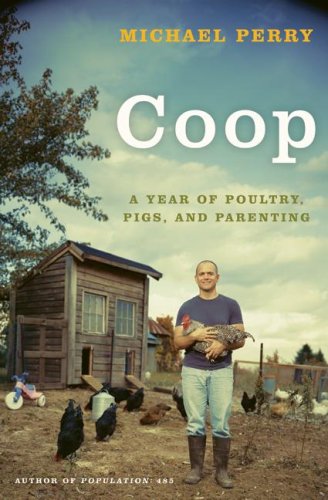
Coop
Coop: a Year of Poultry, Pigs, and Parenting
Michael Perry
Harper, 368 pages
Get it from Amazon >>

I wasn’t going to post any kind of review of Coop here, but I love Michael Perry’s writing so much that I couldn’t not.

In this, the third of his collection of memoirs about his adult life in rural Wisconsin, Perry writes about everything from becoming a parent, both to a stepdaughter (he refers to her as a “given” daughter) and to a new baby girl, to raising hogs to building the titular chicken coop, which project becomes the recurring theme in the book.

As always, Perry’s description of his own carpentry skills is self-deprecating at best, and whether he’s discussing the way he salvaged windows from his previous home for the coop or talking about industrial hand wheels, he’s funny and engaging, and also makes you want to reach into the pages of his book and just offer a hand.

He’s also unabashedly proud of and impressed by the women in his life – and it is that directness and admiration that makes Coop a great gift for a mother, daughter, wife, or friend. It’s not typical chick-lit, not even close, but his writing is so easygoing that reading this book with a cup of coffee on the back porch is something every woman I know would likely enjoy.

I mean, I read it that way, alternating coffee and sips of iced tea, lightly sweetened with local honey.

I’m not sure if Perry has another book planned next, or if he’s going to concentrate on music for a bit, but I eagerly await his next words.

And you should, too.

Review: Truck: A Love Story, by Michael Perry

Truck: a Love Story
Truck: a Love Story
by Michael Perry
Harper Perennial, 320 pages
Get it from Amazon >>

Several days ago in this blog, I mentioned that I had an “author crush” on Michael Perry. I’m currently reading his most recent book, Coop which will be reviewed over at All Things Girl, but I wanted to make sure I talked about the last book of his that I read: Truck: a Love Story.

If the title of the book isn’t enough of a hook, consider that this book really is a love story. Actually it’s three love stories. One, is of the teenage Mike’s love of the fictional character Irma Harding, who was created to be the face of International Harvester, in the 1950s. The second, and the one that provides the continuity in this book, is the author’s love of a vintage International Harvester pickup truck, and his journey through its restoration. The third, most poignant, is of his relationship and eventual marriage to his wife Anneleise, and his fatherly love for her young daughter, Amy.

As usual, Michael Perry tells his story with a lot of warmth and an equal measure of humor. He may be a guy who grew up in rural Wisconsin, but he’s also incredibly bright. Much of the humor is self deprecating – he’s sort of power-tool impaired, for example – but some of it comes from the juxtaposition of a green tea drinking, NPR- and jazz listening writer who is also a fire fighter and amateur farmer.

Because this is a memoir, there really isn’t a plot, but Perry does an excellent job of condensing several events into a coherent narrative.

In short, his memoirs ride the fine line of being candid and creative nonfiction.

And I can’t get enough of them.

New Author Crush: Michael Perry

I tend to read the same way most people approach a dip bar – several repetitions of one author (or, um, exercise) and then a rest. In plainer language, I mean that when I find an author whose work I like, I read everything they’ve written, as quickly as possible, in succession, and then move on, at least for a while.

My current “author crush,” as I tend to describe these reading moods, is one Michael Perry. I’ve written, already, about recently reading his book, Population: 485, and I’m currently in the middle of his second memoir, Truck: a Love Story. Both are warm, funny, vivid and candid in all the right balances. Both have thoughtful sections as well, and I’m really enjoying revisiting the upper midwest, in a way I haven’t done, through literature, since I first discovered Kathleen Norris, early in my marriage.

Norris and Perry are nothing alike, and yet, both have this intense love of the land that comes through their words, and makes you want to sink your fingers into fresh earth, or pick a sun-ripened tomato and eat it, straight from the vine.

I just wanted to take a moment, and share that.

Oh, and to say,the signed copy of Perry’s most recent book, in hardcover, arrived on Thursday.

Bookmarks: The Elephant Man

I don’t remember who wrote the book The Elephant Man on which the movies were based, but I do remember seeing two distinctly different versions of the movie. One was in black and white, and involved prostheses and costumes, and the other…the other creeped me out more because the actor playing John Merrick was not costumed, but playing the part with his naked face, and using only his body language to convey the extreme disfiguration Merrick had to cope with every day.

The latter movie could have been telling a story about someone with severe cystic acne, instead of the bone/skin condition Merrick had, but despite the lack of makeup, the lack of latex body parts and paint, I had no doubt about what I was seeing. Nor did anyone else.

It was my first conscious experience with the power of imagination, of letting the audience (or the reader) fill in the blanks.

I was hooked.

(Update: Amazon says there’s a play by Bernard Pomerance, and a book by Christine Sparks)

Bookmarks: Population 485, by Michael Perry

I read Population 485 fairly recently. In fact, I’d meant to post a real review of this memoir about a man returning to his Wisconsin roots just before we got the call to race to Iowa.

If slimming pills can be found in the form of movies depicting the bloody brutality of mass produced meat, than pills of wisdom can be found in memoirs you don’t think have any direct bearing on the current circumstances of your life.

Translation: I picked up this book several months ago, and forgot I had it, then didn’t read it til I had almost nothing left in my pile. All this week, however, bits of it have been coming back to me – the most simple, and the most poignant. For example, at one point Perry writes about death, saying that it doesn’t really hit you until the last, empty casserole dish has been returned.

The community filled my sister-in-law’s house with food.
I fear what her reaction will be when the last tupperware container has been given back to its rightful owner.

Review: Whom God Would Destroy by Commander Pants

Whom God Would Destroy
by Commander Pands
Pantsateria, 300 pages
Get it from Amazon.com >>

When an author called “Commander Pants” contacted me asking if I’d read his book, Whom God Would Destroy, comparing it to the often-absurd work of Christopher Moore, whose writing I love, I was a bit skeptical. In truth, I was a bit worried that this book would be fodder for fueling an outdoor fireplace, rather than an entertaining read.

Two chapters into the book, I was happily proved wrong, and even though I began reading it in late October, and finally finished it in January (due to it getting lost in the house, my reading mood changing, etc.), I have to say it was one of the most provocative and funny novels I’ve read in a long time, and you should not assume that the fact that it took me seventeen years – well, seventeen weeks – to finish is at all a commentary on the book itself.

The basic premise is simple: God, calling himself “Jeremy” comes back to earth to check up on us. Of course, life has changed a lot since the robe and sandals days of Jesus, and he has to assimilate everything from fast food to digital information and public access cable. That alone would make any novel entertaining, but then Commander Pants ups the ante, introducing us to patients and caregivers in a mental health facility, and using his absurd tale to confront the very brutal realities of sanity vs. insanity, socially acceptable behavior, and mind altering prescription drugs ranging from “mild” anti-depressants to anti-psychotics.

And that’s all before we find out that the aliens just might be real, after all.

If you want a rollicking good read that really examines the social conventions of mental health, you need to read Whom God Would Destroy.

Teaser Tuesdays: Cleaving: a Story of Marriage, Meat, and Obsession

On Teaser Tuesdays readers are asked to:

  • Grab your current read.
  • Let the book fall open to a random page.
  • Share with us two (2) “teaser” sentences from that page, somewhere between 7 and 12 lines.
  • You also need to share the title of the book that you’re getting your “teaser” from … that way people can have some great book recommendations if they like the teaser you’ve given.

Sometimes the most effective diet pill isn’t a pill at all, but a bloody scene involving dead meat and sharp knives. I received Julie Powell’s second book on Tuesday (and why, pray tell, is Amazon suddenly using Velocity Express and requiring signatures?) afternoon, and couldn’t resist peeking at it, even though I have other books in progress, because I loved Julia and Julia, when I originally read it just after it came out in hardcover.

Here, then, even though it’s now Thursday morning, is my “Tuesday Teaser,” from Cleaving: a Story of Marriage, Meat, and Obsession, by Julie Powell (page 43):

So I’ve told you a little bit about seams, those networks of filament that both connect muscles and define the boundary between them. Now, the difficulty is that seams can be thick, or they can be thin. The seam of a tenderloin, for instance, is very thin indeed, and therefore hard to follow. It’s easy to lose your way, which is apt to make you nervous, seeing as how the tenderloin is the single most expensive cut of meat on the steer, thirty-nine bucks a pound at Fleisher’s. If you lose the seam in one direction you waste tenderloin, and there’s only something like eight pounds of it per animal. If you lose it in the other direction, especially right at the head of the muscle, what’s called the “chateaubriand,” you cut into the eye of the sirloin, another expensive cut, and one that short-tempered chefs won’t buy mangled. Beginning butchers, needless to say, don’t get assigned to pull out many tenderloins.

Mini-Review: The Art of Racing in the Rain

Art of Racing in the Rain
The Art of Racing in the Rain
by Garth Stein
Harper, 321 pages
Get it from Amazon >>

I have such a backlog of books to review that there are likely to be endless days of me sitting up late writing little blurbs until the dark circles under my eyes are permanent. Well, I’ve always had minor goth tendencies.

In any case, The Art of Racing in the Rain is a lovely, sad book by Garth Stein about a dog, his person, and the concept of the souls we love never truly leaving us. It’s told as much from the dog’s perspective as the man’s, and I’ve had to put it down more than once while reading it because it was too close to issues with some of my own dogs.

If you love animals, and can stand a good cry, this novel is worth a read.

Lost: One Book

I lost a book somewhere in my house.

Worse, I lost a book I promised to review, while I was in the middle of reading it. The book in question is Whom God Would Destroy, by Commander Pants, which I posted a teaser from sometime in the last month or so. It was really enjoying it, because it was making me think AND making me laugh – a combination which I generally cannot resist.

I have this horrible feeling it got slipped into a stack of shipping boxes (incoming, not outgoing) and is upstairs in the library, buried in a pile, but I looked, and don’t remember seeing it.

Speaking of boxes, however, I have found something to read in the meanwhile: The Ghost and Mrs. McClure, by Alice Kimberly. This is the first in Kimberly’s “Haunted Bookshop” series, and I know it will be good because I know that Alice Kimberly is also Cleo Coyle, who writes the Coffeehouse Mysteries I love so much.

I’m enjoying this book a lot, but I’d rather find the other, and finish it, before moving on entirely.

Review: Dracula: the Un-Dead by Dacre Stoker and Ian Holt

Dracula: the Un-Dead
by Dacre Stoker and Ian Holt
Get it at Amazon >>

It’s October, and even though the temperature is bouncing between hot and cool in much the same fashion as the ball on a ping pong table, there is still a bite to the air, and something indefinable that always comes as Halloween draws nearer. It’s an appropriate time, then, to revisit a classic horror tale. It’s an even better time to experience such a tale in a new way, which is what I did over the weekend, as I immersed myself in Dracula: the Un-Dead, the official unofficial sequel to Bram Stoker’s original novel.

Co-authors Dacre Stoker and Ian Holt do an excellent job of weaving their tale with Bram’s original, and with blending familiar characters with new ones. In this novel, however, Dracula isn’t the villain the original Stoker (Dacre’s great-granduncle) portrayed him to be – though, in all truth – neither is he sweetness and light. Mina Harker (nee Murray) is also painted with a slightly different brush. In this version of the story, which picks up 25 years after the Transylvanian Count’s apparent demise, she and old Vlad consummated their relationship in more ways than just the drinking of blood, and young Quincey Harker is not Jonathon’s son, but his.

Mother and son aren’t exactly the best of friends, however, especially since the younger Harker wants to pursue a career on the stage, and not in Jonathon’s failing law firm, while Mom doesn’t seem to be aging the way a respectable woman should. This latter is also a bone of contention between Mina and her husband.

It’s not just the Harkers who figure into this sequel, however. We see Seward, Holmwood and Van Helsing all dealing in completely different ways with the aftermath of their earlier adventure.

New characters enrich the tale in this novel. Notable among them is Inspector Cotford, a Lestrade-like police detective who is working the Dracula case while also trying to solve the mostly-cold case of Jack the Ripper. His associates are given names that vampire fans of the modern era will find either amusing or jarring, perhaps both. One is Price, but I’ll not reveal the others. Suffice to say that in-jokes abound.

All in all, Dracula: the Un-Dead was both satisfying and entertaining.

Even better, Stoker and Holt have left open the possibility of another sequel.