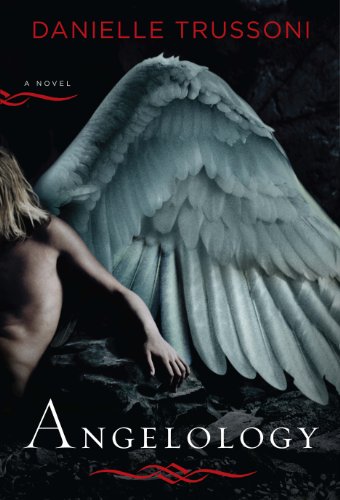
Teaser Tuesday: Angelology

On Teaser Tuesdays readers are asked to:

  • Grab your current read.
  • Let the book fall open to a random page.
  • Share with us two (2) “teaser” sentences from that page, somewhere between 7 and 12 lines.
  • You also need to share the title of the book that you’re getting your “teaser” from … that way people can have some great book recommendations if they like the teaser you’ve given.

I’m watching the current episode of Glee as I write this (DVR’d earlier) and am trying to dash this off before it resumes. It’s been a pajama day for me, as I’m not feeling well. Again. I didn’t even read, but I have a stack of stuff waiting to be read. One of the books in question, is Angelology by Danielle Trussoni.

Suddenly a hot, sticky substance seeped over the skin of my palms. Lifting my hands, I squinted, trying to determine what had happened. A gummy golden film, transparent and glistening as honey, coated my hands, and when I held them up in the light of the angel’s skin, the substance refracted, scattering a reflective dust over the cavern floor, as if my palms were coated in millions of microscopic crystals.

Quickly, before the other angelologists saw what he had done, we wiped our hands against the rocky surface of the cavern wall and slipped them back into our gloves. “Come, Celestine,” Dr. Seraphina said, “Let’s finish with the body.”

(Angelology, by Danielle Trussoni, page 230)

Teaser Tuesday: Twelve Rooms with a View

On Teaser Tuesdays readers are asked to:

  • Grab your current read.
  • Let the book fall open to a random page.
  • Share with us two (2) “teaser” sentences from that page, somewhere between 7 and 12 lines.
  • You also need to share the title of the book that you’re getting your “teaser” from … that way people can have some great book recommendations if they like the teaser you’ve given.

To be honest, when I first began reading Twelve Rooms with a View, the new novel by Theresa Rebeck, I thought the lead character, Tina, was a bit dense. This is a woman who doesn’t know the difference between a prevera review and Prometheus Unbound, I thought. But it turned out that Tina had her own form of intelligence, and I ended up really liking the book. A lot.

Eyeing Mrs. White’s gorgeous pink outfit, I felt a sincere moment of sympathy for those teenage girls learning a broader system of values. I mean, their mother was running all over New York City in designer suits, and they had to throw on the same ugly pleated skirts every morning before heading uptown to hang out with a bunch of nuns. It seemed like a pretty nasty fate, especially considering that they lived in Manhattan, where I would have thought that nobody, and I mean nobody, went to Catholic school to learn values.

— from Twelve Rooms with a View, by Theresa Rebeck (page 94)

Book Trailer: The Baseball Codes

Listening to NPR while I was doing my morning bathroom routine earlier today, my attention was caught by a conversation with the author of a new book called The Baseball Codes that’s all about the official and unofficial rules, regulations, and codes of etiquette involved in baseball. While I’m not generally a sports fan, I do have a soft spot for baseball, and have fond memories of watching ball games on television with my grandfather when I’d be at their house during the summer.

I miss those summers.

In any case, when it comes to marketing books, one of my favorite promotional products isn’t really a tangible product at all, but the book trailer. So, here’s the book trailer for The Baseball Codes, by Jason Turbow:

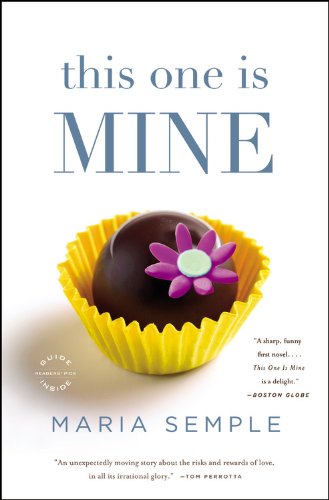
Review: This One is Mine, by Maria Semple

This One is Mine
This One is Mine
by Maria Semple
Back Bay Boo. ks, 320 pages
Get it at Amazon >>

Maria Semple’s debut novel This One is Mine sounded like it would be just my thing when the publicist offered me a review copy. Then I read it, and learned that while Semple’s characters are vivid, and her writing voice easy to read, her book wasn’t quite my thing after all.

This One is Mine is the story of Violet, who has violets tatooed behind her ear, and was once a television writer/producer, but who quit working when she became a mother, choosing to focus on raising her baby and caring for the huge L.A. home she and her music producer husband (David) live in. She does this, not on her own, but with the help of the nanny, whom is called LadyGo (which clueful readers figure out about two-thirds of the way into the book comes from the nanny’s habit of retelling conversations with liberal use of the phrase, “Lady go, “blah blah blah…”). In the opening chapters, however, we see a home with a dead rodent in the hot tub, and honey leaking through the kitchen ceiling, two items that are never resolved in the story.

Violet is restless, and feels trapped, and ends up having a short-lived affair with a D-list bass-player named Teddy. It would be wonderful if this affair stirred Violet from her stupor, and sent her either back to the office, or back home to really take charge, but Teddy is so unlikeable – he’s a loser with bad hygiene and a drug habit who pretty much only cares about music, sex, and his car – that this relationship left me feeling as slimy as Violet should have. Seriously, I like to read in the bath, but this book made me want a shower.

Then there’s Sally, David’s sister. 36, beautiful and completely neurotic, she’s latched onto a sports statistician who is about to become famous and successful in a whole new way – she thinks – and when their relationship isn’t everything it seems, doesn’t talk to him the way reasonable adults do, but hides her problems.

Still the book ends on an up note, and despite the overdramatic characters and implausible situations, it’s important to remember that author Semple is, herself, a producer/writer, and this novel is meant to be social satire. And it succeeds well at this. I especially enjoyed David’s trip to a sweat lodge – I laughed so hard at THAT scene that the laughter served in place of allergy relief.

Is it outright funny? I suspect only if you live in L.A. or are close to people who do, will it generate belly laughs. Do I wish I hadn’t read it? No. It was interesting, just…not particularly my thing. I do think its likely to be quite enjoyable for most women, however.

Except for the tattoos of violets behind the main character’s ears. Those, I really liked.

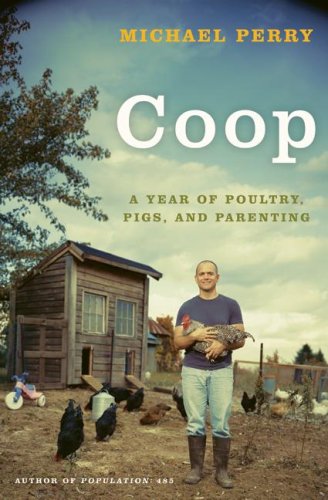
Book Review: Coop, by Michael Perry

Coop
Coop: a Year of Poultry, Pigs, and Parenting
Michael Perry
Harper, 368 pages
Get it from Amazon >>

I wasn’t going to post any kind of review of Coop here, but I love Michael Perry’s writing so much that I couldn’t not.

In this, the third of his collection of memoirs about his adult life in rural Wisconsin, Perry writes about everything from becoming a parent, both to a stepdaughter (he refers to her as a “given” daughter) and to a new baby girl, to raising hogs to building the titular chicken coop, which project becomes the recurring theme in the book.

As always, Perry’s description of his own carpentry skills is self-deprecating at best, and whether he’s discussing the way he salvaged windows from his previous home for the coop or talking about industrial hand wheels, he’s funny and engaging, and also makes you want to reach into the pages of his book and just offer a hand.

He’s also unabashedly proud of and impressed by the women in his life – and it is that directness and admiration that makes Coop a great gift for a mother, daughter, wife, or friend. It’s not typical chick-lit, not even close, but his writing is so easygoing that reading this book with a cup of coffee on the back porch is something every woman I know would likely enjoy.

I mean, I read it that way, alternating coffee and sips of iced tea, lightly sweetened with local honey.

I’m not sure if Perry has another book planned next, or if he’s going to concentrate on music for a bit, but I eagerly await his next words.

And you should, too.

Review: Truck: A Love Story, by Michael Perry

Truck: a Love Story
Truck: a Love Story
by Michael Perry
Harper Perennial, 320 pages
Get it from Amazon >>

Several days ago in this blog, I mentioned that I had an “author crush” on Michael Perry. I’m currently reading his most recent book, Coop which will be reviewed over at All Things Girl, but I wanted to make sure I talked about the last book of his that I read: Truck: a Love Story.

If the title of the book isn’t enough of a hook, consider that this book really is a love story. Actually it’s three love stories. One, is of the teenage Mike’s love of the fictional character Irma Harding, who was created to be the face of International Harvester, in the 1950s. The second, and the one that provides the continuity in this book, is the author’s love of a vintage International Harvester pickup truck, and his journey through its restoration. The third, most poignant, is of his relationship and eventual marriage to his wife Anneleise, and his fatherly love for her young daughter, Amy.

As usual, Michael Perry tells his story with a lot of warmth and an equal measure of humor. He may be a guy who grew up in rural Wisconsin, but he’s also incredibly bright. Much of the humor is self deprecating – he’s sort of power-tool impaired, for example – but some of it comes from the juxtaposition of a green tea drinking, NPR- and jazz listening writer who is also a fire fighter and amateur farmer.

Because this is a memoir, there really isn’t a plot, but Perry does an excellent job of condensing several events into a coherent narrative.

In short, his memoirs ride the fine line of being candid and creative nonfiction.

And I can’t get enough of them.

New Author Crush: Michael Perry

I tend to read the same way most people approach a dip bar – several repetitions of one author (or, um, exercise) and then a rest. In plainer language, I mean that when I find an author whose work I like, I read everything they’ve written, as quickly as possible, in succession, and then move on, at least for a while.

My current “author crush,” as I tend to describe these reading moods, is one Michael Perry. I’ve written, already, about recently reading his book, Population: 485, and I’m currently in the middle of his second memoir, Truck: a Love Story. Both are warm, funny, vivid and candid in all the right balances. Both have thoughtful sections as well, and I’m really enjoying revisiting the upper midwest, in a way I haven’t done, through literature, since I first discovered Kathleen Norris, early in my marriage.

Norris and Perry are nothing alike, and yet, both have this intense love of the land that comes through their words, and makes you want to sink your fingers into fresh earth, or pick a sun-ripened tomato and eat it, straight from the vine.

I just wanted to take a moment, and share that.

Oh, and to say,the signed copy of Perry’s most recent book, in hardcover, arrived on Thursday.

Bookmarks: The Elephant Man

I don’t remember who wrote the book The Elephant Man on which the movies were based, but I do remember seeing two distinctly different versions of the movie. One was in black and white, and involved prostheses and costumes, and the other…the other creeped me out more because the actor playing John Merrick was not costumed, but playing the part with his naked face, and using only his body language to convey the extreme disfiguration Merrick had to cope with every day.

The latter movie could have been telling a story about someone with severe cystic acne, instead of the bone/skin condition Merrick had, but despite the lack of makeup, the lack of latex body parts and paint, I had no doubt about what I was seeing. Nor did anyone else.

It was my first conscious experience with the power of imagination, of letting the audience (or the reader) fill in the blanks.

I was hooked.

(Update: Amazon says there’s a play by Bernard Pomerance, and a book by Christine Sparks)

Bookmarks: Population 485, by Michael Perry

I read Population 485 fairly recently. In fact, I’d meant to post a real review of this memoir about a man returning to his Wisconsin roots just before we got the call to race to Iowa.

If slimming pills can be found in the form of movies depicting the bloody brutality of mass produced meat, than pills of wisdom can be found in memoirs you don’t think have any direct bearing on the current circumstances of your life.

Translation: I picked up this book several months ago, and forgot I had it, then didn’t read it til I had almost nothing left in my pile. All this week, however, bits of it have been coming back to me – the most simple, and the most poignant. For example, at one point Perry writes about death, saying that it doesn’t really hit you until the last, empty casserole dish has been returned.

The community filled my sister-in-law’s house with food.
I fear what her reaction will be when the last tupperware container has been given back to its rightful owner.

Review: Whom God Would Destroy by Commander Pants

Whom God Would Destroy
by Commander Pands
Pantsateria, 300 pages
Get it from Amazon.com >>

When an author called “Commander Pants” contacted me asking if I’d read his book, Whom God Would Destroy, comparing it to the often-absurd work of Christopher Moore, whose writing I love, I was a bit skeptical. In truth, I was a bit worried that this book would be fodder for fueling an outdoor fireplace, rather than an entertaining read.

Two chapters into the book, I was happily proved wrong, and even though I began reading it in late October, and finally finished it in January (due to it getting lost in the house, my reading mood changing, etc.), I have to say it was one of the most provocative and funny novels I’ve read in a long time, and you should not assume that the fact that it took me seventeen years – well, seventeen weeks – to finish is at all a commentary on the book itself.

The basic premise is simple: God, calling himself “Jeremy” comes back to earth to check up on us. Of course, life has changed a lot since the robe and sandals days of Jesus, and he has to assimilate everything from fast food to digital information and public access cable. That alone would make any novel entertaining, but then Commander Pants ups the ante, introducing us to patients and caregivers in a mental health facility, and using his absurd tale to confront the very brutal realities of sanity vs. insanity, socially acceptable behavior, and mind altering prescription drugs ranging from “mild” anti-depressants to anti-psychotics.

And that’s all before we find out that the aliens just might be real, after all.

If you want a rollicking good read that really examines the social conventions of mental health, you need to read Whom God Would Destroy.