Water for Elephants by Sara Gruen

Water for Elephants was recommended to me several years ago when it first came out, but for some reason it didn’t appeal to me at the time, or I passed it over for some other reason. A couple of weekends ago, we were at the library, and I noticed it. In fact, the library we visited was so depressing, that it was one of only three books I bothered to check out.

I finished it tonight, having chosen to savor it and make it last, because once I started reading it, and realized it was about the circus, I was hooked.

This novel is both a behind-the-scenes look at traveling circuses in the 1930s and a love-letter to the art form. Told in flashbacks by the main character, Jacob, who used to be a vet “on a show,” we glimpse the dirtier aspects of circus life, including the often brutal treatment of workers, performers, and animals, the way acts were formed, and the competition between different circuses.

I’ve been telling my husband I want to see the circus for my birthday (Ringling Bros. will be in town), and the fact that this book fell into my lap a month before that event seems to be a favorable sign.

Goes well with caramel corn.

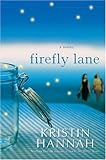
Firefly Lane, by Kristin Hannah

Firefly LaneFirefly Lane
by Kristin Hannah
Get it from Amazon

When you were a teenager did you ever feel like a ram of your head against the wall might be more productive than a conversation with your mother? If you are a parent, have you ever felt that way about your child? If so, this novel is for you.

Firefly Lane is a tale of the lifelong friendship between cool, breezy and somewhat broken Tully, daughter of a strung out leftover hippie, abandoned to her grandmother most of the time, and average, suburban Katie. Their friendship is formed accidentally when they become neighbors, but ends up becoming a sustaining force for both girls.

As they grow up, Tully is the one who knows what she wants and pushes everything out of her way to get it, dragging Katie along in her wake, until, finally, Katie ends up with what SHE really wants – a home and family, and loving husband.

Set against the television news industry Katie and Tully’s friendship follows a timeline from the early 1970’s, when they meet, until present day, when Katie has to face a devastating challenge and needs Tully, estranged in recent years, to help get her through.

While Firefly Lane is not, ultimately, a feel-good novel, it is a strong portrayal of women’s friendships, and the characters drawn by author Kristin Hannah are complex and believable.

Goes well with an ice cold glass of lemonade, an Adirondack chair, and a soft cotton blanket.

V: the Second Generation by Kenneth Johnson

By: Kenneth Johnson
Published by: Tor
Publication date: February, 2008

I was twelve or thirteen when the original V miniseries was broadcast, and a bit older when V: the Final Battle came out. At first, I wasn’t interested, but my step-brother got me into the show, and, because I gravitated toward underdogs even then, I’ll confess that I had a bit of a crush on Willie (played by Robert Englund). This was before I’d seen A Nightmare on Elm Street, of course.

When we were at the bookstore the other night, looking for a diet book I eventually chose not to purchase, Fuzzy’s eye was caught by the trade paperback version of V: the Second Generation, and knowing that I like the series, and have ALL the tie-in books upstairs in a box, he grabbed it for me.

I read it on Friday night.

I have been sort of following news of Kenneth Johnson’s career (also I was in high school with his niece), so I knew he had dropped out of being involved with the second miniseries, and had refused to be part of the short-lived weekly series, and that this book would ret-con most of that.

I was expecting it to be awful.

It was actually a pretty good story. In this version, which picks up twenty years after the original mini-series, which ended with Juliet Parrish and Elias sending a message in the general vicinity of enemies of the alien Visitors, the reptiles are controlling most of earth, 50% of the water has been taken into their mother ships (there’s a five-page description of the Pacific Desert and an image of the Golden Gate Bridge stretching across dry sand), scientists, called Scis, are living in ghettos reminiscent of the Jewish ghettos from Nazi Germany, and the Resistance is nearly dead.

As well, there are a bunch of alien-human hybrid children (all under the age of twenty), referred to as Dregs, who are caught between the human and alien cultures.

We are introduced to several new characters – Ruby, a hybrid 12-year-old adopted by Julie, Nathan, a member of the Visitor Friends (now called Teammates) youth group who was befriended by a fifth columnist, Jon, a brilliant hybrid living on the mother ship and working as a janitor, and Ted, the troubled teenaged son of Willy (which is how Johnson consistently spells Willie’s name, and which drove me nuts) and Harmony (the caterer/waitress from the movie).

Old characters are back as well, Julie, Robert Maxwell (but not his daughters), Willy and Harmony (who didn’t die, because Johnson ignores the second movie), and Martin (again, not dead) the fifth columnist. Mike is presumed dead.

And then there are the Zedti, an alien race who got the transmission and came to help…sort of.

If the novel felt more like a padded film script, well, it’s no secret that Johnson, who was the creative mind behind not only V, but also The Bionic Woman (the original), The Incredible Hulk, and Alien Nation is a great television writer, but not a novelist.

Still, with politics preventing SciFi from working with Warner Brothers to produce a movie version of this story, the book is better than nothing, and was a fun read that kept me occupied for an evening.

Also, there are some great Easter eggs in the text, such as Willy giving Jon a copy of Tenctonese Biogeometrics (the Tenctonese are the aliens in Alien Nation.

Goes well with: 80’s pop hits and a peanut butter sandwich.
The Jane Austen Book Club by Karen Joy Fowler

There had been a lot of hype about The Jane Austen Book Club and I knew it was supposed to take place “in a California river town” but it was pretty clearly referring to Sacramento. I spent many of my teen years in Modesto, Fresno, Stockton and Sacramento, so it was sort of like homecoming to read a novel set in those environs.

The book itself is the story of five women and one man who read and discuss each of Austen’s works. I have to confess that I never appreciated Austen when I was required to read it in high school, but I’m considering renewing my acquaintance with her on the basis of this book, which was a funny, sad, sweet, and very realistic portrayal of real women in many stages of life. As the lone man, Grigg served mostly as contrast.

This book is not one that requires home theater sconces and dramatic music, and is better read sitting on a sunny porch with a glass of iced tea.

The movie that was adapted from it happened to be next on my Blockbuster queue, so I watched the movie almost immediately after finishing the book, and I was not disappointed by either.

Good read.

Queen of the Tambourine

by Jane Gardam

It was the title of this book that hooked me. I envisioned a tale about a street gypsy with pretty skirts and musical talent shaking her tambourine in a band, and having delightful love affairs with men who were ever-so-slightly disreputable.

Instead, I got a story about a woman who had been through a hysterectomy thirty years before, and still hadn’t gotten over it. If people who exhibited cerebral palsy symptoms gave up as easily as this woman did, there would be no triumphant stories, and that comedienne from The Facts of Life would never have had a career.

But I digress. Eliza is clearly mentally unstable, but we don’t really see how far gone she is because this is an epistolary novel – a series of letters all sent to a woman named Joan who may or may not be a real person. She’s always been a little odd, apparently, but now that her Diplomatic Service husband has left her, no longer able to put up with her idiosyncrasies, whatever was holding her together has cracked.

Through the letters we meet a woman who has no children, no friends, no real life outside of her husband, and while I also don’t have children, It was difficult for me to empathize with Eliza, who appeared, more than anything, to need a really good shaking.

There are the requisite revelations of the secret horrors of her life, of course, made to strangers rather than to friends, but I find myself a bit empty after finishing this book. It was well written, well crafted. I just couldn’t relate.

A Lick of Frost

by Laurell K. Hamilton

If sex really does assist in weight loss, Merry Gentry is probably the healthiest, fittest faerie princess in creation, but in her most recent appearance, sex takes a back seat to…lawyers.

Yes, it’s true, the most recent offering in the Merry Gentry series not only has a plot, but there’s so little sex it can’t rightfully be termed faerie porn, though there’s still a lot of commenting on the beauty of her posse of gorgeous preternatural men.

The plot, by the way, involves Merry’s uncle, Kind of the Seelie Court, pressing charges against one of her men for the alleged rape of one of the women in his court. The legal conference takes up the first quarter of the book, and then we move into the political machinations of the UnSeelie vs. Seelie leadership.

If this sounds like a really flippant review, let me just say, I loved this book. The character death at the end made me cry, and there were so many plot twists, including answers to some lingering questions, that despite the tears I came away from the book feeling really satisfied.

The problem is, there’s no way I can say any more than this without spoiling everything.

If the last book in this series was PWP, this one completely made up for it.

Read with a box of tissues close by.

In Their Words: Colleen Gleason

The Rest Falls Away: The Gardella Vampire Chronicles (Signet Eclipse)Rises The Night: The Gardella Vampire Chronicles

I first encountered Colleen Gleason and her wonderful vampire series when someone recommended her work in the comments of this blog. A short time later, she herself commented here, and we’ve exchanged blog comments ever since (though, that’s only been a few months). She is warm, funny, and completely approachable, and even though I confess to not being a particular fan of the regency period, I have become a fan of her series because the themes she addresses are universal, though her approach is completely original. I’m tickled, then, to offer this interview on the very day the third book in the series is being released.

* * * * *

Name: Colleen Gleason
Website: ColleenGleason.com
Most Recently Published Work: The Bleeding Dusk: The Gardella Vampire Chronicles (#3)

Colleen’s brief bio:

Colleen was born and raised in Michigan, and worked in the health care industry in sales and marketing for more than fifteen years before selling her first book. She currently resides near Ann Arbor with her family and is working on the fifth book in the Gardella Vampire Chronicles.

* * * * *
Interview Part One | Interview Part Two

In Their Words: Colleen Gleason (Part 1)

Intro | Part Two
* * * * *

What question are you never, or rarely, asked in interviews, that you really wish people would ask? How would you answer it?

Hmm. I really can’t think of anything that I haven’t been asked. I must have good interviewers.

Conversely, what question are you often asked, that you really don’t like to answer? What don’t you like about that question (no, you don’t have to answer it)?

How are sales/how’s the book doing–mainly because, unless the book hits a best-seller list, it’s pretty hard to tell how a book is really doing (and what does that mean, anyway?) for at least a year. It’s a nebulous question, and there’s not an easy answer.

Who in your life was/is the greatest influence – good or bad – on your writing?

I think my agent had a big hand in helping me to get my writing to a different level. When she first took me on, I was writing well, and that’s why she wanted to work with me. But we had several conversations about–literally about–word choices. Very specific ones, and those conversations helped me to see a fairly simple but effective way to bring my writing to another level. It sounds like such a small thing, but in a way, it was a big thing.

I’ve also been influenced by my favorite authors, because I see their techniques and learn from them, using and adapting to fit my own stories, as far as craft goes.

And other big influences are my two critique partners, who read everything I write, every week, and really support and motivate me to keep writing. They’re tough, and they know their stuff. I don’t think I’d be here without them.

Do you write in longhand first, or do you compose at the keyboard? Tell us about your preferred pens, ink, paper, or platform and program.

I write everything in Word on my Macbook. Then I transfer it to my iMac and fine-tune it. I write one draft, massaging, muscling it into shape as I write–instead of writing one complete draft, then going back over it. I’m constantly editing/rewriting, tweaking, fine-tuning. At the end of the book, I do make a final pass for things like consistencies…but usually that’s pretty minor, since I’ve been pounding the book into shape all along.

What do you consider a “full day’s work” of writing? Do you measure by number of hours, or number of words? Do you spend time doing mundane chores so that you don’t have to write?

I am a great procrastinator! (I think many writers are.) There are so many other fun things to do on the computer besides write–read/answer fan mails, emails from my editor or agent, blogging, “researching” on the Internet, reading gossip columns (ahem). And if I’m sitting at my computer, I’m at least “at work” even if I’m not working.

So, I usually do a great deal of writing away from my desktop, and on my laptop, in a place where I can’t get internet. I often sit in restaurants and/or coffee shops and put my earphones in and plug away, without distractions.

As for a full day’s work…well, I like to try for 5 pages a day, but at the beginning of the book, I definitely chalk up fewer pages. But I make up for it when I get near the end, sometimes doing 10-20 pages in a day.

* * * * *
Intro | Part Two

In Their Words: Colleen Gleason (Part 2)

Intro | Part One
* * * * *

What are you reading these days? Or, what types of things do you like to read when you have time?

I read a variety of things, but I generally stay away from books in the genre that I write–namely, at this time, vampire books. I like to have a clean slate in my head when writing, and not worrying about what’s been done before or what hasn’t. It allows me to be freer in a way.

I’m currently reading A Mortal Bane by Roberta Gellis, who wrote The Roselynde Chronicles — one of my all-time favorite series of books. I recently finished Jamaica Inn by Daphne duMaurier and Duchess on fifth Avenue by Ruth Ryan Langan.

Got tunes? What’s flowing from your headphones or speakers while you write?

Lately I’ve been listening to either Michael W. Smith’s praise and worship music, or a party shuffle from my iTunes library.

How do you start a project? Do you begin with a random idea or an urge to cover a topic, or does research inform your choices? Once you’ve got an idea, do you outline, or just write what comes?

Since I’m writing a series now (and in fact, am writing the last book in the series), I’m already in the middle of one long story, so to speak. So I have a better idea of where it’s going than when I start a brand new project. However, even so, I still don’t plot very specifically before I begin. I have a basic idea of where the story is going and what’s going to happen, and I fill in the details as I write. And sometimes, I take a detour, or the book goes in a different direction than I’d planned….but I still end up in the same place.

When I’m starting a brand new idea, I generally sit down and just write–the first chapter or two–and then I sit back and try and figure out who these people are and what they’re doing. Then I write some more and come up with a general synopsis, and away we go!

Describe your ideal book signing. Is it in a large chain bookstore, or a smaller independent one? Is there a café? Do they have food and drinks that tie in with your book? What is the audience like?

Oooh…fun question!

It doesn’t matter to me where the signing is, or whether there’s food or drink (although I’m never one to pass up food OR drink!).

I have no problem speaking in public, especially about things like my books. So a setup where I can talk and take questions from the audience is wonderful for me. I love to have both readers/fans and non-readers, so that the conversation can go in different directions–some specifics about the books, and some in general about writing.

Tell us a bit about your current project. What’s it about? When is it coming out? Is it drastically different from your last work, or continuing a similar theme? What do you want prospective readers to know?

My newest release, The Bleeding Dusk, is out on February 5, and it continues the story of Victoria Gardella Grantworth. It’s the middle book of the five about her, and in many ways, it turns several aspects of the series on its head. I just finished writing the fourth book, When Twilight Burns, which will be out in August 08. And I’m currently writing the fifth and final book about Victoria.

As for prospective readers…the books can be read out of order, but I don’t suggest it, only because it is one long on-going story about Victoria and her struggle to balance her life with her calling as a vampire hunter in Regency England. So I recommend starting with The Rest Falls Away because then you get to see how she grows, changes, matures throughout the series.

* * * * *
Intro | Part One