In Their Words: Julia Holden (Part 1)

INTRO | PART 2

What question are you never, or rarely, asked in interviews, that you really wish people would ask? How would you answer it?
Considering that both my novels are set principally in Paris, I’m surprised nobody’s ever asked me for travel advice. I’ve got a lot of opinions – and if somebody wanted restaurant suggestions, or to know, for instance, where exactly that magical vintage clothing shop on the Left Bank really is, I’d tell them.

Conversely, what question are you often asked, that you really don’t like to answer? What don’t you like about that question (no, you don’t have to answer it)?
People want to know, what’s with the pseudonym? And I just have to say to them, sorry, I really can’t tell you, next question. I think my mistake was acknowledging publicly that it’s a pseudonym. Most readers would be amazed at how many of their favorite writers are … well, somebody else.

Who in your life was/is the greatest influence – good or bad – on your writing?
I took Frank McCourt’s creative writing class in the eleventh grade. That was decades before Angela’s Ashes, so nobody had any idea that he would someday be this amazing success. But I remember, he taught us that if you want to be a writer, you have to write. That sounds obvious, but it’s not. Writers can’t sit around and wait for inspiration. It’s a lot of work, and it requires enormous discipline. And the only way to get better is by doing it a lot. So I learned that from him – and then much later, when he became a huge phenom, that set a pretty inspiring example that it’s possible to make it even if you never managed to be a twenty-something wunderkind.

Do you write in longhand first, or do you compose at the keyboard? Tell us about your preferred pens, ink, paper, or platform and program.
Sometimes I’ll use pen and paper to outline, or make notes – but when it comes to the actual writing of prose, it’s all on the keyboard. Thank you, Hewlett-Packard, and also Microsoft for the ergonomic keyboard I need when I’m cranking under deadline. But if that sounds too much like a commercial, I’ll counteract it by saying that I use Word, but it’s an evil buggy program and I hate it.

What do you consider a “full day’s work” of writing? Do you measure by number of hours, or number of words? Do you spend time doing mundane chores so that you don’t have to write?
I still have a day job, so my “full day’s work” of writing is typically late at night, and, if I’m under serious deadline pressure, on the weekends. I wrote One Dance in Paris literally in just two months to get it in on time – that’s at least five pages a day, every day. And if I skipped a day, I had to make it up the next day, or on the weekend. So I didn’t have the luxury of distracting myself, with mundane chores or anything else, for that matter. Even just remembering, I get exhausted.

* * * * *
Julia Holden’s most recent novel is One Dance in Paris. She can be found on the web at JuliaHolden.com.
* * * * *

INTRO | PART 2

In Their Words: Julia Holden (Part 2)

INTRO | PART 1

What are you reading these days? Or, what types of things do you like to read when you have time?
I just read Patricia Wood’s Lottery, and I’m in the middle of Allegra Goodman’s Kaaterskill Falls. Very, very different books, but both quite wonderful.

Got tunes? What’s flowing from your headphones or speakers while you write?
Nothing. Silence. Total quiet. Sssshhhhhhhhhhh.

How do you start a project? Do you begin with a random idea or an urge to cover a topic, or does research inform your choices? Once you’ve got an idea, do you outline, or just write what comes?
That depends; so far, every project has been different. One Dance came about by kicking ideas around with my editor. Once we had the idea, I wrote a short synopsis – maybe five pages – and I pretty much wrote the book straight from that, without any formal outline. I did have to do some research, though, including reading a very informative but surprisingly dull book on the history of the Folies Bergère. And thank goodness for the Internet, which gives writers instant access to pretty much all the facts we might need.

By contrast, I just finished a screenplay; it took me only a couple of months to write, but before that, I had been cooking the idea for a full two years. And for what I think is going to be my next book project, I’m doing some serious outlining. I can’t tell you why each one is different; it just turns out that way.

Describe your ideal book signing. Is it in a large chain bookstore, or a smaller independent one? Is there a café? Do they have food and drinks that tie in with your book? What is the audience like?
As a pseudonymous author, my ideal book signing would be one that I could actually attend. The ideal audience would be large, enthusiastic, and in possession of substantial amounts of disposable income with which they intended to buy books. Specifically, mine.

Seriously, I would love to do book signings. Maybe someday. Maybe soon. (See answer to next question.)

Tell us a bit about your current project. What’s it about? When is it coming out? Is it drastically different from your last work, or continuing a similar theme? What do you want prospective readers to know?
Right now, I’m going in a very different direction for what I hope will be my next book. I can’t say much, except that it’s about ballet. And I’d like to publish it under my own name. I’ll probably be talking to my editor and publisher about it in the next few weeks … so wish me luck.

And what would I say to my readers? That’s easy: Thank you. Sincerely.

* * * * *
Julia Holden’s most recent novel is One Dance in Paris. She can be found on the web at JuliaHolden.com.
* * * * *

INTRO | PART 1

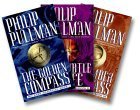
The Amber Spyglass

by Philip Pullman

There are books that you can read while laying flat on a mattress, and there are books you have to sit up to read. The Amber Spyglass, the final installment in the His Dark Materials trilogy is one of the latter. Despite the fact that I was nursing the cold that wouldn’t die while reading it, I was completely upright, reading about Lyra and Will, and their final journey through the world of the dead, and back to their own separate universes, finding love, and maturity, along the way.

Is it wrong of me to wish that my Zorro-dog was really a daemon like Pantalaimon, not for the shape-changing feature (which goes away once you reach a certain level of maturity anyway) but for the ability to communicate? As I was reading about Lyra and Pan I was often distracted by their relationship, wishing I could explain to Zorro why he’s taking all these pills.

Even so, it was a satisfying end to the story, and I’m probably going to pick up Lyra’s Oxford as well.

Booking Through Thursday: 24 January 08

Rather than chastise myself yet again for not having the Uverse guys restring the house with Cat5e cable while they were here in October, I thought I’d answer this week’s question from Booking Through Thursday. It’s technically not Thursday any more, but I won’t tell if you don’t. Deal?

They ask:

What’s your favorite book that nobody else has heard of? You know, not Little Women or Huckleberry Finn, not the latest best-seller . . . whether they’ve read them or not, everybody “knows” those books. I’m talking about the best book that, when you tell people that you love it, they go, “Huh? Never heard of it?”

I think my answers would be Paris to the Moon by Adam Gopnik, Outside Lies Magic, by John Stilgoe, neither of which are fiction. The first is a series of essays about living in Paris as an American with a young child, the second is about finding the extraordinary in ordinary things – like the way a picket fence becomes “invisible” if you ride past it on a bike at just the right speed.

In fiction, I’d have to recommend the novel Mothers by Jax Peters Lowell, which is about Claire, a photographer, and Theo, a caterer/chef, two women who fall in love and raise a child in New York in the early sixties and seventies. I bought it because I liked the picture on the front, and I think it was on the $5 table. I’ve reread it because it has everything a good novel needs to have to make it a comfort book for me: romance, strong women characters, food, art, and scenes at the beach. I would have liked to grow up with Claire and Theo as parents.

Library Plans Have Changed

With the purchase of new exercise equipment – no not beer pong tables, but a weight set that took five hours to put together, my lofty plans for the library have changed.

Is it still a library if you have a weight machine in the corner? I think so, after all the books outweigh the weights. Really. The new plans are to move the television from my office into this room, to add bookshelves so that we can get our current collection off the floor, and to add a new cd player, to provide inspiring tunes to work out with. Inspiring in the “pump up the energy” sort of way.

I’ve used it twice so far, and I like the space – our library is L-shaped, and the weight machine is in the short part of the L along the windows, facing the couch, but far enough info its niche that the couch can still be extended (it’s a sleeper) should it need to be. The thick carpeting mutes the sounds and makes a lovely place for doing crunches, and the windows make the space feel like a studio.

I still wish it was my office, but I like the new use of the space, as well.

I just wish I could read WHILE lifting.

New Bookish Friends

I’ve just spent several minutes teaching my popup blocker that the halo-scan comments some of my blog-buddies use are not a threat, and should be allowed. I’m quite certain I’ve done this before, but I have three computers, so maybe this one got missed.

While I’m on the subject of blog-buddies, I’d like to welcome two bookbloggers to my blogroll.

Becca, who I met through Michele‘s meet-n-greet, has opened Bookstack, and has written recently about the perfect choice of book for taking on a plane.

Carl is someone I’ve just met, when he left a comment on my regular blog. His site is called Stainless Steel Droppings, and he reviews a lot of books, especially sci-fi/fantasy type stuff. His most recent post, however, is related to To Kill a Mockingbird.

Go visit them. You’ll be glad you did.

Back-Up?

As much as I’d love to have a zero gravity recliner. the closest I can come, at least for reading, is a tub full of lightly fragrant bubbles floating on hot water. a back pillow, and a bottle of cool water to sip.

The thing is, more and more recently, I’ve been just lounging in the tub, or getting down to really important tasks, like shaving my legs, and not actually reading.

Even so, I’ve finished reading The Amber Spyglass recently, am halfway through Amy & Isabelle and just received a book of Laura Ingalls Wilder’s newspaper columns, that I’m really looking forward to reading.

My question for You: Where do you like to read? And what’s on your reading list?

The Subtle Knife

by Philip Pullman

If reading fantasy novels that made you think counted as using exercise equipment I would be incredibly buff, because this week, I finished The Subtle Knife, the second novel in the His Dark Materials trilogy that opened with The Golden Compass.

In this installment of Lyra’s story, which opens in “our” version of Earth rather than hers, we meet young Will Parry, son of a missing adventurer and a mother who has clearly had a grief-induced nervous breakdown. Will accidentally finds a doorway to another world, which just happens to be the same world Lyra arrives on following the end of the first book. They eventually join forces, helped along the way by Lee Scoresby, Iorek Byrneson (the armored bear king), witches, angels, and human scientists, as they must also outwit not only Lyra’s mother (Mrs. Coulter) but her father the previously-assumed-to-be-a-white-hat Lord Asriel.

While this is very much a middle novel, setting up relationships and feeding us information to prepare us for book three (which I also finished this week), it was still a satisfying read. Lyra and Will both develop from precocious kids into complex characters, and learn to use their innate skills (like lying and storytelling, or the art of not being noticed) to help their cause.

There is, of course, much talk about Dust, or elementary particles, of Shadows and Spectres and Angels, but it is in no way smarmy or pandering. These books may technically be targeted to young adults, but there’s a reason they’re found in the general sci fi/fantasy section of most bookstores.

Full of Grace

by Dorothea Benton Frank

Maria is the daughter of an Italian American couple who relocated to South Carolina to live out their golden years. She lives in a townhouse in Charleston with her neurosurgeon lover Michael, whom her parents refuse to acknowledge because not only are Maria and Michael not married, but he’s also an athiest, as well as not Italian, but Irish.

While many would classify Ms. Frank’s work, including this one, as being somewhat akin to the series romances that came with advertisements to win diamond pendants with your purchase of six volumes – cute pendants mind you, but still – she is more in the Nora Roberts and Anne Rivers Siddons category of fiction – not quite chick-lit, not quite general literature, but definitely elevated above the 200-page formula romance.

In this novel, Frank proves she can write comedy as well as romance, because we get a rollicking family farce involving Catholic dogma, hard science, and endless trays of lasagna, all served up with a southern flair.

I bought this on the $4.98 table the weekend I returned from Mexico, because I knew it would be a good “comfort novel.” I was not wrong.

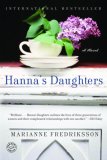
Hanna’s Daughters

by Marianne Fredriksson

Hanna, Johanna, and Anna – three generations of Swedish women, grandmother, mother, daughter. This novel by Marianne Fredriksson was an impulse buy – I’d just come home from ten days with my mother, and missed the mother-daughter dynamic. I expected something light and fluffy, instead, I got to read the histories of three fictional women, and about how their social inheritance of manners and gender roles informed their lives and choices.

Anna’s story really bookends the other two, for the novel is her interpretation, first as a thesis then as a novel, of the women who raised her, but taken as a whole, it’s a fascinating look at how in some fashion we are all our mother’s daughters, even when we don’t wish to be.

The first third of the novel was difficult to read, both because of the content (there’s a rape of a very young girl) and because the grammar reflects the uneducated way of speaking Hanna had, with funky verb tenses. Until I got to the next section, I was almost convinced that this was just a really bad translation, but it was done for effect.

I wouldn’t recommend this as a light reading, but if you’re in the mood for a respite from dealing with small business phone systems and endless faxes, and want to really explore generational culture…this book is a great addition to the pile.