The Subtle Knife

by Philip Pullman

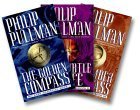
If reading fantasy novels that made you think counted as using exercise equipment I would be incredibly buff, because this week, I finished The Subtle Knife, the second novel in the His Dark Materials trilogy that opened with The Golden Compass.

In this installment of Lyra’s story, which opens in “our” version of Earth rather than hers, we meet young Will Parry, son of a missing adventurer and a mother who has clearly had a grief-induced nervous breakdown. Will accidentally finds a doorway to another world, which just happens to be the same world Lyra arrives on following the end of the first book. They eventually join forces, helped along the way by Lee Scoresby, Iorek Byrneson (the armored bear king), witches, angels, and human scientists, as they must also outwit not only Lyra’s mother (Mrs. Coulter) but her father the previously-assumed-to-be-a-white-hat Lord Asriel.

While this is very much a middle novel, setting up relationships and feeding us information to prepare us for book three (which I also finished this week), it was still a satisfying read. Lyra and Will both develop from precocious kids into complex characters, and learn to use their innate skills (like lying and storytelling, or the art of not being noticed) to help their cause.

There is, of course, much talk about Dust, or elementary particles, of Shadows and Spectres and Angels, but it is in no way smarmy or pandering. These books may technically be targeted to young adults, but there’s a reason they’re found in the general sci fi/fantasy section of most bookstores.

Full of Grace

by Dorothea Benton Frank

Maria is the daughter of an Italian American couple who relocated to South Carolina to live out their golden years. She lives in a townhouse in Charleston with her neurosurgeon lover Michael, whom her parents refuse to acknowledge because not only are Maria and Michael not married, but he’s also an athiest, as well as not Italian, but Irish.

While many would classify Ms. Frank’s work, including this one, as being somewhat akin to the series romances that came with advertisements to win diamond pendants with your purchase of six volumes – cute pendants mind you, but still – she is more in the Nora Roberts and Anne Rivers Siddons category of fiction – not quite chick-lit, not quite general literature, but definitely elevated above the 200-page formula romance.

In this novel, Frank proves she can write comedy as well as romance, because we get a rollicking family farce involving Catholic dogma, hard science, and endless trays of lasagna, all served up with a southern flair.

I bought this on the $4.98 table the weekend I returned from Mexico, because I knew it would be a good “comfort novel.” I was not wrong.

Hanna’s Daughters

by Marianne Fredriksson

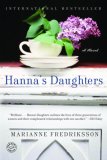
Hanna, Johanna, and Anna – three generations of Swedish women, grandmother, mother, daughter. This novel by Marianne Fredriksson was an impulse buy – I’d just come home from ten days with my mother, and missed the mother-daughter dynamic. I expected something light and fluffy, instead, I got to read the histories of three fictional women, and about how their social inheritance of manners and gender roles informed their lives and choices.

Anna’s story really bookends the other two, for the novel is her interpretation, first as a thesis then as a novel, of the women who raised her, but taken as a whole, it’s a fascinating look at how in some fashion we are all our mother’s daughters, even when we don’t wish to be.

The first third of the novel was difficult to read, both because of the content (there’s a rape of a very young girl) and because the grammar reflects the uneducated way of speaking Hanna had, with funky verb tenses. Until I got to the next section, I was almost convinced that this was just a really bad translation, but it was done for effect.

I wouldn’t recommend this as a light reading, but if you’re in the mood for a respite from dealing with small business phone systems and endless faxes, and want to really explore generational culture…this book is a great addition to the pile.

Tales from the Captain’s Table

edited by Keith R. A. DeCandido

Easing back into the SEO world of cpm and cpa, and various other acronyms, after ten days of beachy bliss was difficult, so I did what every avid reader does: I bought some comfort books. One of these was a Star Trek book: Tales from the Captain’s Table. It’s a collection of short stories from various ship captains in the Trek-verse – Picard, Riker, Demora Sulu, and others, and they’re tied together by the fact that they’re all told in the Captain’s Table, a special bar with entrances from many worlds, where only ship captains are welcome.

Cap, the bartender, is glimpsed in small interludes, and the bar itself reforms to the specifications of whatever a given patron expects. I like storytelling, and I like the concept of the neighborhood cafe / bar / pub, so this book appeals to me on many levels.

While I don’t always like short stories, in this format, they’re the logical choice.

After reading this book, I felt much more at home inside my head.

The Tipping Point

by Malcolm Gladwell

I was first introduced to Malcolm Gladwell’s work via my stepfather, who left me his copy of Blink when he was visiting us over Christmas in 2006. I thought that book was amazing, with all of the insights about the first few split-seconds of every encounter.

The Tipping Point is amazing, but in a quieter way. It’s about social and medical epidemics – about how word of mouth works, about the different types of personalities that drive hot-or-not trends, and about how the two merge in almost every aspect of society. In the journey of this concept, the author talks about needle exchanges, AIDS Patient Zero, vintage shoes, Paul Revere’s ride, and various examples of information collection and critical mass.

There’s really no way to review it without spoiling the experience. Read this book.

Common Themes: Mysteries and Cars

It’s a classic scene. The young woman is driving down a twisting road with her long blonde hair streaming behind her, and suddenly, she realizes she’s going too fast. She slams her feet down on the Corvette brakes, but nothing happens – the brake lines have been cut!

For my last “common themes” list of the year, I offer five mysteries with cars involved in them:

1) Swapping Paint: A Stock Car Racing Mystery, by Jim Lavene
2) The Muscle Car Mystery: From the Case Files of Private Investigator James Mitchell, by M. L. Angell
3) The Keys To The Car, by Robert P. Robertson
4) Last Car to Elysian Fields, by James Lee Burke
5) The Clue of the Phantom Car, by Bruce Campbell

Many car-related mysteries are in series, of course, and most seem to be targeted toward young readers, probably to attract boys to books (this is a guess), so I decided to give you a double list, and mention some of my favorite cars in fiction.

My favorite fictional car is probably the title “character” in Chitty-Chitty Bang-Bang, which was written by Ian Fleming, the man who created James Bond. His fondness for cool gadgets is evident even in this classic work of children’s fiction.

Cars in detective fiction include poor V. I. Warshawski’s vehicke, which is forever being left in odd places, and never seems to work terribly well, and then there’s also Harry Dresden’s Blue Beetle. (These two characters belong to Sara Paretsky and Jim Butcher, respectively.)

In one of my favorite books ever, two of the characters, Lily the female chessmaster and Nim, the mysterious mentor, both have ragtop sports cars and like to drive with the top down in winter, which behavior I completely fail to understand.

Although, I completely understand the appeal of ragtops in general.
At least, when it’s warm.

Home away from Home

If Barnes and Nobel was closer, it might well become my second home. It’s already my favorite weekend destination. Oh, we have a library in the neighborhood, and I used to be a frequent haunter of libraries, but used books smell funny, and I don’t like to have to give things back.

We have a new Borders that is slightly closer than the B&N, but I don’t really like it as well, and no, it’s not because they serve non-Starbucks coffee. It’s just…not as warm, not as inviting, doesn’t have comfy chairs, and seems too bright somehow.

I like Half Price Books, despite the funky used-book smell, because they do encourage lingering and lounging, but they don’t generally have cafes, and I think they’re the poorer for it. Books and coffee go together. So do books and tea.

So, for now, since our town lacks ANY decent independent bookstores, I shall stick with Barnes and Nobel.
And their green comfy chairs.

Scenes from a Bookstore

You’d have thought, by listening to the intensity in his voice, that the old man was trying to find a decent New York Moving Company willing to transport a grand piano between boroughs, but no, he was merely consulting with the Barnes and Noble info-desk dude about a book he really needed to have. “Can you hold this while I run to the car to get money?” he asked? Of course the answer was yes.

A bit later I approached the desk myself, asking sheepishly, “I need you to look up a title. I know the first four words are ‘On the beach with’ but I don’t remember the rest, and I know you hate it when people do this because I managed a bookstore in college and hated it, too.”

We couldn’t find the book.

It’s from an interview with Julianna Margulies in the December 15th 2007 edition of the American Airlines magazine.

Oh, well.

Browsing

Hola, everyone. I’m back from Mexico, where I barely had time to read, though I did finish The Tipping Point, by Malcom Gladwell who also wrote Blink, and re-read a good portion of Anne Rivers Siddons’s Outer Banks because a weathered copy was in the casita and I needed something in the bathroom.

Bathroom reading is a thing. If you don’t do it, just nod, smile, and move on. If you do, well, you understand.

Friends, who were in La Paz for the holiday as well, mentioned looking at pens, and I remembered my grandfather once ordering a case of personalized pens with his name and phone number on them. I’m not a fan of ballpoint, being a retractable roller-ball sort of person, but I still have a couple of those pens.

Escapism

While packing today I’ve been feeling rather like I’m planning an escape, except that all I’m escaping is the winter doldrums, and the not-even-terribly-cold weather that I really can’t complain about. I don’t really travel to escape.

I read to escape. When life feels like one endless treadmill, albeit one without the benefit of granting exercise or physical fitness, I pick up a good book. If I’m cold, I read about somewhere warm, if I’m missing the beach, I read a novel that takes place on the shore.

Sometimes I’ll make the bed with fresh sheets, brew tea, and read for an entire blissful afternoon or evening, coming out of the book mood as refreshed as if I’d been napping – perhaps more so. Other times, I’ll read in fits and snatches only, but always, always, there are words and books and pages.

It’s my favorite form of escapism.