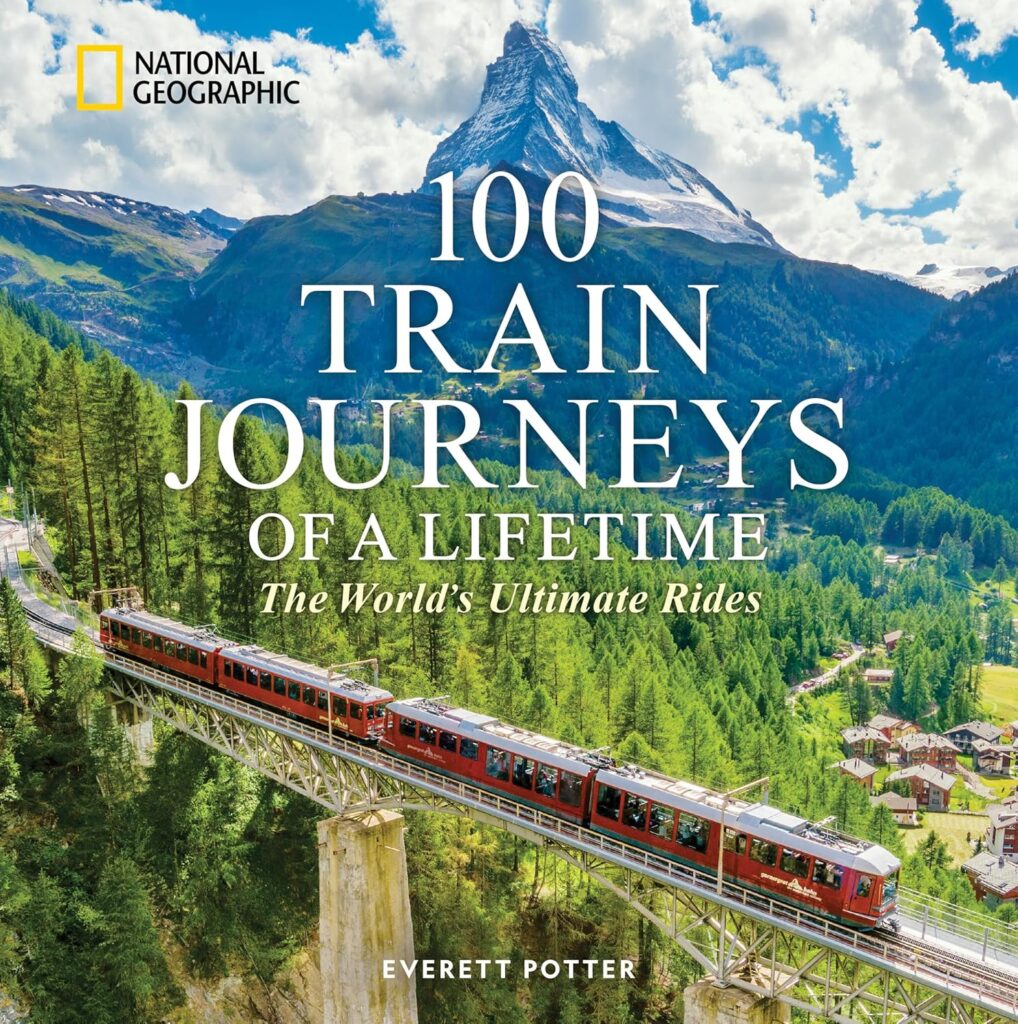


The ultimate traveler’s reference, this gorgeous coffee table book features bucket list–worthy travel recommendations for every country in the world.
Featuring beautiful National Geographic photography and 250 illustrated maps, this big and bold volume offers expert advice for must-see sights and hundreds of must-do experiences.
Pack your bags for the ultimate world odyssey! Curated by the world-savvy travel writers and editors of National Geographic, this breathtaking volume features the ultimate experiences in every country of the world, coupled with iconic photography, more than 50 point-of-interest National Geographic maps, and destination overviews highlighting both tried-and-true sights and lesser-known experiences.
Plus, top 10 lists, highlights of cultural treasures, fascinating histories, and recommended itineraries will inspire you to plan your next adventure.
Spin the globe and find:
The ultimate flavors of India’s spice hub—and the markets where you can taste them all;
Natural beauty worth hiking for, including the Skradinski Buk waterfall in Croatia and El Yunque National Forest in Puerto Rico;
Safaris big (the Great Migration in Tanzania) and small (lions on Calauit Island in the Philippines);
Tasting tours of the world’s best wine regions from South Africa and France to Germany and Napa Valley;
Historical relics, from the Colosseum in Rome to the Maya treasures in Mexico;
And so much more!
Covering all seven continents and every country in the world, The Traveler’s Atlas of the World delivers essential information, fun road trips (Germany’s great castles, a journey down the Nile, a road trip through the United States’ national parks), and infinite inspiration through more than 300 spectacular photographs with signature storytelling and invaluable traveler’s secrets.
NATIONAL GEOGRAPHIC is one of the world’s leading nonfiction publishers, with an extensive list of titles in categories such as history, travel, nature, photography, space, science, health, biography, and memoir. A portion of its proceeds is used to fund exploration, conservation, and education through ongoing contributions to the work of the National Geographic Society.
My Thoughts
There’s something about a map you can touch — the faint texture of the paper beneath your fingertips, the promise folded between borders and coastlines. The Traveler’s Atlas of the World brings back that tactile wonder, reminding us that exploration begins long before we board a plane.
This is no dry reference guide. It’s a visual feast — a blend of art and information that invites you to linger. Each page pairs National Geographic’s signature photography with maps that feel alive: textured, colorful, humming with possibility. It’s a book that begs to be spread open on a table, coffee in hand, a finger tracing routes you might someday take — or simply dream about.
What I love most about this atlas is the sense of old-school adventure it rekindles. In an age where GPS tells us exactly where to turn, The Traveler’s Atlas reminds us why we travel at all: to be surprised, to get a little lost, to imagine the world not as data points but as stories waiting to unfold. The digital map can get you there; this one makes you want to go.
It’s a celebration of curiosity — of countries we know by heart and those we might never reach, but can visit here, one breathtaking image at a time.
Goes well with: a cozy armchair, a steaming mug of chai, and an evening spent planning impossible journeys.
About the book: National Geographic The Photographs: Iconic Images from National Geographic
Publisher : National Geographic
Publication date : October 28, 2025
Print length : 464 pages
For tastemakers and citizens of the world, this iconic collection features the best of National Geographic’s world-class imagery across more than 250 cutting-edge photographs.
This glorious, large-format photography collection will immerse animal, science, and nature lovers in the unparalleled legacy of National Geographic’s best-in-class imagery. Featuring fan favorites like the Afghan girl and the sunken prow of the Titanic, as well as gems unearthed from the organization’s celebrated archive, THE PHOTOGRAPHS is for anyone passionate about discovering, protecting, and honoring the wonders of the planet.
In these pages, you’ll find dazzling images from every corner of the globe, including magnificent wildlife and human achievements in science, technology, exploration, archaeology, and adventure. Step into the lives of acclaimed National Geographic photographers like Brian Skerry, Anand Varma, and Jodi Cobb, and read interviews with legends and rising stars like Rob Clark, David Doubilet, Erika Larsen, Camille Seaman, and many more.
Both vivid and timeless, THE PHOTOGRAPHS is a must-have for anyone who loves photography, nature, and the human story.
NATIONAL GEOGRAPHIC is one of the world’s leading nonfiction publishers, with an extensive list of titles in categories such as history, travel, nature, photography, space, science, health, biography, and memoir. A portion of its proceeds is used to fund exploration, conservation, and education through ongoing contributions to the work of the National Geographic Society.
JIMMY CHIN (foreword) is a National Geographic photographer, award-winning film director, renowned mountain climber, and bestselling author. His photography book There and Back became a New York Times bestseller in 2021; his documentary film Free Solo won the Academy Award for Best Documentary Feature. Nyad, his first scripted feature, starring Annette Bening and Jodie Foster, was nominated for two Academy awards.
My Thoughts
Before I ever learned to read, I learned to look. My grandfather kept neat stacks of National Geographic magazines in his den — golden spines lined like treasure, each issue a portal. I remember flipping through the glossy pages, the scent of paper and ink as much a part of the experience as the photos themselves. Faces, creatures, storms, and ruins — the world felt vast and intimate all at once.
The Photographs rekindles that same sense of wonder, distilled into one breathtaking collection. Across more than 250 images, National Geographic’s legendary photographers remind us what it means to see — truly see — our planet and ourselves. There’s the iconic Afghan girl, her gaze as piercing now as it was decades ago. The ghostly prow of the Titanic resting on the ocean floor. And there — a line of surfers, tiny yet fearless, framed against an impossible blue wave. That image, especially, feels like a heartbeat: humanity poised at the edge of nature’s vastness, daring and small all at once.
What makes this volume remarkable isn’t just its scope — though it spans continents and decades — but its restraint. Each image stands almost alone: no essays, no captions beyond a name, a place, a year. That sparseness lets the photography breathe, invites silence, reflection. The book itself is beautifully made, large enough to do justice to its subjects, and designed with reverence rather than spectacle.
For anyone who grew up tracing the edges of the world through National Geographic, this collection is both time capsule and testament. For newcomers, it’s a revelation — proof that the human eye, when paired with patience, empathy, and craft, can still surprise us.
The Photographs isn’t merely a coffee-table book. It’s a reminder that beauty has always been both fragile and ferocious — and that our world, still, is worth looking at closely.
Goes well with: a strong cup of Ethiopian coffee, a lazy Sunday morning, and a window that catches the light just right.
Sean Mitchell was teaching English at a private school in Ohio when the New Journalism piqued his interest and lured him toward a profession that was much harder to crack than he imagined. After an editor in Washington, D.C. finally gave him a chance, he found a calling that would require and reveal multiple skills: editing an “underground” newspaper in his hometown of Dallas, writing magazine length stories about long distance truckers and Z.Z. Top, serving as the Dallas Times Herald’s first rock critic and then its theatre critic, winning national recognition for his reviews.
Moving to Los Angeles to cover Hollywood for the strangely singular and doomed Herald Examiner and then the Los Angeles Times, he profiled stars like Clint Eastwood, Ann-Margret and his irascible former St. Mark’s School of Texas soccer teammate Tommy Lee Jones. While examining the nation’s preoccupation with celebrity, he wondered if journalists like him were part of the problem or part of the solution?
Sean Mitchell grew up in Dallas, where he was editor of the city’s first alternative weekly, then a reporter and cultural critic for the Dallas Times Herald, before moving to Los Angeles to cover Hollywood for the Herald Examiner and Los Angeles Times. A graduate of St. Mark’s School of Texas and Brown University, he has also worked as an English teacher, videographer, and designer of custom wood fences.
My Thoughts
Some memoirs are pleasant enough to skim with a cup of coffee. This one? I devoured it in a single greedy gulp. Irresistible Calling is witty, engaging, and brimming with the kind of lived-in detail that makes you laugh, tear up, and—without even noticing—learn a lot.
Sean Mitchell may technically be a boomer, but his story is timeless. This GenXer found myself nodding along, hooked from page one. He opens in childhood, when a glossy holiday travel magazine inspired his parents to trade a fading Bethlehem, Pennsylvania steel town for the sun-soaked suburbs of Dallas. The 1950s details are spot-on, yet instantly relatable: family yearning for more, neighbors measuring success in conformity, and kids caught in the in-between.
Mitchell’s own path takes him from a prestigious Dallas boy’s school (where he forged friendships with classmates like Tommy Lee Jones) to college during the heyday of the 1960s, and eventually into journalism. His career arc—covering theater, film, and music in D.C., Dallas, and Los Angeles—offers a front-row seat to cultural history. The Hollywood interviews sparkle, but it’s his long, thorny, and wildly entertaining relationship with Jones that steals the show.
Threaded through the anecdotes is a thoughtful meditation on American life: the promise and collapse of the counterculture, the longing of his parents for “something more,” and his own drive to make a mark in the shifting world of newspapers. I especially loved his mother’s journey toward joy and passion, and felt the weight of his father’s quiet disappointment.
Mitchell writes with humor, candor, and a critic’s eye for the telling detail. The result is more than one man’s life story—it’s a cultural time capsule of America from the 1950s through the 1980s.
Verdict: Highly recommended for fans of memoirs, American cultural history, or simply anyone who appreciates a smart, funny, beautifully written life story.
Goes well with: A bottomless diner mug of coffee and a Sunday paper, spread all over the table.
Houston Skyline by Carol A. Taylor is a collection of poetry inspired by a life filled with change and growth. From her humble beginnings in rural Texas, where her family lived simply, to her career in the high-rises of the business world, and later to her years as a language teacher, Carol’s journey is one of perseverance and self-discovery.
Her poems reflect her experiences, blending memories of her childhood with reflections from her later years. Through themes of family, identity, and place, Carol shares her story in a way that is both personal and relatable.
This collection offers a thoughtful look at how life shapes us, showing how Carol found her voice through poetry and her love for storytelling.
Carol Taylor’s volume of poems, Houston Skyline gives us glimpses into the author’s life in the form of a collection of her poems and short bits of transitional prose. Some of the pieces have been published before, others are new, but every one was a treat to be savored.
At times gentle, wry, poignant, and wistful, this collection is well-crafted without feeling crafty. It’s sometimes very candid (“Hard Times” is a recollection about a damaged toilet seat!) and often tied to the weather, which makes sense, because the weather in Texas changes on a dime and is never without drama.
“You seldom see downpours like that ay more, like the deluge the day they buried old Berry, rain blowing sideways and dark coming down,” she writes in “Funeral in the Rain,” and immediately you can feel it, smell it, taste it.
Taylor’s word-choices are delicious, and her descriptions are cinematic. Because it’s poetry, it’s an easy book to pick up, put down, read through, and then revisit, which is what I did.
If you love poetry, in general, and Texas in particular, you will love this book. If you merely love either one of those things, I feel Houston Skyline will make you love them.
Goes well with: sweet tea, fresh strawberries, and a summer rainstorm.
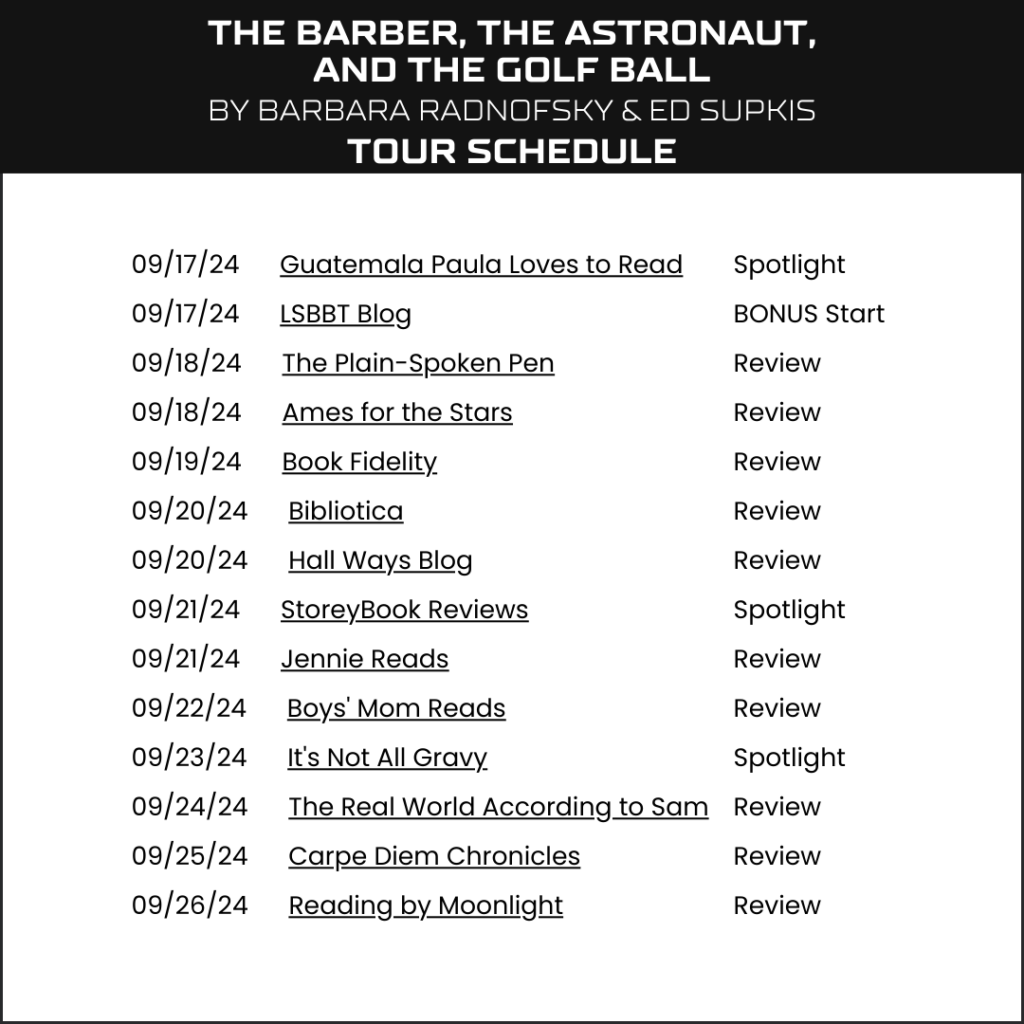
About the book, The Barber, the Astronaut, and the Golf Ball
Genre: Biography / Golf / Space Travel
Publisher: Stoney Creek Publishing
Pages: 202
Publication Date: September 17, 2024
Scroll down for giveaway.
In 1971, famed astronaut Alan Shepard returned from the moon and went to get a haircut. Before settling into the barber’s chair in Webster, Texas, near NASA’s Mission Control, Shepard gave his longtime barber and friend, Carlos Villagomez, an autographed golf ball.
During his Apollo 14 moonwalk, Shepard had conducted a world-famous demonstration of gravity by hitting a golf ball in an out-of-this-world sand trap. It took him two tries.
Carlos, a Navy combat veteran and barber for numerous astronauts, says Shepard gave him the ball immediately after he returned to earth and was released from quarantine.
Had Shepard taken a third ball to the moon? And did he give it to his barber as a token of their long friendship?
The debate provides a backdrop for The Barber, The Astronaut, and The Golf Ball, a story of two extraordinary men and their lasting friendship. The book offers a rare glimpse behind the scenes of America’s space program at its pinnacle and shows the ordinary people who supported one of the nation’s most monumental scientific endeavors.
Praise for The Barber, The Astronaut, and The Golf Ball:
It’s perfect!! Barbara and Ed capture Daddy and his long friendship with Carlos. —Laura Shepard, Daughter of Alan Shepard
Brings back the glory days of the U.S. Space Program and the importance of the “little people” who made it happen. We see stern Shepard in a new and admirable light – in Shepard’s high regard for the vast team of dedicated supporters who enabled astronauts to succeed. —Charlie Duke, Apollo Astronaut
About the authors, Barbara Radofsky & Ed Supkis, MD
Barbara Radnofsky and Ed Supkis grew up in the 1960s in the shadow of NASA’s
Manned Spacecraft Center and married in 1982. They have three children and five
grandchildren. The couple —with many other community members — are co-owners of
Brazos Bookstore, an independent bookseller. As children of NASA scientists, Barbara, and Ed had front-row seats to the development of the space program and the community built around it on rural cow pastures near Webster, Texas.
Barbara Radnofsky is a writer, mediator, teacher and lawyer. She’s the author of A Citizen’s Guide to Impeachment, a nonpartisan explanation of U.S. constitutional impeachment history and practice.
Ed Supkis, MD is a board-certified anesthesiologist specializing in cardiac anesthesia. He served as Director of Quality Assurance for the Division of Anesthesiology and as Medical Director of Respiratory Care for the Division of Surgery and Anesthesiology.
I’m a space junky. More than that, I’m a great fan of the Mercury, Gemini, and Apollo missions. I’ve read memoirs of the various astronauts, and devoured Andrew Chaikin’s book A Man on the Moon cover to cover… twice. So when I got the chance to review The Barber, the Astronaut, and the Golf Ball saying yes was a no-brainer.
I was not disappointed. Authors Barbara Radnofsky and Ed Supkis have done a deep dive into history and the interwined stories of Al Shepard, astronaut, and Carlos Villagomez, barber, and the autographed golf ball that may or may not have traveled to the moon and back is the delightful result.
More than addressing the debate about the origins of Villagomez’s prized souvenir, this book gives us an insider’s view of two men, one lauded as a cultural hero, the other who was mostly behind-the-scenes, and the very real friendship they shared.
We don’t celebrate men’s friendship enough, but this book does that. It also humanizes Shepard, a complicated man at best, in a way that other biographies and memoirs haven’t been able to do. The Al Shepard in this book is more than a stereotype, but a dynamic, flawed but still exceptional, human being.
If you love stories about the space program and the Apollo missions, you will love this book. If you enjoy historical anecdotes, you will enjoy this book. And if you like to get to know our cultural heroes as dimensional beings, you will appreciate this book. I know I did.
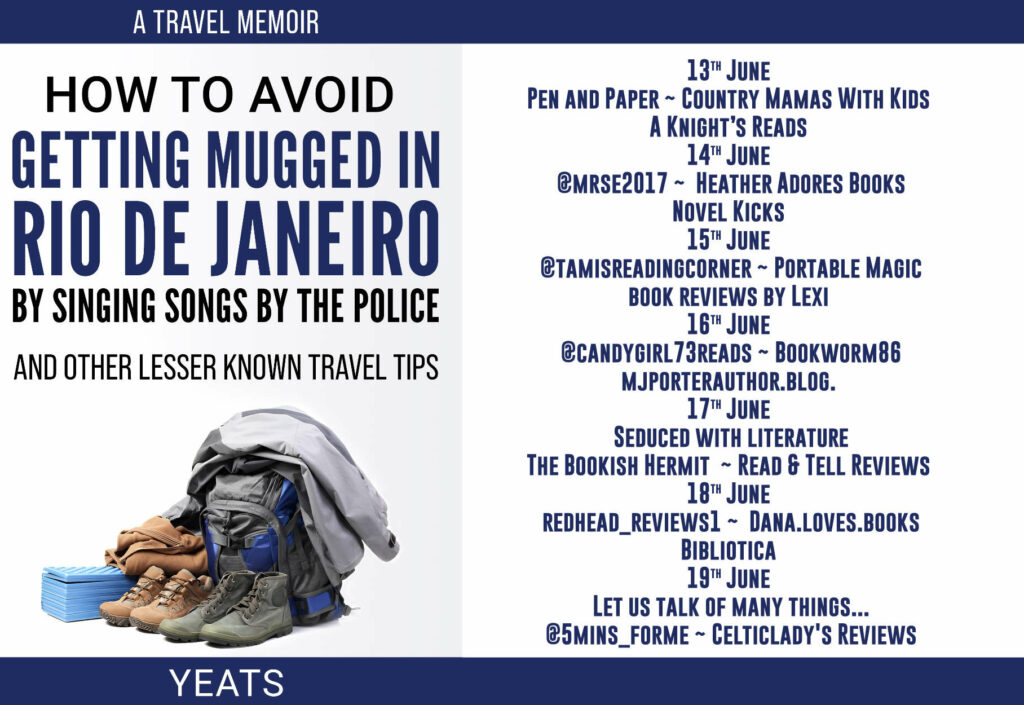
About the book, How to Avoid Getting Mugged in Rio De Janeiro by Singing Songs from the Police
and Other Lesser Known Travel Tips
Publisher : Independently published (December 2, 2023)
Language : English
Paperback : 250 pages
Australian author Simon Yeats, who from an early age learned that the best way to approach the misfortunes of this world is to laugh about it.
Simon shares his comedic insights into the unusual and uproarious elements of living life as an Aussie ex-pat and having a sense of Wanderlust as pervasive as the Bubonic Plague in the 1300s.
From what to do when several people converge to rob you after midnight on a deserted Copacabana Beach, to how to save the Sierra Mountain Range from a wildfire outbreak due to a lack of quality toilet paper, to where not to go in Tijuana when trying to locate the origins to stories of the city’s mythical adult entertainment, to how to save yourself from drowning when caught in a storm while sailing off the California coast.
Simon Yeats has gone into the world and experienced all the out of the ordinary moments for you to sit back and enjoy the experience without the need to lose an eye or damage your liver.
Simon Yeats has lived nine lives, and by all estimations, is fast running out of the number he has left. His life of globetrotting the globe was not the one he expected to lead. He grew up a quiet, shy boy teased by other kids on the playgrounds for his red hair. But he developed a keen wit and sense of humor to always see the funnier side of life.
With an overwhelming love of travel, a propensity to find trouble where there was none, and being a passionate advocate of mental health, Simon’s stories will leave a reader either rolling on the floor in tears of laughter, or breathing deeply that the adventures he has led were survived.
No author has laughed longer or cried with less restraint at the travails of life.
Read an Extract from How to Avoid Getting Mugged in Rio…
I spend my first night in the USA, in a downtown Los Angeles motel, wrapped in a wet blanket of fear, dismayed I have been dropped onto the set of a dystopian film. The land of the free and the home of always needing to defend myself with a gun. In November 1988, I was only 20. Timid and naïve, but taking life by the short and curlys, venturing to another country on my own. In a group, but by myself in that group. Everyone else on the university work exchange heads to the US that Northern Hemisphere winter/Southern Hemisphere summer with a companion. Except for one other guy in the 30 strong party, Dohers. I will get to him later. This is my coming-of-age experiment. I will have to dig deep inside me to find the character to survive three months in the US, or else I will turn tail and jump on the first plane home.
On that first night in the city of angels, a return flight was looking awfully tempting.
Our downtown motel looks like a block from Skid Row. I had never seen a homeless person before in my life. I naively thought that spending 20 minutes sitting on the sidewalk at the end of my parent’s driveway when I ran away from home qualified as having been homeless for periods of my youth. Every time I venture out to go to the nearby diner to eat, I am evading homeless people pushing shopping carts like a game of Frogger.
Making the USA my first port of call as an independent overseas traveler, after just one week-long ski trip to Thredbo on the solo, is as nerve-wracking as being asked to fill in on lead guitar for The Rolling Stones after one guitar lesson.
“Hey kid. I heard you plucking on those strings, and you’ve got potential. I need you to fill in on the opening night of The Stones’ Voodoo Lounge Tour in Springfield. Keith Richards has…”
“… Keith Richards has died?”
“Keith Richards. Dead? Fuck no. That bastard will still be kicking long after you are pushing up daisies, my friend. No, Keith wanted to be at the birth of his 76th illegitimate child, so he asked if I could find a replacement for him for the one night.”
“Wow. Do you think I am up for it?”
“Not by a long shot. But Mick Jagger will get a kick out of watching you squirm.”
On a nearly moonless night in October 1943, a single gunshot rang out in Littlefield, Texas. A prominent Texas doctor and his wife were found bound, shot, beaten, and murdered. The only witness: their five-year-old daughter, who was bound to silence and refused to speak about what happened for 70 years.
The heinous crime remains unsolved. For years, the courts tried to convict one suspect, but forensic evidence contradicted the prosecution’s case. Investigators, including the famed Texas Rangers, failed to bring anyone to justice.
Eight decades later, the questions linger over the plains of the Texas Panhandle: who killed the Hunts and why?
Author and historian Christena Stephens spent more than a decade researching the Hunt murders, re-examining every twist and turn in the legal process, uncovering new evidence, and drawing new conclusions about who might have been responsible. She also convinced Jo Ann Hunt to break 70 years of silence and tell her story for the first time. Armed with Jo Ann’s account, Stephens takes the reader back to that deadly night and through the years of trauma that followed.
Why did the criminal justice system repeatedly fail to bring anyone to justice? What could have scared a 5-year-old girl into a lifetime of silence? What did investigators miss? And most importantly, who killed Roy and Mae Hunt?
Bound in Silence is a true crime tour-de-force, a meticulously researched, impeccably told tale of unsolved murder on the High Plains.
Christena Stephens is a native Texan growing up amongst cotton fields and spending time exploring the nature of the Llano Estacado. After earning two Master of Science degrees, she started a project to preserve ahistorical Texas ranch, thus began her interest in history, research, and writing. She did not intend to be a historian but was mentored by the best Texas historians. Several of her writings have been published in anthologies, along with her photographs. In science and history, truths need to be accurately told. That is her mission-truth and authenticity. She still resides on the Llano Estacado enjoying sunsets and chance porcupine encounters. She is an ardent advocate of wildlife conservation and her heart belongs to her dogs.
Christena Stephens’s new book, Bound in Silence is where true crime, history, and creative non-fiction all meet to form a whole that is both a gripping story and a grisly one.
In this case, this book really tells two stories, the first is a murder mystery taken from the pages of Texas history: the death by shooting of a doctor (Roy Hunt) and his wife (Mae). And author Stephens takes down a well-researched and equally well-written path of whodunnit, and why, and how.
The second story is that of the Hunt’s older daughter, JoAnn, who was in the room (albeit stuffed in a closet) while her parents were being murdered. For decades, she kept silent, scared into event-specific muteness, until the author got her story.
Stephens’s narrative style is straight to the point without being dull or dry. Her photographer’s eye comes in handy – her descriptions of people and places, while taken from photos and press clippings – feel cinematic. Her choice of topic is a compelling one, because it gives a glimpse into the psychology of childhood trauma and fear, as well as into the gory events themselves.
Overall, this is a well-crafted account, and deserving of a lot of notice.
Goes well with: a whiskey flight and Texas barbecue.
Bruce and Karen Gowen are facing a retirement that neither one wants. Bruce can’t imagine life without employment. Karen wants change, adventure, a chance to spread her wings and fly away after thirty years of raising their large family.
Their opportunity comes in a way they can both helping their daughter and son-in-law with a hotel project in Panajachel, Guatemala.
Never ones to do anything halfway, the Gowens sell everything, including one of their businesses. What they can’t sell, they give away. With their worldly possessions down to two checked bags and two carry-ons each, they fly one way to Guatemala City. Then on to Panajachel, a tourist town on scenic Lake Atitlan, in the southern highlands of Guatemala.
Here they begin their new life, a time filled with incredible experiences, tough challenges, and unexpected adventure in one of the most beautiful settings on earth. A place where the Maya culture permeates the land. A land and people that will transform anyone fortunate enough to encounter the magic of these hills in Guatemala.
Born and raised in central Illinois, Karen attended Northern Illinois University in DeKalb and the University of Illinois in Champaign-Urbana. She transferred to Brigham Young University, where she met her husband Bruce, and there graduated with a degree in English and American Literature.
Karen and Bruce have lived in Utah, Illinois, California and Washington, currently residing in Panajachel, Guatemala. They are the parents of ten children. Not surprisingly, family relationships are a recurring theme in Karen’s writing.
My Thoughts

Many people – me included – fantasize about giving up everything we know and going on a mad adventure in another place. Most of us never do so, but Brian and Karen Gowen did, and their story is chronicled in We Burned Our Boats.
Part adventure-travel memoir, part personal examination, part analysis of a marriage and a life, the Gowens’ story has it all: love, fear, courageous acts, and international intrigue. Okay, maybe more like being intrigued by new customs and habits. It’s an easy read, and very vividly related. Karen’s writing makes you feel like you’re with them on their journey.
I’ve never really considered relocating to Guatemala (my fantasies typically involve Fez or Marrakech), but this book made me almost – almost – consider it.
I recommend We Burned our Boats to anyone who loves memoirs or travel, or travel-memoirs.
I’m so excited to be bringing you this spotlight. The authors have brought a personal, informational, deeply important subject to us in an accessible way. And now, it’s also available as an audiobook! Please take a look at
SECOND LIVES: The Journey of Brain-Injury Survivors and Their Healers, by Ralph B. Lilly, MD & Diane F. Kramer, with Joyce Stamp Lilly – Narrated by Loren C. Steffy & Joyce Stamp Lilly
About the book, SECOND LIVES: The Journey of Brain-Injury Survivors and Their Healers
Genre: Audiobook / Biography / Medical Professionals / Neuroscience
Publisher: Stoney Creek Publishing
Listening Length: 6 hours and 21 minutes
Publication Date: February 28, 2024
“Discharged from a hospital just means you’re not dead.” These words of Ralph B. Lilly, M.D., describe his early struggle to recover from a traumatic brain injury. Lilly was a forty-four-year-old practicing neurologist sitting on his motorcycle at a red light when a drunk driver rear-ended him in 1980. In the ICU, after regaining consciousness and being told what happened, he asked, “What’s a hospital? What’s a motorcycle?” This tragic experience transformed his life and his approach to his neurology practice: doctors treat those with brain injury; but loved ones heal them.
Second Lives: The Journey of Brain Injury Survivors and Their Healers is written by Dr. Lilly and Diane F. Kramer. After his death in 2021, Kramer completed the book with the assistance of Lilly’s wife Joyce Stamp Lilly. This memoir weaves together Ralph Lilly’s experience with a collage of stories about his patients and their healers. After his recovery, Lilly retrained in the emerging field of behavioral neurology, which focuses on behavior, memory, cognition, and emotion after brain injury.
His clinical skills and expert witness testimony were sought by physicians, survivors, families, and attorneys to secure the best “second life” for survivors. His many patients marveled at his uniquely compassionate approach: “What doctor gives you his cell number and says call any time?” Lilly’s pioneering career spanned forty years from Brown University’s Butler Psychiatric Hospital in Rhode Island to Nexus Health System and private practice in Houston, Texas. He treated ER and hospital inpatients whose loved ones were in acute quandary, as well as outpatients who’d long given up finding a doctor who knew how to help. Lilly’s memoir is full of heart, not science, and will provide insight to general readers, family, and friends of patients with brain injury, as well as those who treat them.
His narration is unintentionally poignant, often punctuated by wry humor. He generously incorporates the words of his patients and their families in telling their stories. Their gratitude for his care is profound. As one former patient said, “Without Dr. Lilly, I’d be dead or in jail.”
About the authors, Ralph B Lilly, M.D. and Diane F. Kramer
Ralph B. Lilly, MD
A neurologist for over half a century, Ralph B. Lilly, MD had a passion for learning and teaching. A traumatic brain injury in 1980 shifted his focus from general neurology to behavioral neurology, the study of how brain injury affects behavior. After completing a fellowship in neurobehavior at the University of California, Los Angeles, he served as a clinical assistant professor with the Brown University Program in Medicine in Providence, Rhode Island, consulting with psychiatrists looking for possible neurological causes for their patients’ psychiatric symptoms. In Texas, he worked joined what is now Nexus Health Systems and became a clinical assistant professor at The University of Texas in Houston. Lilly focused his life’s work on treating brain-injury survivors and counseling their families, who were victims in their own right. He saw these “healers” as instrumental in guiding the injured loved one to a “new life.” He practiced in Arizona, Rhode Island, Massachusetts, Texas, and wherever he was called to help. Before his death in 2021, Lilly lived in Washington, Texas, with his wife, Joyce, three dogs, six cats, and two horses.
Diane F. Kramer
Diane F. Kramer retired from the counseling and psychology departments of Austin Community College in 2008 and began writing personal essays, family histories, and fiction. As a volunteer with the Brenham Animal Shelter, she wrote a weekly column on animal welfare for The Brenham Banner Press. Her writing has also appeared in Alamo Bay Press anthologies and blogs Peace through Pie and Drash Pit. She currently writes website copy and press releases for Brenham Lifetime Learning and the Read of Washington County. She lives with her husband and their rescue dog and cat in rural Texas.
I recently had the chance to read the digital ARC of Dean Butler’s forthcoming book, Prairie Man: My Little House Life & Beyond. As someone who grew up watching the series (it was appointment viewing for our family) and eventually married a real Prairie Man of my own, I was excited to read this book. Thanks to Kensington Publishing Corp. and NetGalley for the opportunity.
About the book, Prairie Man: My Little House Life & Beyond
Publisher : Citadel (June 25, 2024)
Language : English
Hardcover : 288 pages
An illuminating, insider’s journey through the world of Little House on the Prairie and beyond, from Dean Butler, who starred as Almanzo Wilder, the man Laura “Half Pint” Ingalls married—on the iconic show still beloved by millions of fans as it reaches its 50th anniversary.
With a foreword from Melissa Gilbert (Laura) and Alison Arngrim (Nellie)!
Cast just before his twenty-third birthday, Dean Butler joined Little House on the Prairie halfway through its run, gaining instant celebrity and fans’ enduring affection. Ironically, when the late, great Michael Landon remarked that Little House would outlive everyone involved in making it, Butler deemed it unlikely. Yet for four decades and counting, Butler has been defined in the public eye as Almanzo Wilder—a role he views as the great gift of his life.
Butler had been cast as a romantic lead before, notably in the made-for-TV movie of Judy Blume’s Forever, opposite Stephanie Zimbalist. But Little House was, and remains, one of the most treasured shows in television history. As the eventual husband of Laura “Half-pint” Ingalls—and the man who would share actress Melissa Gilbert’s first real-life romantic kiss—Butler landed as a central figure for the show’s devoted fans.
Now, with wit and candor, Butler recounts his passage through the Prairie, sharing stories and anecdotes of the remarkable cast who were his on-screen family. But that was merely the beginning of a diverse career that includes Broadway runs and roles on two other classic shows—Moondoggie in The New Gidget and Buffy’s ne’er-do-well father, Hank, in Buffy the Vampire Slayer. Coming of age during a golden era of entertainment, Butler has evolved along with it, and today enjoys success and fulfillment as a director and producer—notably of NBC Golf’s Feherty—while remaining deeply loyal to Little House.
The warmth, heart, and decency that fans of Laura and Almanzo fell in love with on Little House echo through this uplifting memoir, a story, in Butler’s words, about “good luck, good television, and the very good—if gloriously imperfect—people who made it so.”
Dean Butler is an actor, writer, director, and producer best known to television audiences all over the world for his portrayal of Almanzo Wilder on the long‑running series Little House on the Prairie, based on the iconic Little House books written by Laura Ingalls Wilder. On the other side of the camera Dean produced 80 episodes over 10 seasons of NBC Golf Channel’s Emmy nominated series, Feherty. Dean currently lives with his family in California.
As a lifelong fan of all things Laura Ingalls Wilder (though my first loyalty is to the books), the television show Little House on the Prairie was an important part of my childhood, partly because I share a first name with two of the leads, and partly because I have fond memories of watching it with my mother. (I was born in 1970 -years before the show – so, no, I was NOT named after either of those two famous Melissas). I remember being giddy with joy when the character of Almanzo Wilder was finally added to the show, and, as I’ve shared with more than one person, I remember getting permission from my mother to do my homework in front of the TV (during commercials) so I wouldn’t miss a minute of the two-part episode where Laura and her “Manly” get married.
Needless to say, I’ve read all of the memoirs from various cast members, all women – until now – and I was excited to learn about this memoir.
I was not disappointed. Author Dean Butler is honest in the way he shares his story, and the tone is down to earth. Early in the text he mentions that a common attitude in his family is that of “modest pride,” and that really fits Butler – at least as he portrays himself here – perfectly.
If you’re expecting a salacious tell-all, this is not the book for you. Butler says himself that not all stories need to be told. So when discussing the relationship that ended in his first marriage, he withholds the woman’s name. I respect him for that. He’s not a saint. He’s made human mistakes and has human flaws. And yet, he’s one of the good guys.
A through-line of Butler’s story is that his role as an actor -and in life – is to be the guy who supports a young actress, and it’s a role he’s particularly good at. From Forever (yes, there was a movie based on Judy Blume’s infamous young adult novel), to Little House, to The New Gidget, and even to Buffy the Vampire Slayer Dean made his name as the good guy the heroine could count on. (We don’t count the nightmare version of Hank Summers – that was fiction within fiction.)
When his career turned from being in front of the cameras to being a documentarian, writing, narrating, producing, and editing, it seems as if Butler found his true niche. He’s been a champion of the real Almanzo Wilder’s story, carried the torch for the Laura Ingalls Wilder legacy, and become half the heart of contemporary Little House fandom (Alison Arngrim is the other half). He spent years producing a talk show for the Golf Channel. He comes across as a thoughtful, self-aware man who has access to an incredible platform, and uses it for good.
They say that you should never meet your heroes. Butler himself recounts more than one encounter with someone he admired that did not go well. I haven’t met him, but if this book is anything to judge by, Dean Butler is exactly the person he seems to be. If you want to read a memoir that will shock you with secrets and harsh truths, go read anything Carrie Fisher wrote – she was candid and hilarious in her writing. If you want a fairly accurate portrait of one of Hollywood’s genuine “nice guys,” especially if you’re a fan of Little House on the Prairie, you’ll find Prairie Man a satisfying read.
Goes well with: cinnamon chicken (but personally I prefer shawarma).