True Believer

by Nicholas Sparks

Jeremy Marsh is a skeptic whose had some success with the media, and when he goes to a small town in North Carolina to debunk some graveyard ghost-lights, it’s pretty clear he intends to solve the mystery and beat a hasty retreat to his home in New York. Instead he finds himself falling in love with town librarian Lexie Darnell.

As with many of Sparks’s novels, True Believer is a gentle tale with earthy three-dimensional characters that seem like people any of us might know. Character is as vital as plot with him, and that’s good, because to be honest, I found the plot of this offering to be a bit predictable. I won’t outline it here, because I don’t like to offer spoilers, I’ll just say that it’s best to read this novel because you want to visit a cozy small town and meet interesting people, and not because you’re looking for a great surprise ending or plot twist.

As a cozy novel, True Believer goes well with a rainy day and hot tea, and in that light, it’s an enjoyable read.

Forever in Blue

by Ann Brashares

The fourth and final installment in the stories of the Sisterhood was the least juvenile of a series that really is universal, and shouldn’t be ignored just because of it’s YA label. In this novel, the girls are separate more than not, and the Pants are shared throughout their first year of college, not just during the summer. While not every story ends up completely happy, each of these young women grows and changes and sets the stage for what her life will become, and it’s great to watch them all deal with real issues, that real college freshman often encounter, and triumph over their personal obstacles.

I loved this series because the girls were so real.
I wanted to hate this book because it meant saying goodbye to old friends, but the beauty of books is that you can always re-read them.

Comfort Food

Comfort Food: A Novel (IPPY Award Winner for Best Regional Fiction, West–Pacific) by Noah Ashenhurst

When I posted my list of planned reading for the 11 Decades challenge, I included Comfort Food because I liked the title, and because I like reading new authors. Imagine my surprise when the author contacted me and offered a review copy – of course I said yes.

I’m glad I did.

This novel is the story of six Gen-X college students, and the way their lives interweave. We are introduced to all of them in the initial chapter, and then each section gives us a significant moment in each of their lives, finally coming full circle to connect the first person we met to the woman he loves. Because of this structure, Comfort Food reminds me very much of the improv game “Four Square” or “Pan Left” in which there are four players who form different intersecting pairs of relationships.

What I loved most about the novel, however, was the language. Ashenhurst’s descriptions of the Pacific Northwest let you feel the misty air. Whether he’s talking about the pot-stench floating in a cheap off-campus apartment, or the visceral moment when one character realizes his wife is cheating on him, the words chosen give a vivid picture of place, and of the people existing in that place at that time.

I’d love to read more from this author.

Summers of the Sisterhood

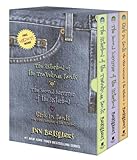
Sisterhood of the Traveling Pants / Second Summer of the Sisterhood / Girls in Pants (3 Book Set) by Ann Brashares

Despite the fact that a very kind author sent me a review copy of his book, and despite the fact that I’ve read the first fifty pages and found it gripping, having been burned to a crisp put me in the mood for light, fluffy reading.

Since I’ve seen The Sisterhood of the Traveling Pants on cable many times at this point, and even rented the dvd when it was first available, and since my friend Erin had mentioned them several weeks ago (months, really) when the fourth book had just come out, AND since YA books are less expensive than general fiction, I ordered them all.

I’m glad I did. Like J. K. Rowling’s Harry Potter series, Brashares’s novels are not all all “kiddie lit” but well-written, interesting coming-of-age novels that happen to have teenaged protagonists. The four girls who make up the Sisterhood are all three-dimensional. None of them are perfect. All of them are unique. Their stories are every bit as interesting as any more grown up chick-lit characters, and the writing is considerably less fluffy than many. Bookstores and publishers may classify these books as YA, but to me, they’re comfort reading. You know there will ultimately be a mostly-happy ending, but you also know the characters will progress, and that not everything will be sunshine and roses.

I’m a fast reader. I received these on Wednesday evening, and am now a bit more than half way through the third book. Is it too early for me to recommend them? No. Because everyone has gone through adolescence, and that makes these novels (which, at around 300 pages each, are a satisfying length) truly universal.

If you have daughters. If you are a daughter. If you are remotely in touch with your inner teen-aged girl, you must read these books.

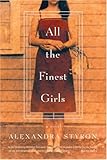
All the Finest Girls

by Alexandra Styron

I found this novel, the story of Adelaide “Addy” Abraham, to be an extremely difficult read, and as I’ve analyzed it, I’ve realized it was because I found the main character annoying. Addy is the daughter of an actress and an artist who are both too self-absorbed to have any clue of how to be parents, so they hire Lou, recently arrived from the Caribbean island of St. Clair, to be her nanny. As the novel opens, however, we are introduced to an adult Addy, a broken, sour person, who has come for Lou’s funeral.

The novel flips between Addy’s present – the funeral and her interactions with Lou’s family, who are polite, but don’t hail her as the visiting dignitary she imagined herself to be – and two different parts of Addy’s past, her adulthood including a sort of influenza-induced breakdown, and her childhood, which often found her pitting Lou and her parents against each other.

By the time a fragile, broken Addy makes peace with her even more broken parents, the novel has ended, and while the language used within it was vivid, the places realistic, and the characters plausible, I found the whole book to be…somehow missing something.

Or maybe I was missing something.

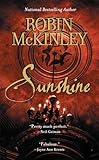
Sunshine

Sunshine by Robin McKinley

First, I don’t usually take ten days to finish a book – any book – and admittedly, I finished this a couple days ago, but it was our anniversary, and then I was jazzed from workshop so I couldn’t focus. But, it did take me longer than usual to finish Sunshine, and I’m not sure why. Something about the book lulled me into a weird moody place where I just couldn’t zip through the words the way I usually do. I think it was that Robin McKinley did such a great job of setting the scene, and letting us see the characters.

In any case, I picked up Sunshine because I couldn’t resist the notion of a vampire novel with that name, and I generally like vampire novels. This one was wonderfully rich in detail – set in an alternative present in which police forces have supernatural ops forces to guard against the Others – weres, demons, and vampires.

Lest this sound at all like the worlds of Tanya Huff, Laurell K. Hamilton, or the BuffyVerse, let me assure you that McKinley’s supernatural “now” is much grittier, much creepier, and much darker, with the backstory of Voodoo Wars and the knowledge that humanity is losing its war against the Others.

Brightening up the darkness, is Sunshine, a plucky baker and dessert pusher at the local coffee bar. She has a slightly crazy family, a tattooed bike-riding boyfriend, and a great apartment, and then she drives out to the lake cottage her family once owned, and is kidnapped – not fed upon – by vampires, and thrown into a cell with another vampire, Constantine, who is chained in the corner opposite hers.

To tell more would destroy the plot. While it does have predictable elements – Sunshine and Constantine eventually team up and escape and there are inevitable repercussions – the story never seems old or stale, and while it is complete in and of itself, it feels like the beginning of a series.

If anything, I’d have liked to see more of Constantine – he’s very present in the entire novel but doesn’t have much page count – and a little more of Sunshine and Mel.

Also, recipes for the desserts would be cool. But maybe that’s just my inner chocoholic talking.
Fool Moon

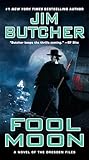
Fool Moon (The Dresden Files, Book 2) by Jim Butcher

Book Two of Jim Butcher’s fantasy/mystery series The Dresden Files mixing it up with werewolves, of which, we learn from Bob (the spirit in the skull) there are many different kinds. Butcher’s novels are designed so that readers who follow the series in order will pick up the continuing relationships between the characters, but so that they can be read as stand-alone stories as well – which is my wordy way of saying that there was enough introduction included to make sure that new readers knew who everyone was, but not so much that it felt at all repetitive.

With the eponymous television series now in its seventh week on the Sci-Fi channel (here in the States, and on Space, I think, in Canada) comparisons are inevitable, but while the feel of the series is sort of “cozy paranormal” the books retain a much more classic detective novel tone, with strong secondary characters like local crime lord John Marcone offering a surprising amount of depth and personality.

Harry, of course, is our main focus, and in this novel we see just how fragile his friendship with cop Karrin Murphy really is, and get a little bit better knowledge of his on-again off-again romance with Arcane reporter Susan.

The action and exposition nicely balance each other, and over all the story does what Jim Butcher does best: entertains, and leaves us wanting more.

Venus Envy

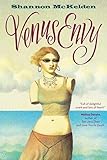
Venus Envy by Shannon McKelden

Venus may be a goddess on Mt. Olympus, but she’s been sentenced to play fairy godmother to the lovelorn until Zeus decides she’s learned whatever lesson he might intend. Rachel Greer, bank employee and frequen dater of loser men, is Venus’s latest mission – and it’s not an easy one. Rachel’s relationship history has bruised her so badly that even when a hunky firefighter is practically stalking her (in a good way, honest!) she keeps avoiding him.

McKelden’s characters are quirky and funny, and this novel is a feel-good read that reminds us what the best chick-lit is all about.

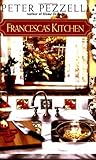
Francesca’s Kitchen

Francesca’s Kitchen by Peter Pezzelli

Francesca Campanile is a classic Italian-American widow. Her youngest child has reached adulthood and doesn’t live at home any more, and her older children have moved to opposite ends of the country and have families of their own. Needing to feel needed, she answers an ad for a single mother looking for a nanny. What she finds is a new family.

The mother, Loretta, works too many hours, and the kids, Penny and Will (one wonders if the other was a fan of <i>Lost in Space</i>, have no structure. Francesca changes that, becoming a mother figure to Loretta and a grandmother-figure to the kids. When Loretta hits it off with Francesca’s unmarried son, the family unit is cemented into one.

What could be a cheesy tale is made real by the validity of the various character’s emotions: Francesca feels old and useless, Loretta feels like a failure as a mother, etc.  That Italian food and home cooking are prevalent themes only makes the book stronger, for the kitchen is the heart of any home. And that’s what this book has plenty of: heart.

Warning: may make you crave baked ziti.

Love Walked In

Love Walked InLove Walked In

I picked up this book at the airport in Dallas on my way to San Jose a few weeks ago, because I realized I’d forgotten to pack a book to read. I ended up not reading on the flight out there at all, but then started it in the hotel later that night. By the time I was home a few days later I was finished. In any case, it was an impulsive choice – the least offensive of the airport fare – and hey, the main character, Cornelia Brown, was the owner of a cafe. I like cafe stories.

As it turns out,  Marisa de los Santos’s novel is really two stories – there’s old-movie loving Cornelia’s search for romantic bliss, and then there’s the parallel tale of precocious young Clare, daughter of Cornelia’s new boyfriend Martin, who is looking for emotional stability and a sense of home.

Naturally both stories merge, but with a twist that makes this more than just chick-lit, and closer to general romance, though not in the Silhouette sense of the word.  It’s a gentle tale with vivid characters. Great for bathtub reading.