Star Trek: Exodus by Josepha Sherman & Susan Schwartz

Star Trek Exodus
Star Trek: Exodus Book One of the Vulcan’s Soul trilogy
by Josepha Sherman & Susan Schwartz
Get it from Amazon.

Fans of Star Trek have always wondered exactly what it was like when a significant number of Vulcans packed up their belongings like so much Delsey luggage, and moved away to eventually become Romulans. In this trilogy, we find out.

It’s a story that runs in two timelines at once. The first takes place in the days of Surak, and shows us the acts that led up to and caused the Sundering, and the second shows us Spock, Saavik, Uhura, and Chekov rushing off with cooperation from modern Romulans to face down a little known enemy called the Watraii, who are as obscure as they are dangerous.

Both story lines have a mix of action sequences and character sections, which allow us not only to catch up the the characters we know, but also grow to like the original characters we meet.

A further review will be posted when I finish reading the trilogy.

Goes well with peanut butter and jelly sandwiches, and ice cold milk.

V: the Second Generation by Kenneth Johnson

By: Kenneth Johnson
Published by: Tor
Publication date: February, 2008

I was twelve or thirteen when the original V miniseries was broadcast, and a bit older when V: the Final Battle came out. At first, I wasn’t interested, but my step-brother got me into the show, and, because I gravitated toward underdogs even then, I’ll confess that I had a bit of a crush on Willie (played by Robert Englund). This was before I’d seen A Nightmare on Elm Street, of course.

When we were at the bookstore the other night, looking for a diet book I eventually chose not to purchase, Fuzzy’s eye was caught by the trade paperback version of V: the Second Generation, and knowing that I like the series, and have ALL the tie-in books upstairs in a box, he grabbed it for me.

I read it on Friday night.

I have been sort of following news of Kenneth Johnson’s career (also I was in high school with his niece), so I knew he had dropped out of being involved with the second miniseries, and had refused to be part of the short-lived weekly series, and that this book would ret-con most of that.

I was expecting it to be awful.

It was actually a pretty good story. In this version, which picks up twenty years after the original mini-series, which ended with Juliet Parrish and Elias sending a message in the general vicinity of enemies of the alien Visitors, the reptiles are controlling most of earth, 50% of the water has been taken into their mother ships (there’s a five-page description of the Pacific Desert and an image of the Golden Gate Bridge stretching across dry sand), scientists, called Scis, are living in ghettos reminiscent of the Jewish ghettos from Nazi Germany, and the Resistance is nearly dead.

As well, there are a bunch of alien-human hybrid children (all under the age of twenty), referred to as Dregs, who are caught between the human and alien cultures.

We are introduced to several new characters – Ruby, a hybrid 12-year-old adopted by Julie, Nathan, a member of the Visitor Friends (now called Teammates) youth group who was befriended by a fifth columnist, Jon, a brilliant hybrid living on the mother ship and working as a janitor, and Ted, the troubled teenaged son of Willy (which is how Johnson consistently spells Willie’s name, and which drove me nuts) and Harmony (the caterer/waitress from the movie).

Old characters are back as well, Julie, Robert Maxwell (but not his daughters), Willy and Harmony (who didn’t die, because Johnson ignores the second movie), and Martin (again, not dead) the fifth columnist. Mike is presumed dead.

And then there are the Zedti, an alien race who got the transmission and came to help…sort of.

If the novel felt more like a padded film script, well, it’s no secret that Johnson, who was the creative mind behind not only V, but also The Bionic Woman (the original), The Incredible Hulk, and Alien Nation is a great television writer, but not a novelist.

Still, with politics preventing SciFi from working with Warner Brothers to produce a movie version of this story, the book is better than nothing, and was a fun read that kept me occupied for an evening.

Also, there are some great Easter eggs in the text, such as Willy giving Jon a copy of Tenctonese Biogeometrics (the Tenctonese are the aliens in Alien Nation.

Goes well with: 80’s pop hits and a peanut butter sandwich.

Prep by Curtis Sittenfeld

Prep
by Curtis Sittenfeld
published by Random House
published in 2005

~~~
In Prep I was expecting a posh boarding school story where the rich-bitch characters bragged about hotel deals in exotic foreign countries and wore designer clothes to class.

Instead, I got the story of one Lee Fiora, a young girl from Indiana who decides that boarding school sounds like a romantic sort of thing, applies to several, gets a scholarship, and is then obligated to go. We follow Lee through her four years of school at Ault, meet her roommates, glimpse her classes, but just as Lee never really connects with anyone there (largely through her own choosing), I felt that we never quite connected with Lee.

I was somewhat of a loner in high school as well, and stories of individuals who are gloomy are not always the most appealing things to read, but unlike Lee, I was never bitter, and while I’d never care to go BACK, my high school experience was mostly positive. That being said, I confess to finding boarding schools romantic when I was thirteen or fourteen and I wonder if I’d have ended up as dark and depressed as Lee had I gone to them.

Somehow, I suspect not.

Nevertheless Prep was an interesting read, if only from the standpoint of Lee’s life being compelling in the same way in which a train wreck is.

Goes well with a stiff drink.

The Jane Austen Book Club by Karen Joy Fowler

There had been a lot of hype about The Jane Austen Book Club and I knew it was supposed to take place “in a California river town” but it was pretty clearly referring to Sacramento. I spent many of my teen years in Modesto, Fresno, Stockton and Sacramento, so it was sort of like homecoming to read a novel set in those environs.

The book itself is the story of five women and one man who read and discuss each of Austen’s works. I have to confess that I never appreciated Austen when I was required to read it in high school, but I’m considering renewing my acquaintance with her on the basis of this book, which was a funny, sad, sweet, and very realistic portrayal of real women in many stages of life. As the lone man, Grigg served mostly as contrast.

This book is not one that requires home theater sconces and dramatic music, and is better read sitting on a sunny porch with a glass of iced tea.

The movie that was adapted from it happened to be next on my Blockbuster queue, so I watched the movie almost immediately after finishing the book, and I was not disappointed by either.

Good read.

Queen of the Tambourine

by Jane Gardam

It was the title of this book that hooked me. I envisioned a tale about a street gypsy with pretty skirts and musical talent shaking her tambourine in a band, and having delightful love affairs with men who were ever-so-slightly disreputable.

Instead, I got a story about a woman who had been through a hysterectomy thirty years before, and still hadn’t gotten over it. If people who exhibited cerebral palsy symptoms gave up as easily as this woman did, there would be no triumphant stories, and that comedienne from The Facts of Life would never have had a career.

But I digress. Eliza is clearly mentally unstable, but we don’t really see how far gone she is because this is an epistolary novel – a series of letters all sent to a woman named Joan who may or may not be a real person. She’s always been a little odd, apparently, but now that her Diplomatic Service husband has left her, no longer able to put up with her idiosyncrasies, whatever was holding her together has cracked.

Through the letters we meet a woman who has no children, no friends, no real life outside of her husband, and while I also don’t have children, It was difficult for me to empathize with Eliza, who appeared, more than anything, to need a really good shaking.

There are the requisite revelations of the secret horrors of her life, of course, made to strangers rather than to friends, but I find myself a bit empty after finishing this book. It was well written, well crafted. I just couldn’t relate.

A Lick of Frost

by Laurell K. Hamilton

If sex really does assist in weight loss, Merry Gentry is probably the healthiest, fittest faerie princess in creation, but in her most recent appearance, sex takes a back seat to…lawyers.

Yes, it’s true, the most recent offering in the Merry Gentry series not only has a plot, but there’s so little sex it can’t rightfully be termed faerie porn, though there’s still a lot of commenting on the beauty of her posse of gorgeous preternatural men.

The plot, by the way, involves Merry’s uncle, Kind of the Seelie Court, pressing charges against one of her men for the alleged rape of one of the women in his court. The legal conference takes up the first quarter of the book, and then we move into the political machinations of the UnSeelie vs. Seelie leadership.

If this sounds like a really flippant review, let me just say, I loved this book. The character death at the end made me cry, and there were so many plot twists, including answers to some lingering questions, that despite the tears I came away from the book feeling really satisfied.

The problem is, there’s no way I can say any more than this without spoiling everything.

If the last book in this series was PWP, this one completely made up for it.

Read with a box of tissues close by.

Amy and Isabelle


by Elizabeth Strout

Continuing the recent trend of reading books about mother-daughter relationships, I picked up Amy and Isabelle because I liked the cadence of the title, and found myself in a slow novel, not in the plodding sense of the word, but in the sense that this was a story of gradual emergence.

The book opens on a hot summer day in an office where there is no air conditioning, and while the period is never specified, the mention of typewriters and and lack of computers, or even any specific office supply other than such things as legal pads and Papermate pens puts us in the late sixties to early seventies.

We are introduced to both characters, Amy, the teenaged daughter of single mother Isabelle, within the first few pages, and while the rest of the novel does peel away their layers – Isabelle was raped by a family friend, never married, and has an unrequited crush on the boss, while Amy is discovering sex and lust and is openly attracted to her substitute math teacher – I never got past the feeling of wanting the story to really BEGIN.

It’s a slow tale, of people who live slow, quiet lives, and while the details are impeccable, I was left unsatisfied. Some undefinable “something’ is missing from Strout’s work.

Full of Grace

by Dorothea Benton Frank

Maria is the daughter of an Italian American couple who relocated to South Carolina to live out their golden years. She lives in a townhouse in Charleston with her neurosurgeon lover Michael, whom her parents refuse to acknowledge because not only are Maria and Michael not married, but he’s also an athiest, as well as not Italian, but Irish.

While many would classify Ms. Frank’s work, including this one, as being somewhat akin to the series romances that came with advertisements to win diamond pendants with your purchase of six volumes – cute pendants mind you, but still – she is more in the Nora Roberts and Anne Rivers Siddons category of fiction – not quite chick-lit, not quite general literature, but definitely elevated above the 200-page formula romance.

In this novel, Frank proves she can write comedy as well as romance, because we get a rollicking family farce involving Catholic dogma, hard science, and endless trays of lasagna, all served up with a southern flair.

I bought this on the $4.98 table the weekend I returned from Mexico, because I knew it would be a good “comfort novel.” I was not wrong.

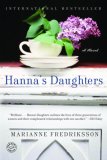
Hanna’s Daughters

by Marianne Fredriksson

Hanna, Johanna, and Anna – three generations of Swedish women, grandmother, mother, daughter. This novel by Marianne Fredriksson was an impulse buy – I’d just come home from ten days with my mother, and missed the mother-daughter dynamic. I expected something light and fluffy, instead, I got to read the histories of three fictional women, and about how their social inheritance of manners and gender roles informed their lives and choices.

Anna’s story really bookends the other two, for the novel is her interpretation, first as a thesis then as a novel, of the women who raised her, but taken as a whole, it’s a fascinating look at how in some fashion we are all our mother’s daughters, even when we don’t wish to be.

The first third of the novel was difficult to read, both because of the content (there’s a rape of a very young girl) and because the grammar reflects the uneducated way of speaking Hanna had, with funky verb tenses. Until I got to the next section, I was almost convinced that this was just a really bad translation, but it was done for effect.

I wouldn’t recommend this as a light reading, but if you’re in the mood for a respite from dealing with small business phone systems and endless faxes, and want to really explore generational culture…this book is a great addition to the pile.

Sex, Murder and a Double Latte

by Kyra Davis

San Francisco mystery novelist Sophie Katz, half Jewish, half African American, drinks chocolate brownie frappucinos as if they were nutritional supplements and talks to her cat as if he’s a person. In this, the first book about her and author Kyra Davis’s first novel to be published, she also finds life imitating art, as she ends up trying, with her friends (one of whom owns a sex toy store, the other of whom is her gay hair stylist), to solve a murder that seems as if it’s ripped out of the pages of her last novel.

Along the way, she also has to deal with her mother, her sister and young nephew, and the fact that her prime suspect for the murder is also the man who stole her newspaper at Starbucks, and whom she’s dating…sort of.

Davis’s writing is fresh and funny, and manages to blend chick-lit with the mystery genre, her characters are interesting, and her plot works. A good mixture of froth, foam, and fear.