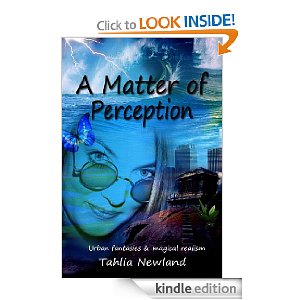
A Matter of Perception, by Tahlia Newland

A Matter of Perception

When Tahlia Newland, an on-and-off blog-buddy of mine, asked me to read and review her collection of magical realism/urban fantasy short stories, there was no way I could refuse, but the truth is I’d have read this collection of six tales no matter who the author was.

Taken together, these stories are a collection of different ways to perceive fantasy, and to use fantasy to perceive reality. The collection feels like a complete suite – all moods and tastes are well represented. Taken separately, well, let’s do that, shall we?

The Drorgon Slayer’s Choice
An unnamed photographer’s assistant sees an interdimensional monster, and is rescued by a god, though she does some rescuing of her own. It’s a great blend of action, romance, and philosophy. This was my favorite of the collection, and not just because it’s the longest or most developed. I really wanted to know what happens next

The Bone Yard
This one is the darkest in the series, in terms of mood. It involves a woman in a desperate situation being helped by supernatural beings, though the twist at the end is rather grisly. A balance of classic horror and modern terror.

Mistril’s Mistake
With great power comes great responsibility, even when you’re a wizard. The colored light battle had me imagining light sabers (but only a little), but the story about taking ownership of your actions is actually very good. More, please?

A Hole in the Pavement
What if our emotional troughs became literal holes that we fell into? That’s the premise of this story, and Newland envisions it beautifully. It was delicate and delicious.

Not me, it can’t be
Mind blowing: alternate points of view between a modern woman undergoing chemo and an ancient (fantasy?) world woman about to become a ritual sacrifice – and each are apparently dreaming of the other in a fabulous riff on the old “Am I a man dreaming I am a butterfly, or a butterfly dreaming I am a man” conundrum. I was teary at the end.

Rose Coloured Glasses
Easily the lightest tale in the sextet, this story is about an office worker named Sally who discovers a new perspective on her colleagues (and a possible new romance) thanks to a very special pair of glasses. Haven’t we all wished for these at some point?

I believe that any fan of fantasy, magical realism, or just a really gripping tale, will find this collection of stories compelling and entertaining, but what really puts the cherry on top is Newland’s explanation of the themes, included at the back of the book. Excellent book group fodder, but perfect for a plane trip, as well.

Goes well with hot chocolate and a brownie.

This book is available for Amazon Kindle. Buy this book from Amazon.com >>
Star Trek Fiction Roundup

During October, when I wasn’t reading mysteries, I was reading Star Trek novels, because they’re quick and fun, and after writing all day I don’t always have enough brain power to read in unfamiliar worlds. Besides, just because something is a tv-tie-in doesn’t make it bad writing. The Pocket Books Star Trek fiction has let beloved characters expand beyond the limits of episodic television in wonderful and surprising ways.

So which ones did I read in October, 2011?

Some Assembly Required

I finished Some Assembly Required, the 3rd Starfleet Corps of Engineers Omnibus, which was, as always, really interesting. The SCE books were all ebooks originally, and reading them in clumps of a few seems to work incredibly well. I was a little concerned, when I first began to explore the series, that I wouldn’t like a tie-in that only had one (really) canon character, but these new additions to the Trekiverse are as three-dimensional as any that have ever graced our screens.

Maximum Warp: Book One

I also read Maximum Warp books one and two, which take place between First Contact and Nemesis, and involve dead zones in space, an uneasy trade agreement with the Romulans, and the return of Ambassador Spock. The dead zones are a great invention, as they create jeopardy without having to leave the ship, and have no real target. What was eerie was watching them affect Data, and seeing him described as “weak” and “tired” – words not usually associated with an android character.

Maximum Warp: Book Two

Book one, by necessity had a lot of the exposition, and setup, while book two had more of the political intrigue and action, but the pair of them kept me interested for two or three days (I read them during the work week, so it took me longer), and I was happy with my latest escape to the future.

These all go well with tomato soup and grilled cheese, or a toasted bagel and clam chowder.

Review: The Shakespeare Manuscript

The Shakespeare Manuscript

The Shakespeare Manuscript
Stewart Buettner

Product Description (from Amazon.com):
Not one of Shakespeare’s plays exists in manuscript form until a failing bookseller discovers a long-lost, early version of HAMLET. In an attempt to trace the puzzling manuscript’s origins, its new owner finds he can’t trust the identity of play’s author and soon has doubts about his own. But by then, the race to stage the new HAMLET is on, taking a toll on everyone involved. In the end, the new play leaves audience and actors alike wondering about the unexpected and moving consequences of the play they’ve just experienced.

Review:

This was my last book for the 2011 RIP Challenge, but I’ve been so busy that I’m a week (or more) behind in getting the review loaded. I FINISHED reading it on October 27th, however, so it still counts.

This was part soft mystery part contemporary fiction. We have a dynamic playboy director, an agoraphobic actress, the actresses gay rare bookseller father who seems to be suffering from dementia, a politician and his family, and a remote country house. All of the ingredients, I thought, for “Deathtrap” with “Hamlet.”

It was no “Deathtrap.”

But it was a lovely story about relationships, finding your place in the world (again), and being true to yourself. It was also an exploration of Shakespeare’s Hamlet, who really wrote it, and whether or not the script found in the novel is really an early version of the script, a prequel, or a hoax.

The characters felt like they could have been real, for the most part, and I liked that the author didn’t give us a real answer to who wrote the script…there are several possible solutions to that mystery.

Goes well with a mug of strong coffee and a slice of peach pie.

The Shakespeare Manuscript
Stewart Buettner
Performance Arts Press, April 2011
278 Pages
Buy this book from Amazon.com >>
Readers Imbibing Peril (art by Melissa Nucera)

Review: Pirate King

Pirate King

Pirate King
Laurie R. King

Description (from Amazon.com):
In this latest adventure featuring the intrepid Mary Russell and her husband, Sherlock Holmes, New York Times bestselling author Laurie R. King takes readers into the frenetic world of silent films—where the pirates are real and the shooting isn’t all done with cameras.

In England’s young silent-film industry, the megalomaniacal Randolph Fflytte is king. Nevertheless, at the request of Scotland Yard, Mary Russell is dispatched to investigate rumors of criminal activities that swirl around Fflytte’s popular movie studio. So Russell is traveling undercover to Portugal, along with the film crew that is gearing up to shoot a cinematic extravaganza, Pirate King. Based on Gilbert and Sullivan’s The Pirates of Penzance, the project will either set the standard for moviemaking for a generation . . . or sink a boatload of careers.

Nothing seems amiss until the enormous company starts rehearsals in Lisbon, where the thirteen blond-haired, blue-eyed actresses whom Mary is bemusedly chaperoning meet the swarm of real buccaneers Fflytte has recruited to provide authenticity. But when the crew embarks for Morocco and the actual filming, Russell feels a building storm of trouble: a derelict boat, a film crew with secrets, ominous currents between the pirates, decks awash with budding romance—and now the pirates are ignoring Fflytte and answering only to their dangerous outlaw leader. Plus, there’s a spy on board. Where can Sherlock Holmes be? As movie make-believe becomes true terror, Russell and Holmes themselves may experience a final fadeout.

Pirate King is a Laurie King treasure chest—thrilling, intelligent, romantic, a swiftly unreeling masterpiece of suspense.

Review:
I’ve been a fan of Laurie R. King’s Holmes and Russell series since it began, so you know I was eagerly awaiting Pirate King. I bought when it came out, but saved it to savor in October, because mysteries are better when the weather begins to turn cool.

I’m also a fan of Gilbert and Sullivan’s The Pirates of Penzance, and it’s cheesy musical social satire, so the fact that Ms. King combined the two in this latest novel (which, admittedly, has much more Russell than Holmes in the first half of the story) made me deliriously happy.

I loved seeing Pirates through Mary Russell’s turn-of-the-century feminist eyes. I loved the way King had a movie about a movie about a play as the center of the novel – a preposterous situation – without it seeming preposterous. I even loved that much of the action took place in Morocco, a place that keeps haunting me in the books I read, and a place I’ve always wanted to visit.

Is there anything I didn’t love? I (still) wish we got to see more of Holmes and Russell having down time, to see the reality of their relationship. I felt there wasn’t quite enough Holmes in this entry into the series, and that when he does show up it’s a little anti-climactic.

Overall, however, I’m still a fan, although I was reading this during the same period of time that I was doing my annual re-watching of The West Wing, and I think Aaron Sorkin’s love of Gilbert and Sullivan might have colored my response to this novel, just a bit.

Pirate King
Laurie R. King
Bantam, September, 2011
320 pages
Buy the book from Amazon.com >>

Readers Imbibing Peril (art by Melissa Nucera)

Mini-Review: Lassiter

Readers Imbibing Peril (art by Melissa Nucera)

Lassiter
Paul Levine

This is a mini-review, because the real one will be over at All Things Girl later this month, but I just finished reading Lassiter, which is one of my entries for RIP. It’s a little more violent than I usually like in a mystery, but really a compelling read, an old-school detective novel, in a decidedly modern setting.

I’ve got to go back and read all the first books in this series…because Lassiter (the character) is awesome.

Lassiter

Lassiter
Paul Levine
Bantam, September 2011
304 pages
Buy the book from Amazon.com >>

The Sunday Salon: Monster Mash?

Illustration from Mary Shelley's Frankenstein

When we think of monsters – not monstrous people or monstrous acts – but Hollywood-style monsters, two of the first that come to mine have to be Frankenstein and Dracula.

Two years ago, as part of an English/Literature tutorial for a friend’s son, we studied Bram Stoker’s Dracula, and noted the differences in the way the character was written and the way he’s appeared since. For example: Dracula can walk about during the day, but his powers are limited to that of an ordinary person; his powers include the ability to take the forms of bat or wolf, fog, or elemental dust.

Then, too, there’s the ending – or rather, the ending of the Count, not quite the ending of the novel:

By this time the gypsies, seeing themselves covered by the Winchesters, and at the mercy of Lord Godalming and Dr. Seward, had given in and made no further resistance. The sun was almost down on the mountain tops, and the shadows of the whole group fell upon the snow. I saw the Count lying within the box upon the earth, some of which the rude falling from the cart had scattered over him. He was deathly pale, just like a waxen image, and the red eyes glared with the horrible vindictive look which I knew so well.

As I looked, the eyes saw the sinking sun, and the look of hate in them turned to triumph.

But, on the instant, came the sweep and flash of Jonathan’s great knife. I shrieked as I saw it shear through the throat. Whilst at the same moment Mr. Morris’s bowie knife plunged into the heart.

It was like a miracle, but before our very eyes, and almost in the drawing of a breath, the whole body crumbled into dust and passed from our sight.

I shall be glad as long as I live that even in that moment of final dissolution, there was in the face a look of peace, such as I never could have imagined might have rested there.

The Castle of Dracula now stood out against the red sky, and every stone of its broken battlements was articulated against the light of the setting sun.

More than one more modern author, among them Fred Saberhagen, has looked at this death scene, and noted that since 1) You can’t kill a vampire with a knife, and 2) Dracula crumbled into dust, he was not actually killed at the end of the novel. A novel, which by the way, he appears on only 58 pages of. The rest of the 200+ pages are spent talking about him, his powers, his deeds, and everyone else’s life. Like the shark in Jaws, Dracula-the-character is scariest when we don’t actually see him.

But Dracula was a past project.

For the last month, I’ve been reading mysteries, partly because I love them, but partly because it’s autumn, and I think mysteries go well with lengthening shadows and crisper evenings, but the book I began this morning takes me back into classic monster fare.

It’s Mary Shelley’s Frankenstein, which, I’m almost embarrassed to admit, I’ve never actually read. I remember seeing Boris Karloff as the Monster in the old movie, and being chilled at the scene with the little girl, the Monster, and the flower. I remember reading riffs on Frankenstein, and of course I know that Rocky Horror for all its silliness is still derivative of Shelley’s work.

So as the nights lengthen further, the weather grows cooler even where I live, in Texas, and the shadows turn into puppet creatures beckoning us to explore the dark and deep parts of our psyches, I’m about to take a break from conventional mysteries and thrillers, leave the comfort of cozy novels, and begin reading Frankenstein.

The Sunday Salon.com

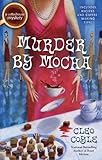
Review: Murder by Mocha

Readers Imbibing Peril (art by Melissa Nucera)

Murder by Mocha
Cleo Coyle

Description (from Amazon.com):
The national bestselling author of Roast Mortem serves readers a fresh new Coffeehouse Mystery.

Includes chocolate recipes!

A divorced, single mom in her forties, Clare Cosi is a coffee shop manager by day, an irrepressible snoop by night. When something is wrong, she considers it her mission in life to right it, and murder is as wrong as it gets.

Can coffee enhance your love life? Clare’s Village Blend coffee beans are being used to create a new java love potion: a Mocha Magic Coffee that’s laced with an herbal aphrodisiac. The product, expected to rake in millions, will be sold exclusively on Aphrodite’s Village, one of the most popular online communities for women. But at the product’s launch party, one of the website’s editors is murdered. Clare is convinced someone wants control of the coffee’s secret formula and is willing to kill to get it. Can she stir up evidence against this bitter killer? Or will she be next on the hit list?

Murder by Mocha

Review
I’m not entirely sure what prompted me to start reading Cleo Coyle’s Coffeehouse Mysteries, but I fell in love with her work pretty much instantly. Why wouldn’t I? I’ve been a barista, and I am a coffee snob.

In the most recent addition to this series, Clare Cosi is getting more and more serious with her police detective boyfriend Mike Quinn, and there are two separate murder cases. One’s Clare’s baby, and involves the company funding Mocha Magic, the chocolatey coffee aphrodisiac for which her beans are being used. The other’s a cold case that involves Mike’s colleague (and Clare’s daughter’s lover) Franco.

As always the dialogue is snappy, the descriptions of place feel three dimensional, and the plot is gripping without being too bloody or too silly. It was nice to see Clare’s ex in a helpful role this time, and I get a big kick out of her (former) mother-in-law, as well as the staff of the Village Blend Coffeehouse.

Cosi’s books are always a great way to fall into a season of Autumn mystery reading, and this one marks my first official entry in the 2011 R.I.P. celebration of dark literature.

Goes well with: a salted caramel mocha.

Murder by Mocha
Cleo Coyle
Berkeley, August 2011
384 pages
Buy this book from Amazon.com >>

Sunday Salon: Re-discovery

The Sunday Salon.com

Have you ever bought or borrowed a book, either because it looked interesting, or because a friend recommended it, and then found that you’ve actually read it before?

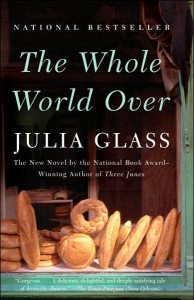
That happened to me recently. I was exchanging emails and blog comments with my friend Becca, because I’d mentioned that one of my favorite books to re-read was Bread Alone. She suggested I might like The Whole World Over, by Julia Glass. Later that weekend, I bought a copy at the local used bookstore, in hardcover, for under $5.

That evening in the bubble bath, I cracked open the book, only to find the opening pages eerily familiar. Sure, there’d been a sense of deja vu when I’d looked at the cover in the store, but I’d just assumed I’d seen similar cover art. Nevertheless, I began reading the book anew.

And the thing is, I don’t mind this sort of rediscovery. I remember that I’d enjoyed the book the first time I’d read it, but I read very quickly, so there are times when, depending on my mood in the moment, certain things catch my attention differently. Example: When I was little, and read Little Women for the first time, the part that I cried through was when Beth died. When I read it again as a young adult, who’d had some experience with love and relationships, I was moved by the scene where Jo refuses Laurie, because on one level, we want these two brash kids to be together, but anyone who’s had a best friend of the opposite gender knows that those relationships never work when they cross into romance.

The Whole World Over, then, is going to remain my “bathtub book” for the next couple of weeks. I know the story well enough that I don’t need to race through it to see what happens, but that doesn’t mean I won’t appreciate a slow, savoring read of it while I soak in lavender-scented bath bubbles.

What about you? Do you ever “re-discover” a book? Do you embrace the situation, or feel cheated out of a new story?

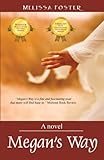
Review: Megan’s Way, by Melissa Foster

Megan's Way by Melissa Foster

Megan’s Way
Melissa Foster

Description (from Amazon.com):

What would you give up for the people you love?

When Megan Taylor, a single mother and artist, receives the shocking news that her cancer has returned, she’ll be faced with the most difficult decision she’s ever had to make. She’ll endure an emotional journey, questioning her own moral and ethical values, and the decisions she’d made long ago. The love she has for her daughter, Olivia, and her closest friends, will be stretched and frayed.

Meanwhile, fourteen-year-old Olivia’s world is falling apart right before her eyes, and there’s nothing she can do about it. She finds herself acting in ways she cannot even begin to understand. When her internal struggles turn to dangerous behavior, her life will hang in the balance.

Megan’s closest friends are caught in a tangled web of deceit. Each must figure out how, and if, they can expose their secrets, or forever be haunted by their pasts.

Review:
I was introduced to Megan’s Way when it was included in a daily mailing of free kindle books. Some of those free offerings are fabulous, some not so much, but this one is definitely in the first category. It’s warm, human, and really well constructed. The characters sing. Their environments feel three-dimensional. Had I actually paid full price for this, I would be equally happy with the purchase.

At the heart of this book is a mother-daughter relationship, between the title character Megan and her teenaged daughter Olivia that hits all the right notes to feel real, even though a sense of magical realism is overlaid upon the entire story. This woman and this girl are completely believable – Megan, the free-spirited artist who embodies the concept of “spiritual, but not particularly religious” and Olivia, the girl who hasn’t quite come out of her shell, and who is as much a friend as she is a daughter to Megan. Their relationship reminded me very much of my own relationship with MY mother, who remains my closest confidante even now.

But vignettes of mother-daughter moments do not a novel make. Foster has crafted a lovely story of friendship, intrigue, love, and truth in Megan’s Way. Megan’s best friend Holly, who gave birth to a baby we’re told didn’t make it, at the same time that Olivia was being born, finds herself unable to have children at the same time that Megan’s cancer returns, and it is their intertwining stories that balance the sweetness of the mother-daughter scenes.

The men in this novel aren’t given as much page-time, but their presence is felt, even so. This book won an award for being a beach book, and I can’t help but notice that Holly’s husband Jack (a long-time friend of both women) and their other friend Peter both live on the page in ways that the men in Elin Hilderbrand’s (probably the queen of beach reading) books never do. These are real men, with distinct emotions and opinions.

Yes, there is a fair amount of drama, yes there is emotional intrigue lacing the book, but there’s nothing soap-opera about the story. Instead, Foster has painted a picture of a plausible family-by-choice, made more vivid by hidden truths, human imperfections, everyday magic, and tons of love.

Goes well with: a strong cup of tea, and New England clam chowder, with oyster crackers.

Megan’s Way
Melissa Foster
304 pages, Outskirts Press, July, 2009
Buy this book at Amazon.com

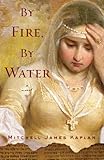
Review: By Fire, By Water, by Mitchell James Kaplan

By Fire, By Water

By Fire, By Water
Mitchell James Kaplan

Description (from Publishers Weekly, via Amazon.com):
Kaplan, a screenwriter, sets his debut novel in 15-century Spain, amid the Inquisition, the attempt to unify the kingdoms of Spain under Christian rule, and the voyage of Christopher Columbus to what the seaman expects will be the Indies. The action centers on the historical figure of Luis de Santángel, chancellor to the king of Aragon and a converso, a Jewish convert to Christianity at a time when the Inquisition sought to repress judaizing. Santángel is friend and financier of Columbus, surviving parent of young Gabriel, and more curious than is prudent about his Jewish heritage. While he learns about Judaism in clandestine meetings, a parallel story unfolds, centering on Judith Migdal, a beautiful Jewish woman who learns to become a silversmith in Granada, located in the last part of Spain under Muslim rule. Santángel’s attraction to Judith grows, even as the Inquisition closes in and the prospect of another world to the West tantalizes. Kaplan has done remarkable homework on the period and crafted a convincing and complex figure in Santángel in what is a naturally cinematic narrative and a fine debut.

Review:
When the author of By Fire, By Water, Mitchell James Kaplan, contacted me about reviewing his amazing novel set at the dawn of the Spanish Inquisition, I said yes, even though period novels really aren’t my thing, because the story intrigued me. I started reading it immediately, and loved it. I hadn’t planned for my life to go into a tailspin before I could write the review.

Still, this story, which is part history, part social commentary, and part romance, has stuck with me. It’s about religion and faith, and how they differ, and how they’re similar, but it’s also about wealth and politics and passion. The love story between Judith and Luis is poignant, but written with a lot of truth.

Maybe it’s Kaplan’s background as a screenwriter, but this book sings it’s vividness to the world. Reading it, I had such strong senses of place and time – I could see it as a movie in my head. (I could totally see this film as a Merchant Ivory production.)

This review is vague and disjointed not because I didn’t love the story – because I did. If all historical novels were this interesting and well crafted, and relevant to modern times, I’d read more of them. It’s just that I read it very quickly several months ago, and the details have blurred.

I do remember thinking, however, that if this book were a movie, the after-the-credits cookie would be a time jump to modern times and a connection to the Hidden Jews of New Mexico, or some such.

Anyway, buy this book. It’s brilliant. Epic, even.

By Fire, By Water
Mitchell James Kaplan
320 pages, Other Press, May 2010
Buy this book from Amazon.com >>