Review: Hoodoo Sea by Rolf Hitzer

Hoodoo Sea
Hoodoo Sea
by Rolf Hitzer
Get it from Amazon.com >>

There’s something really exciting about reading an author’s first work, so when I was offered the opportunity to review Rolf Hitzer’s debut novel, Hoodoo Sea, I jumped at the chance. After all, I like a good action-adventure novel, and coming home from a vacation that involved climbing lighthouses and hanging out at murky cold beaches put me in just the right frame of mind for such a work.

In Hoodoo Sea, Hitzer introduces us to Scott Reed, a NASA wing commander chosen to command the test mission of the first speed-of-light craft. Oh, and Reed, like the author, is Canadian.

Reed and his three teammates take off with no issue, and immediately head for that part of the ocean known as “Hoodoo Sea” by navy types, and “the Bermuda triangle” by the rest of us. Their craft is surrounded by a dense fog, instruments go wonky, and there are flashes of bright light. Finally, they land, but on an Island populated by hunter-gatherer types and giant wolves with flashlight-bright eyes. This is where their adventure really begins.

Part action-adventure, part survival tale, and part paranormal thriller, Hoodoo Sea is a compelling read, with strong characters and just enough detail to allow the reader to visualize the scene without feeling like it’s overkill.

I liked that the mission team included a woman, and that the American vs. Canadian bickering was realistic without overpowering the plot. I enjoyed the descriptions of the native population, including Tribefeeder Henpo, and the hints that the wolves might not be wolves.

I confess, that when my stepfather, who peeked at the book before I could, pointed out that author Hitzer is from Winnipeg, just like his main character, I was a bit concerned there would be elements of “Marty Stu-ism” – self insertion – but the story didn’t read that way.

While the ending seemed a bit abrupt, and had a sort of “but it was all a dream” cheat that most writers are warned against in high school, in this novel, that device worked well, and did not in any way diminish the story.

Congratulations, Rolf Hitzer, on a great first novel. More, please?

Check back on Monday , October 26th for a guest post from Rolf Hitzer.
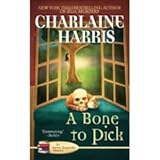
Book Review: A Bone to Pick

A Bone to Pick
by Charlaine Harris
Get it from Amazon >>

Just as looking at a jumbled pile of Ferrari parts doesn’t hint at the beauty of a finished car, so, too, does the first novel in a series not really give an adequate picture of the entire collection.

I’ve now finished the second in Charlaine Harris’s Aurora Teagarden series, A Bone to Pick, and while I found the first book enjoyable, I’m much more in love with Roe Teagarden in this second installment.

In this book, she inherits a house and a pile of money from her recently-deceased friend Jane, and later finds that she’s inherited a mystery as well. In between dealing with the fact that ex-lover Arthur and his new wife are living across the street from said house (and expecting a baby), and dating the Episcopal priest who performed her mother’s recent marriage ceremony, Roe must also figure out what the mystery is, and why she’s been charged with solving it.

As with the first novel, this book is a cozy story, gentle, and homey, and perfect when it’s raining outside, and you don’t feel very well.

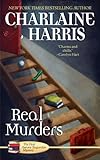
Book Review: Real Murders by Charlaine Harris

Real Murders
by Charlaine Harris
Get it at Amazon >>

When a friend gave me almost the entire collection of Charlaine Harris’s Aurora Teagarden mysteries to read, I was a little bit leary. After all, this was the same woman who had captured my attention with the Sookie Stackhouse books. How would her earlier series compare?

I had nothing to worry about, at least with book one, Real Murders. It’s the story of a serial killer who is committing crimes and staging them to look like famous murders of the past, and it’s quite entrancing. Already, I’m eager to see what happens next with Aurora “Roe” Teagarden, mild mannered librarian.

In truth, these books are somewhat akin to literary air filters, washing away the fast-paced, sex-laden stories that are so prevalent today (not that I mind sex, really, but, still…) and replacing them with slower, gentler stories where plot and character are explored with a sense of graciousness.

I’ve no idea what I’ll find in book two. But I’m looking forward to the experience.

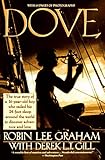
Book Review: Dove by Robin L. Graham

Dove
by Robin L. Graham
Get it from Amazon >>

I bought the book Dove shortly after re-reading Maiden Voyage, because it kept showing up on Amazon’s list of “people who bought this book also liked…” and reading about people going to see on sailing ships is a welcome respite from the world of articles about auto insurance quotes that I generally inhabit.

After reading it, I’m a bit disappointed, because it didn’t have the same pull for me that Aeibi’s book did, but overall I thought it was an interesting tale of a young man who didn’t really fit in the conventional world, finding himself on the sea.

Where Aebi’s Maiden Voyage happened during a time when she and I were of a similar age, Dove takes place in the late sixties, and there are minor cultural issues – generally the treatment of Polynesian people and culture – that I found a little disturbing.

For the most part, however, Dove (which is the name of author Graham’s boat), is a grand adventure, with a bit of nostalgia mixed in.

Wednesday Salon

Technically this should be a Sunday Salon entry, but I slept through half of Sunday, and spent the other half cleaning, so I’m writing a chattery post now because I’m in the middle of half a dozen novels, but not done enough with any to write reviews…yet.

Lately, I’ve been in a mystery mood – everything from the kinds of novels where dead bodies are wrapped up in rugs, to the kinds of novels that are more about puzzles. I’m reading the Aurora Teagarden series, by Southern Vampire Mysteries author Charlaine Harris, but I’m re-reading Laurie R. King’s latest Holmes/Russell novel The Language of Bees as well.

The Teagarden novels actually predate the Sookie Stackhouse series, and while they share the same southern flair, they’re also a bit cozier, and a bit gentler. These are modern mysteries for those of us who still hold Miss Marple and Hercule Poirot fondly in our hearts.

As to Laurie R. King – I reviewed a number of her Holmes/Russell novels this spring, as I was re-reading them all (and filling out my collection) in preparation for the most recent book. She writes amazingly plausible Holmes situations, adding a sidekick/wife/colleague who blends perfectly into the world.

Don’t believe me? Check out this trailer for the most recent book:

Guest Post: Eddie Godshalk

Last month, I reviewed Eddie Godshalk’s book, The Missing Keys to Thriving in Any Real Estate Market. Today, I’m happy to offer a guest post by Mr. Godshalk. I hope you find it as informative as I did.

How did macroeconomics and flawed Market Information cause The Housing Crisis?


Macroeconomics
is the broadest view but important measure of the economic system. As applied to housing it would address influencing factors such as disposable income, migration, available usable land, interest rates, etc. Macroeconomics in real estate applies to national or regional data. The regional data typically being the MSA (Metropolitan Statistical Area), what is more currently called the CSA (Combined Statistical Area) or which there are approximately 400 in the US. The MSA or CSA, is often referred to as a “market.”

All this data was available and many eyes were watching so how did all macro data fail? Part of the problem is that most professionals only have access to free or inexpensive data or information. You cannot make better assessments than the data available. Not only is much of the relevant data not free, it is very hard to find. Then integrating the data into meaningful results is a no-trivial task.

In assessing a real estate investment decision, you can examine data from various sources that consider the property itself, the block, the Census Track, the Zip Code, the County, the MSA/CSA, the state, and the country. Certainly the farther and farther you go out, the less relevance and meaning you have in trying to assess any particular valuation.. Any of us in real estate know you can drive around any area beyond a very local area, and see that nothing homogeneous about any city or neighborhood in America. While this is intuitive, you cannot find any free data or readily available data to make a true assessment of a specific local market condition. The more uncertain or unstable the conditions the riskier and evaluation becomes. We have now gone through a time that exposes the weaknesses in the tools we have been using.

In Progress: Animals In Translation by Temple Grandin

My birthday was last Monday (the 17th), and, as usual, I received a book from my aunt in Connecticut. In recent years she’s been sending more non-fiction than fiction, but I’m not sure that’s intentional.

In any case, she knows that there is no drug rehab equivalent for bibliophiles, and really, as addictions go, reading is a pretty safe one. I mean, what other substance sends you to a bookstore or library when you’re jonesing for a fix? How often do you see a voracious reader begging on the street corner, “Man, I just need a dollar for another book?”

But I digress.

My birthday book this year is Animals in Translation, by Temple Grandin. I’m barely into it, but already I’m fascinated. It’s about how people with autism respond to animals, often understanding them on levels that neuro-typical humans cannot. I’m reading it as a dog-lover and animal rescue volunteer who loves animals, but apparently this book is quite well regarded. In fact, I found a link to it on the PLoS Biology website, in which the editors actually asked Ms. Grandin to respond to something they’d posted. The complete article is here.

It’s all really interesting, and makes me look at my dogs in a new light. I’ll review the book when I’ve finished with it, of course, but I wanted to share what I have in progress for a change.

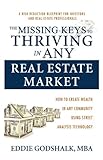
Review: The Missing Keys to Thriving in Any Real Estate Market by Eddie Godshalk, MBA


The Missing Keys to Thriving in Any Real Estate Market: How to Create Wealth in Any Community Using Street Analysis Technology
Eddie Godshalk, MBA
Get it at Amazon

If you’ve never working in any aspect of the real estate market, you may not think Eddie Godshalk’s book, The Missing Keys to Thriving in Any Real Estate Market, is for you. You’d be wrong, because while the last part of the book, which explains his Home Value Predictor, is aimed at real estate professionals, the first part is a thorough explanation of why the housing market has tanked, why there are so many foreclosures, and how some of the financial strife related to real estate finance could have been averted.

Even better, Godshalk explains the history of housing bubbles, how they work, why they work, and what’s happening now, in accessible language that anyone can understand, even if they’ve never taken a single finance course.

After reading his book, you’ll have a better understanding not just of the big picture, but also of the smaller sections – like why your own home is worth what it is, and why you may not be able to refinance any time soon.

If, on the other hand, you are a real estate professional, whether you’re a Realtor, broker, lender, or appraiser, you’ll finish The Missing Keys… with a better understanding of the industry in which you work, and you’ll also be armed with powerful tools that will help both you and your client.

Once such tool is Godshalk’s Home Value Predictor, which you can learn about in-depth at HomeValuePredictor.com.

As someone who worked as a mortgage loan processor and underwriter for half her life, I can honestly say that while I was asked to review Mr. Godshalk’s book, I wish I’d had it to offer every client I worked with – especially those taking subprime loans, because it should be required reading for homeowners and real estate professionals alike.

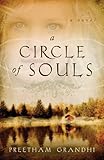
Review: A Circle of Souls by Preetham Grandhi


A Circle of Souls
Preetham Grandhi
Get it at Amazon >>

When Preetham Grandhi contacted me via this blog, asking if I’d consider reviewing his new novel, A Circle of Souls, I immediately stopped surfing websites for Myrtle beach vacation rentals and jumped at the chance. I was in the mood for a thriller, I told him via email, and after reading the description of the story, I thought it was just the sort of book I would love.

I was not wrong.

A Circle of Souls opens with a young girl on her way home from school – she never arrives, and the search for her (and later her killer) are half the plot of the novel. Intertwined with the murder mystery, however, is another mystery: that of a little girl who is having very vivid dreams which may be causing her harm.

Set in a sleepy Connecticut town, and filled with characters like the child psychologist working with Naya (the girl with the dreams) and a female FBI agent, neither of whom are at all predictable or “stock” characters, this book grips you from the start, teasing you with a cozy afternoon before it really dives into the action.

Despite the fast pace of the novel, and some rather bloody descriptions, there is also a gentleness to this story that is both lyrical and somewhat reassuring.

One of the ways I judge the quality of a novel is how willing I am to put it down and resume a non-reading activity. This book kept me enthralled to the point where I could not sleep until I knew what had happened.

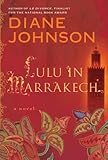
Review: Lulu in Marrakech, by Diane Johnson


Lulu in Marrakech
Diane Johnson
Get it at Amazon >>

I had just finished re-reading The Eight. which had some lovely scenes set in Tangier, and wanted something similarly exotic. I was standing in Barnes and Noble, talking to my friend Deb on the phone, and I saw the lovely red cover with Lulu in Marrakech, across the center, and thought, “Ah, just what I was looking for!”

While I’ve read and enjoyed many of author Diane Johnson’s other novels, those involving an out-of-place American trying to navigate Parisian society, this novel seemed to be penned by a completely different woman. Sure the cover was pretty, and the concept – an American spy called Lulu is sent to Morocco to observe and report because she has a well-connected lover – was intriguing, but the book lived up to neither.

Instead of a bold heroine, Lulu (not her real name) was a meek, constrained, self-deprecating young woman, who wouldn’t even confront her lover when she suspected an affair. The supporting characters could have been cut from stock cloth, and while her observations of local life and culture were interesting, there was no sense of BEING in Morocco.

I don’t like to give bad reviews, and I always try to find something nice to say, but the best I can do about Lulu in Marrakech is this: it’s made me appreciate Johnson’s other works, like Le Divorce all the more.