Mini-reviews: Three by Elin Hilderbrand

I’ve been reading a lot of Elin Hilderbrand’s work this summer. In fact, I think I now own all of her Nantucket novels, though I still have at least three left to read. These novels, which are not a series, but are all set on the island of Nantucket, are easing my yen for the beach the way the best weight loss pills help you shed pounds safely.

Here’s a brief wrap-up of the last three Hilderbrand novels I’ve read:

The Castaways

The Castaways is the story of four successful couples, all friends for years, who refer to themselves collectively as The Castaways. When one of the couples dies in a tragic boating accident, secrets about the intertwining relationships among the surviving six people then come out. This was a deliciously dishy novel about affairs of the heart and the flesh, and it’s much more satisfying a read than I thought it would be.

Nantucket Nights

Nantucket Nights starts out being a story about female bonding, when three long-time friends meet for their annual ritual of Midnight Swimming, off a remote stretch of beach, after the summer season is officially over, but one of them doesn’t come back from the swim. All three women, Val, Kayla and Antoinette, are distinctly different but still strong personalities, but I thought the mystery element of the plot was a bit predictable.

Summer people

Summer People is the most recent novel I’ve finished reading, and while I enjoyed it, it felt a little unfinished. While the adult storyline is a little weak – that of Beth grieving over her dead husband while being confronted almost daily with her former lover, a year round Nantucket resident, as opposed to she and her family who are summer people – the teen storyline is a little meatier: Beth’s twin teen children, Winnie and Garrett each deal with grief and first love during their summer, Winnie with Marcus, the son of her dad’s last client, and Garrett with his mother’s ex-lover’s daughter. Like Nantucket Nights, this novel includes an unwanted pregnancy story, and the pair leave me suspecting that author Hildebrand is anti-choice, but despite that, her stuff is wonderful summer reading.

Goes well with: Fresh caught saltwater fish, grilled, with summer veggies, and either lemonade, iced tea, or beer.
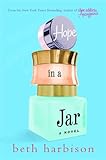
Review: Hope in a Jar, by Beth Harbison

Hope in a Jar
Hope in a Jar
by Beth Harbison
St. Martin’s Griffin, 368 pages
Buy it from Amazon >>

When I saw Beth Harbison’s novel Hope in a Jar staring at me from the summer reading table at the bookstore, I didn’t connect the title with the Philosophy product at all, mainly because I haven’t used Philosophy in over a decade. I’m an Aveda girl, for the most part, although I’ve been branching out a little lately.

Just a few chapters into the sometimes fluffy, sometimes deadly serious story about Allie and Olivia – childhood best friends who part ways over a dark rumor only to reconnect at their 20-year high school reunion – I realized that this writer was my contemporary in more ways than one, and not just because of the dialogue that covered everything from fat burners that really work to which flavor of Lip Smackers is the coolest (I liked root beer, personally), but because I actually recognized every single pop-culture reference in her story.

There’s comfort in the familiar, which is why even though the plot was fairly predictable, I enjoyed this novel immensely. Books don’t always have to have a lofty purpose, or educate a starving mind. Sometimes, it’s okay to read for the sheer pleasure of being entertained, and Harbison excels at entertaining. Sure, I figured out the ending way before the end of the book, but I still enjoyed watching the characters get there, because the dialogue was spot on, the relationships made sense, and the descriptions were so vivid (as vivid as many of the outfits we all wore as children in the 1970s and 1980s) that it was almost like attending my own 20-year high school reunion, without any of the attendant angst.

Hope in a Jar made me laugh out loud, a lot, and sometimes, that’s what a book SHOULD do. I haven’t read any of Harbison’s other work, but I know that when I do, I’ll enjoy it immensely.

Goes well with: Steak-ums sandwiches and cold Tab

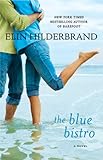
Review: The Blue Bistro, by Elin Hilderbrand

The Blue Bistro
The Blue Bistro
by Elin Hilderbrand
St. Martin’s Griffin, 336 pages
Buy from Amazon >>

The Blue Bistro may be the fourth of author Elin Hilderbrand’s novels set on the island of Nantucket, but it’s only the second I’ve read. Thankfully, her novels are not a series, as much as they are a collection. Most don’t even mention the same restaurants.

In any case, this novel, which is set in and around a beach front restaurant, (restaurant books are not the best appetite suppressants, by the way), tells the story of 28-year-old Adrienne Dealey, freshly off the Colorado ski slopes, where she worked as the concierge in a tone-y hotel, and looking for a new life, without her old lover, who wasn’t good for her. Telling is the fact that she misses the dog, more than the man.

Having been advised to try Nantucket for the summer, Adrienne begins looking for work, and in the process, meets Thatcher Smith, who co-owns the famous Blue Bistro with his childhood friend, the reclusive, but amazingly talented, Fiona Kemp. What follows is part hard work, part romance, and part mystery – what hold does Fiona have on Thatcher, that he can’t (or won’t) even spend the entire night with Adrienne after they become lovers?

As is expected of Hilderbrand novels, there is sophisticated, realistic romance set against the charming backdrop of Nantucket in the summertime.

You can almost feel the salt in your hair.

Goes well with: Champagne and lobster tails.

Review: Barefoot, by Elin Hilderbrand

Barefoot"
Barefoot
by Elin Hilderbrand
Little, Brown and Company, 528 pages
Get it at Amazon >>

Last month when I got home from Mexico, and had the opportunity to splurge on books, I looked for beach reading – books that took place in cute coastal villages. I’d been eying the paperback version of Elin Hilderbrands’s sixth Nantucket novel Barefoot for months, and finally brought it home on that trip. I didn’t actually read it it until the beginning of June, however, and when I did, it took a while before I was hooked. This is a novel that starts slowly, cresting like the gentlest of waves.

I don’t mind that sort of novel – sometimes they can be really satisfying reading – and I also didn’t mind that this was really an extended character piece. It begins, of course, with three women, Vicki, Brenda and Melanie, arriving on Nantucket for a summer in the cottage that Vicki and Brenda (sisters) inherited from their aunt. Melanie’s along for the ride because she’s a friend of Vicki’s. Each woman comes with baggage of the figurative kind as well as actual luggage. For Vicki, it’s cancer – she’ll be having chemo while summering by the shore. Brenda was a hotshot professor at a small, private university, fired for having an affair with her student (it should be noted that this isn’t a creepy kind of affair – her student was older than she was – but it was a professional faux pas). And Melanie…Melanie is newly pregnant, but because her husband is having an affair he refuses to end, the only birth announcements she’s made – or pregnancy announcements, for that matter, are to the other women with her on the trip, and, within a couple of chapters, the young islander Josh, who first greets them at the airport, then ends up becoming whatever the male version of an au pair is, since Vicki came with her two young children.

During the summer, Brenda works on the book/screenplay that she hasn’t been able to focus on elsewhere, Vicki becomes empowered with regard to her disease, and Melanie has a summer fling with young Josh.

None of these things are at all surprising, nor is the ending of the novel remotely unpredictable, but sometimes you don’t need a great twist for a novel to be satisfying; sometimes, all you need are vivid descriptions, three-dimensional characters (even when you find some of their behavior a bit annoying), and a cute coastal village. Hilderbrand provides all of those.

Goes well with: lemonade and a tuna sandwich from inside a picnic cooler at the beach.

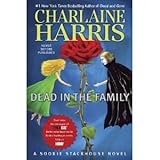
Review: Dead in the Family


Dead in the Family
by Charlaine Harris
Ace Hardcover, 320 pages
Get it at Amazon >>

Even though it’s been less than two weeks since I’ve read Charlaine Harris’ latest addition to the Sookie Stackhouse / Southern Vampire Mystery series, I don’t remember much about it. I don’t mean that I didn’t enjoy it, because I did, or that it wasn’t well-written, because it was, but that it seemed like it didn’t really have a definitive plot. Oh, I mean, there was a stray faerie, and an unidentified shifter, but most of the book seemed transitional.

For example: Sookie is dealing with the aftermath of losing her “fairy godmother,” forging a relationship with her young cousin, who shares her ability, trying to find boundaries in her relationships with Eric (romantic) and Bill (who, quaintly, is still referred to as Vampire Bill by most of the folks at Merlotte’s, but, while there’s some wrapping up of loose threads, and some setup of future events, book ten feels very much like the middle novel of a trilogy, making it one of the rare books in this series that HAS to be read in order or the reader will be left completely confused.

Diehard Sookie Stackhouse fans will not want to miss this book, which came out six weeks ago (giving book clubs enough time to discuss it before last Sunday’s beginning of season three of True Blood), but I’m left feeling like the story wasn’t complete. Less is more, of course, as the adage goes, but…this book included a visit to Eric’s house, and I’m not certain if I know whether or not his taste runs to modern furniture, or something much more exotic.

Goes well with: peach pie and sweet tea.

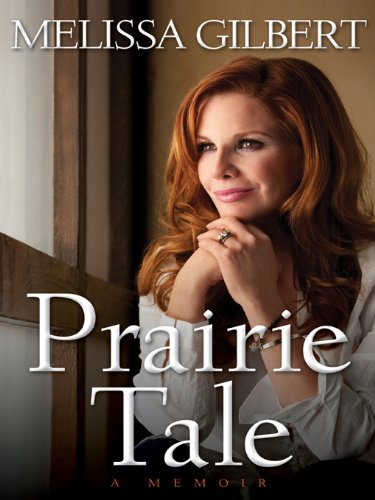
Review: Prairie Tale

Prairie Tale
Prairie Tale: a Memoir
Melissa Gilbert
Gallery, 384 pages
Get it from Amazon >>

I’ve been a fan of Melissa Gilbert ever since the first episode of “Little House of the Prairie” first aired, but I hadn’t realized she’d published her memoir until I saw it for sale among the souvenirs of “Little House on the Prairie: the Musical” several weeks ago. I ended up buying the trade paperback version, and reading it in one night.

In Prairie Tale Gilbert starts with her childhood as a kid in pigtails going to commercial auditions, and walks us through the grittiest details of her life until now. She speaks wryly about her nervousness about the kissing scenes and love scenes with Dean Butler, who played Almanzo on the show, and candidly about her first serious relationship, with Rob Lowe. She shares her dreams, and also shares her struggle with the loss of Michael Landon, and her deeper struggles with both self esteem and alcohol. If she’d been using Lipovox, she’d have written about that too, no doubt.
o
In the end, this book does what a good memoir should: it makes us feel as if we’ve had a long chat with someone we once wished we could be friends with.

Goes well with strong coffee and a slice of corn bread.

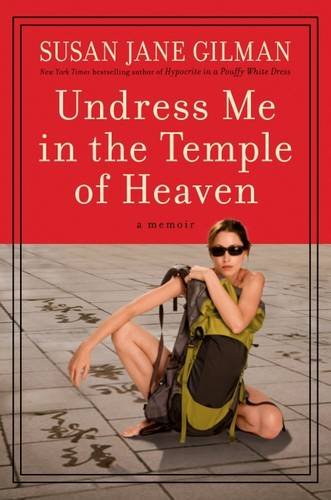
Review: Undress Me in the Temple of Heaven

Undress Me in the Temple of Heaven
by Susan Jane Gilman
Grand Central Publishing, 320 Pages
Get it from Amazon >>

I read almost all of Susan Jane Gilman’s travel epic while sitting in the Mexicana Elite lounge in Mexico City about ten days ago, and on the plane trip home. I had a few hours to kill between connections, and the only other book I had left after vacation was a hardcover – not easy to read on the plane – so I began reading the novel while curled up in a lovely recliner, being served glasses of Mexican Coca Cola, and chatting (at intervals) with various Mexican businessmen – I was the only woman in the room, and every time one of them moved, they offered to get me something. I felt very popular, but there was nothing sexual in it, just sincere graciousness.

It’s interesting reading a travelogue while traveling yourself. This book, about the author’s backpacking trip through the People’s Republic of China after her college graduation, about “ten minutes after” Westerners were allowed into the country had that “out of the world” quality that really good romances do, but it’s not at all romantic (well, bits of it are), it’s more nitty-gritty psychodrama, for Suzie (as she was known then) develops a cold that slowly builds to pneumonia almost immediately after leaving Hong Kong, and Claire becomes convinced she’s an International Spy with Serious Enemies – really convinced.

While this book is a memoir, it reads like an epic novel – adventure, fear, great escapes, and true friends in unexpected places, all show up. In fact, about the only thing not mentioned is where you can buy off-label extenze, and that’s only because it had yet to be invented.

Read this book. Then take a long hot bath.

Goes well with Chinese takeout and steaming hot tea. Or banana chocolate chip pancakes.

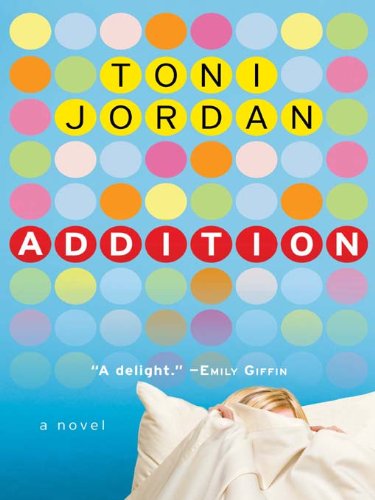
Review: Addition, by Toni Jordan

Addition
Addition
by Toni Jordan
Polebridge Press (Harper San Francisco), 272 pages
Get it at Amazon >>

You’re not supposed to judge books by their covers, I know, but it was the cover of Toni Jordan’s novel Addition that hooked me, with its pretty rows of brightly colored objects. Then I read the back, and thought, “Hmm. This is interesting.”

Protagonist Grace Lisa Vandenburg has been “counting things” since she was a young girl, and by “counting things” I don’t mean “inventorying pool filters,” but that she’s high-functioning OCD. High functioning in that as long as she sticks to a routine, she can leave her apartment and do things. . . to a point. Her routine is pretty specific though – she goes so far as to remove two eggs from every carton because she has to have TEN not TWELVE, and she steals a banana from a guy at the grocery store because she miscounted and is already in line.

When the same guy is at her table at the cafe where she goes every day for a slice of orange cake and a hot chocolate, Grace has to break out of the comfort of counting. The two fall into a quirky relationship, and the Boy even gets her to try therapy again. But her niece, and closest confidant isn’t thrilled with well-adjusted Grace, preferring a blend of the original version and the one that has been through therapy.

Toni Jordan’s characters are delightfully quirky, and her glimpse into the mind of someone with OCD is both interesting and enlightening. The novel is paced a little slow, at first, but then it gets better, and the end is satisfying, but let’s be clear: this is summer reading at it’s best.

Goes well with: A slice of orange cake and hot chocolate, obviously.

Guest Post: Author Rolf Hitzer (Hoodoo Sea) on Writing Rituals

Hoodoo Sea
Hoodoo Sea
by Rolf Hitzer
Get it from Amazon.com >>

Every author has their own ritual for when they write. Some have to wear a specific pair of Naot shoes. Others have to light a candle, brew coffee, and stir the milk in three times, clockwise. Last week, we reviewed Rolf Hitzer’s debut novel, Hoodoo Sea, which you can buy by clicking on the link above. This week, Mr. Hitzer shares one of his writing rituals with us.

My Writing Ritual
by Rolf Hitzer

Prior to my decision of writing a novel, I had without a doubt, believed myself to be a normal person. Then I began to realize how annoyed I would become if I didn’t follow a certain procedure every time I sat down to scribble a few words.

Before writing, Hoodoo Sea, I didn’t drink tea. In fact, having a cup of tea was for the elderly or the British people. However, I found myself making a cup of tea each time I prepared myself for a writing session. Why? To this day, I still don’t know. And, I couldn’t have any tea, oh no, it had to be Chamomile Tea with a teaspoon of honey.

At first, I had thought nothing of it, that is, until I had run out of tea bags. Panic surged through me. Where did that feeling come from? I shrugged it off and sauntered down into the basement where my office was. I plunked myself into my chair, and again, became agitated. My focus and concentration became lost like the characters in my novel.

Well, after experiencing that incident I was never without Chamomile Tea again. What I find really bizarre about this is when I had finished, Hoodoo Sea, I stopped drinking tea altogether just like I had before. That is…until I started my second novel.

Review: The Longest Trip Home by John Grogan

The Longest Trip Home
The Longest Trip home
John Grogan
Get it from Amazon.com >>

It’s weird the way some books fall into your life exactly at the right moment. For example, the day after I got home from my recent trip to New York and New Jersey, on a flight where I resorted to actually reading the different ads all professing to be about the best weight loss pills, or coolest diving watch, or whatever, because I just wasn’t in the mood for the book I had with me, I found Dracula: the Un-Dead, a new “Magic Kingdom” novel from Terry Brooks, Sarah’s Key (which the woman across the aisle of the plane swore was a great novel despite being a Holocaust story), and John “Marley and Me” Grogan’s latest memoir, The Longest Trip Home.

I reviewed the Dracula book earlier this week, and finished Sarah’s Key the next day, though I haven’t posted the review yet (look for it on Tuesday), and I finished the Grogan book yesterday. It is that book that seemed perfectly time.

First, I have to share, in case I hadn’t, that I love Grogan’s writing style. I never read his columns, but I loved Marley and Me as much for his storytelling capabilities as because I’m a sucker for a good dog story.

Second, like Mr. Grogan, though to a lesser degree, I’m “culturally Catholic.” My Italian-American relatives still watch the news in Italian (from their plastic-wrapped New Jersey living room), and have palm crosses stuffed between the pages of the Bible and the Dictionary, and pictures of the Pope above the TV. My grandmother kept her rosary beads at her bedside, even after she was mostly senile, and while I have serious issues with the politics of the Catholic Church, I will always have a special place in my heart for the ritual, the music, and the “smells and bells.”

But this isn’t my general blog, so let me talk about the book.

The Longest Trip Home is about Grogan’s life, growing up as a good Catholic boy in the Michigan suburbs, and growing away from his family and his religion as he became an adult, a journalist, and a husband and father.

It’s a linear book, tracing the author’s life in mostly-chronological order, and if there’s a focus on the funnier side of things, I can’t blame him – humor connects us in ways straight facts cannot.

From his stint as altar boy to his founding of an underground paper in high school, to his first meeting with the woman who ultimately became his wife, Grogan shares his life in fairly candid language, with some concessions made for the protection of real people.

Most poignant, is the last quarter of the book, where Grogan must deal with the aging of his parents, and eventual death of his father, but while some of it is sad, none of it is ever maudlin.

It’s a wonderful memoir, and an entertaining read, but for me, personally, it was also validation of this habit of clinging emotionally to Catholic roots even if we don’t cling to the modern form of the religion.

I hope John Grogan continues to write books.
I’ll be first in line for his next offering.