

Review: Pueblos Mágicos: A Traveler’s Guide to Mexico’s Hidden Treasures by Chuck Burton

About the book, Pueblos Mágicos: A Traveler’s Guide to Mexico’s Hidden Treasures  Pueblos Magicos Cover
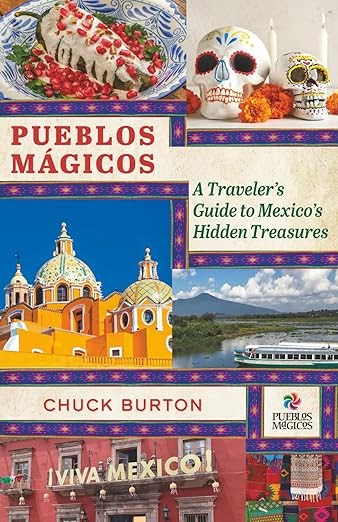
  • Pages: 296
  • Publisher: Bayou City Press
  • Publication Date: Oct, 3 2025
  • Categories:  General Mexico Travel Guide

Pueblos Mágicos: A Traveler’s Guide to Mexico’s Hidden Treasures covers 62 of the towns in the Government of Mexico’s “Pueblos Mágicos” initiative, a program that identifies and promotes towns in Mexico that have special cultural or historical significance. Most of these places are small and less well-known than Mexico’s large cities and popular tourist destinations.

Author Chuck Burton, a long-time Mexico traveler and resident, has visited all of these towns. He has chosen 10 towns as his Favorites and awarded Honorable Mention status to an additional 10 towns. For each of those categories, he also writes about “bonus towns,” nearby towns that are also worthy of a visit. Additional chapters divide Mexico’s states into four regions (Northern, North Central, South Central, and Southern), with Pueblos Mágicos towns in each region identified and described.

The book contains maps showing the locations of all 62 towns, a glossary of Spanish/Mexican words, and an extremely useful index. The author opens the book with background information on the practicalities of visiting the Pueblos Mágicos and closes it with additional information, such as travel information on Mexico City and some suggested itineraries for visiting the Pueblos Mágicos. Photos of towns and sites are included, as are a description of the Pueblos Mágicos program and the author’s thoughts on why we travel.

Buy, read, and discuss this book:

Amazon | Barnes & Noble | Bookshop | Goodreads 


About the author, Chuck Burton Pueblas Magicas Chuck Burton

An old Northern California hippie and charter member of the Love Generation, Chuck Burton has been traveling around the world budget/backpack style for fifty years. His current areas of expertise are Mexico, Southeast Asia and India. Occasionally he has paused his travels to replenish his coffers, primarily as a tax preparer, professional bridge player and teacher, freelance writer and substitute teacher. His greatest joy has been raising his daughter Marisol, adopted in Colombia in 1985 along with his ex-wife. Chuck is fluent in Spanish and currently resides in Mazatlan, Mexico with his longtime companion Kathy Gilman.

Connect with Chuck:

Amazon Author Page | Website


My Thoughts MAB-2025

Early in the introduction to Pueblos Mágicos, Chuck Burton includes a line that immediately caught my attention: “Earn your money where the pay is good, then spend it carefully in warm, cheap countries.” It is pragmatic, a little cheeky, and quietly revealing. That philosophy sets the tone for the book as a whole. This is certainly a beautiful travel guide, but it is also grounded, lived-in, and deeply human. At times, it reads less like a conventional guidebook and more like a thoughtful travel memoir shaped by years of experience.


Burton’s familiarity with Mexico informs every chapter. He has personally visited all 62 towns included in the book, and that firsthand knowledge shows in both structure and voice. Ten towns are highlighted as favorites, ten more receive honorable mention, and nearby “bonus towns” expand the scope without overwhelming the reader. The regional organization — Northern, North Central, South Central, and Southern Mexico — makes the book especially useful for travelers who want to plan realistically rather than romantically.


This book also corrected one of my long-held assumptions. My parents lived in La Paz, Baja California Sur for twenty years, and during my frequent visits we spent plenty of time in their nearby Pueblo Mágico, Todos Santos. Until reading this book, I believed the designation applied primarily to art colonies, and that Todos Santos received attention mainly because it is home to the famous, or infamous, Hotel California. Burton’s explanation of the Pueblos Mágicos initiative reframes that understanding entirely. These towns are recognized not for trendiness or notoriety, but for cultural continuity, history, and community identity. Seeing Todos Santos placed in a broader national context deepened my appreciation for a place I thought I already knew well.


The practical elements of the book are excellent. Clear maps, an extremely useful index, a glossary of Spanish and Mexican terms, and suggested itineraries make this a guide meant to be carried and consulted, not just admired on a shelf. The photographs enhance the text without overwhelming it, while Burton’s closing reflections on why we travel reinforce the book’s thoughtful, unhurried approach.


Pueblos Mágicos encourages slower travel and deeper curiosity. It invites readers to look beyond the obvious and to value presence over checklists. This is a guide for travelers who want to understand where they are standing, not simply collect destinations.


Goes well with: a well-worn passport, street tacos ordered by the kilo, a cold local beer like Indio or Bohemia, and the slow satisfaction of realizing how much there still is to learn about a place you thought you knew.

Review: Fiesta of Smoke by Suzan Still

About the book, Fiesta of Smoke

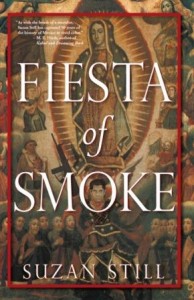
Fiesta of Smoke

Against a backdrop of rebellion and intrigue, love between Javier Carteña, commander of insurgent Mexican forces, and Calypso Searcy, an American novelist at the pinnacle of her career, sizzles with passion across a broad sweep of history. Encompassing time from the Conquest of the 1500s to the present, the story races across space as well, from the forests of Chiapas to the city of Paris. There, an international investigative reporter named Hill picks up the swiftly vanishing trail of Calypso’s disappearance, and unwittingly becomes involved in one of the great dramas of the twentieth century and one of the great love stories of any age.

Buy a copy from Amazon.


My Thoughts:

It seems appropriate that I’m posting this review on November 1st – Dia de los Muertos is in full swing in La Paz, BCS, Mexico, where my parents live – and I’m still bearing traces of Halloween glitter as I write this morning. Not that Fiesta of Smoke is a Halloween story – it’s not. What it is is a genre-bending epic that takes us to Mexico in the present, recent past, and ancient past, Paris, and points between. It’s part adventure, part fiery romance, part historical, part political…but in this case the actual novel is much, much, more than the sum of those parts.

In fact all those different aspects provide the setting and history we need in order to truly understand the dynamic between the lead characters, Javier, Calypso, and Hill. The first two have a relationship that reminded my of my loud Italian relatives, screaming at each other one moment, making out in the next, all with an underlying connection that is largely invisible to outside observers. (Though, in my family, gunfire was generally not on the menu.)

Then there’s Hill, who falls for Calypso the first time he sees her – which may or may not be the first time WE meet her, as she’s doing perfect developpes on the Pont Neuf. (That scene really captured my attention. I haven’t been in shape enough to be a proper dancer in decades, but I remember what it’s like to want to combine a perfect setting with a perfect movement.)

The three leads move around each other in ways that often reminded me of a Celtic knot, coming together, falling away, their patterns and adventures a great dance through history, geography and passion. Politics, too are involved, and reading this novel while listening to my mother describe the various modern political parties (I think PAN is in power right now), was a bit of a trip.

If my description is vague, it’s because it’s so hard to take a 500+ page novel that is beautifully written – and let me interrupt myself here to mention that author Suzan Still’s depictions of food are as tantalizing as her use of language – this book reads like an opera, truly – and condense it into a few paragraphs.

Read Fiesta of Smoke. If you’re not doing NaNoWriMo, read it this month – it’s the perfect November novel – it’ll keep you warm on cold nights, and fuel your imagination on dark mornings. If you ARE doing NaNo, read it anyway. Writers have to read, right? Either way, you will be swept away, as I have.

I’m supposed to be spending Christmas with my parents in Baja Sur, but suddenly my itch to go south of the border is stronger than ever.

Goes well with: chicken mole, grilled chayote, and Indio beer.


About the Author, Suzan Still

Suzan Still

Text taken from the author’s website: Suzan Still holds a masters in art and writing and a doctorate in depth psychology. A retired university art professor, she also taught creative writing in a men’s prison, where she became increasingly concerned with issues of social disenfranchisement–as the reader of Commune of Women will discover. She continues to explore this theme in her novel-in-progress, Fiesta of Smoke, which focuses on the coming revolution in Mexico, where she has traveled for over thirty years. As a writer, she favors the novel form but also has published poetry and nonfiction and is an avid journal-keeper. Also, she has led dream groups for over twenty-five years. Her fascination with dreams will be evident to the reader of Commune of Women, while, as an artist, she is delighted to introduce her artwork to the world as the cover image for the novel. Her interests include painting and collage, sculpting in marble, photography, foreign travel, gardening, cooking, antiques and all things French. Suzan lives in the foothills of California’s Sierra Nevada Mountains on land that her family pioneered, with her husband and an assortment of rescued fur children, who take her for her daily walk in the woods.

Connect with Suzan:

Website: SuzanStill.com
Facebook: Suzan.Still


Special thanks to the folks at TLC Book Tours for giving me the opportunity to read Fiesta of Smoke. Here’s an opportunity for you: the first person to comment on this post can get a copy of Suzan Still’s previous novel Commune of Women.

I feel compelled to add: for the average American tourist, Mexico is very safe. Yes, there are “drug wars” but those are mostly around the US/Mexico border, and mostly involved drug cartel members killing each other. Most of Mexico has fewer fatalities in a whole year than major U.S. cities do in a month. Be smart, be aware, but don’t be afraid.

TLC Book Tours