Book Review: A Bone to Pick

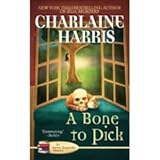
A Bone to Pick
by Charlaine Harris
Get it from Amazon >>

Just as looking at a jumbled pile of Ferrari parts doesn’t hint at the beauty of a finished car, so, too, does the first novel in a series not really give an adequate picture of the entire collection.

I’ve now finished the second in Charlaine Harris’s Aurora Teagarden series, A Bone to Pick, and while I found the first book enjoyable, I’m much more in love with Roe Teagarden in this second installment.

In this book, she inherits a house and a pile of money from her recently-deceased friend Jane, and later finds that she’s inherited a mystery as well. In between dealing with the fact that ex-lover Arthur and his new wife are living across the street from said house (and expecting a baby), and dating the Episcopal priest who performed her mother’s recent marriage ceremony, Roe must also figure out what the mystery is, and why she’s been charged with solving it.

As with the first novel, this book is a cozy story, gentle, and homey, and perfect when it’s raining outside, and you don’t feel very well.

Book Review: Real Murders by Charlaine Harris

Real Murders
by Charlaine Harris
Get it at Amazon >>

When a friend gave me almost the entire collection of Charlaine Harris’s Aurora Teagarden mysteries to read, I was a little bit leary. After all, this was the same woman who had captured my attention with the Sookie Stackhouse books. How would her earlier series compare?

I had nothing to worry about, at least with book one, Real Murders. It’s the story of a serial killer who is committing crimes and staging them to look like famous murders of the past, and it’s quite entrancing. Already, I’m eager to see what happens next with Aurora “Roe” Teagarden, mild mannered librarian.

In truth, these books are somewhat akin to literary air filters, washing away the fast-paced, sex-laden stories that are so prevalent today (not that I mind sex, really, but, still…) and replacing them with slower, gentler stories where plot and character are explored with a sense of graciousness.

I’ve no idea what I’ll find in book two. But I’m looking forward to the experience.

Book Review: Dove by Robin L. Graham

Dove
by Robin L. Graham
Get it from Amazon >>

I bought the book Dove shortly after re-reading Maiden Voyage, because it kept showing up on Amazon’s list of “people who bought this book also liked…” and reading about people going to see on sailing ships is a welcome respite from the world of articles about auto insurance quotes that I generally inhabit.

After reading it, I’m a bit disappointed, because it didn’t have the same pull for me that Aeibi’s book did, but overall I thought it was an interesting tale of a young man who didn’t really fit in the conventional world, finding himself on the sea.

Where Aebi’s Maiden Voyage happened during a time when she and I were of a similar age, Dove takes place in the late sixties, and there are minor cultural issues – generally the treatment of Polynesian people and culture – that I found a little disturbing.

For the most part, however, Dove (which is the name of author Graham’s boat), is a grand adventure, with a bit of nostalgia mixed in.

Wednesday Salon

Technically this should be a Sunday Salon entry, but I slept through half of Sunday, and spent the other half cleaning, so I’m writing a chattery post now because I’m in the middle of half a dozen novels, but not done enough with any to write reviews…yet.

Lately, I’ve been in a mystery mood – everything from the kinds of novels where dead bodies are wrapped up in rugs, to the kinds of novels that are more about puzzles. I’m reading the Aurora Teagarden series, by Southern Vampire Mysteries author Charlaine Harris, but I’m re-reading Laurie R. King’s latest Holmes/Russell novel The Language of Bees as well.

The Teagarden novels actually predate the Sookie Stackhouse series, and while they share the same southern flair, they’re also a bit cozier, and a bit gentler. These are modern mysteries for those of us who still hold Miss Marple and Hercule Poirot fondly in our hearts.

As to Laurie R. King – I reviewed a number of her Holmes/Russell novels this spring, as I was re-reading them all (and filling out my collection) in preparation for the most recent book. She writes amazingly plausible Holmes situations, adding a sidekick/wife/colleague who blends perfectly into the world.

Don’t believe me? Check out this trailer for the most recent book:

Guest Post: Eddie Godshalk

Last month, I reviewed Eddie Godshalk’s book, The Missing Keys to Thriving in Any Real Estate Market. Today, I’m happy to offer a guest post by Mr. Godshalk. I hope you find it as informative as I did.

How did macroeconomics and flawed Market Information cause The Housing Crisis?


Macroeconomics
is the broadest view but important measure of the economic system. As applied to housing it would address influencing factors such as disposable income, migration, available usable land, interest rates, etc. Macroeconomics in real estate applies to national or regional data. The regional data typically being the MSA (Metropolitan Statistical Area), what is more currently called the CSA (Combined Statistical Area) or which there are approximately 400 in the US. The MSA or CSA, is often referred to as a “market.”

All this data was available and many eyes were watching so how did all macro data fail? Part of the problem is that most professionals only have access to free or inexpensive data or information. You cannot make better assessments than the data available. Not only is much of the relevant data not free, it is very hard to find. Then integrating the data into meaningful results is a no-trivial task.

In assessing a real estate investment decision, you can examine data from various sources that consider the property itself, the block, the Census Track, the Zip Code, the County, the MSA/CSA, the state, and the country. Certainly the farther and farther you go out, the less relevance and meaning you have in trying to assess any particular valuation.. Any of us in real estate know you can drive around any area beyond a very local area, and see that nothing homogeneous about any city or neighborhood in America. While this is intuitive, you cannot find any free data or readily available data to make a true assessment of a specific local market condition. The more uncertain or unstable the conditions the riskier and evaluation becomes. We have now gone through a time that exposes the weaknesses in the tools we have been using.

Sunday Salon: Ship-shape

The Sunday Salon.com

I realize that I’m actually writing this on Monday evening. I’m either slightly late for yesterday, or really early for the 30th, but either way I was mulling this over yesterday, but never manage to post it.

My reading this week has been a leisurely revisiting of one of my favorite books, Maiden Voyage, by Tania Aebi. It’s the memoir of the author’s two-year trip around the world as the solo handler of a sailboat. She wrote it twenty years ago, and I bought it when it was new, and have re-read it a few times, over the years.

I’m not sure why this book resonates so with me. Part of it, I think, is that I love the ocean in a way that most people who don’t sail rarely do. Part of it is that the romance of being alone on a sailboat in the middle of the ocean appeals – and the risk. Part of it is that I relish the coziness of a ship’s bunk with a small furry animal for company, and reading myself to sleep as the waves gently rock me.

There are, of course, moments I do not wish to experience, even vicariously. At one point, Aebi describes having an earache in the middle of the ocean, and how she heats a sock-full of salt and holds it against her ear. Another tale in the book is the relatively brief mention of a fellow sailor’s issue with a toothache, and how he basically gets drunk so he won’t care, since it’s not exactly like there are orange nj cosmetic dentists hanging in the tropics. Or if there are, they’re sailing, too, and not seeing patients.

Mostly, though, I recognize that I, who considers “roughing it” to be a hotel without room service or wifi, and who can’t even sit through movies where people are cold, wet, tired, hungry, dirty and lacking toilet paper, would probably not be happy for more than a day or two than the minimalist conditions Tania Aebi seemed to thrive upon, as much as I like to imagine I might.

For Tania Aebi, Maiden Voyage represents two years of her life, twenty years ago.

For me, it’s several hours of reading enjoyment and lovely dreams about sailing, which is, after all, what reading is all about.

In Progress: Animals In Translation by Temple Grandin

My birthday was last Monday (the 17th), and, as usual, I received a book from my aunt in Connecticut. In recent years she’s been sending more non-fiction than fiction, but I’m not sure that’s intentional.

In any case, she knows that there is no drug rehab equivalent for bibliophiles, and really, as addictions go, reading is a pretty safe one. I mean, what other substance sends you to a bookstore or library when you’re jonesing for a fix? How often do you see a voracious reader begging on the street corner, “Man, I just need a dollar for another book?”

But I digress.

My birthday book this year is Animals in Translation, by Temple Grandin. I’m barely into it, but already I’m fascinated. It’s about how people with autism respond to animals, often understanding them on levels that neuro-typical humans cannot. I’m reading it as a dog-lover and animal rescue volunteer who loves animals, but apparently this book is quite well regarded. In fact, I found a link to it on the PLoS Biology website, in which the editors actually asked Ms. Grandin to respond to something they’d posted. The complete article is here.

It’s all really interesting, and makes me look at my dogs in a new light. I’ll review the book when I’ve finished with it, of course, but I wanted to share what I have in progress for a change.

Review: Life’s A Beach by Clare Cook

I picked up Clare Cook’s novel Life’s a Beach because I was in the mood for a book to give me a jolt of laughter the way thoroughbreds get a jolt of energy and nutrients when given horse supplements. I was not disappointed.

Ginger is a fun-loving, woman a bit older than I am (specifically, in her early forties), with a sister about to turn fifty. She’s still living in her parent’s garage apartment (she hates the term FROG – finished room over garage), with her cat named Boyfriend and her non-committal boyfriend, a glass-blower named Noah. Glass is a trend in Ginger’s life. Between real jobs, she’s been trying to find herself, and her current incarnation involves making sea glass jewelry.

Against the background of her mother’s entree into the Red Hat Society, her father’s unwillingness to downsize and sell the family home, and her sister’s upcoming birthday, Ginger is a breath of fresh air, but living in denial, so when her eight-year-old nephew Riley gets tapped to be an extra in a horror movie, she is more than willing to go to the set and act as his guardian.

Clare Cook, who previously gave us Must Love Dogs, sends us on a wonderfully funny, sometimes sappy journey to the shore and beyond, all the while holding up a rather forgiving mirror to those of us who know that fifty really is the new thirty.

Review: The Wednesday Sisters by Meg Waite Clayton

When I saw The Wednesday Sisters on the “new in paperback” table at Barnes and Noble, I had to read the back cover. I did so, and took it home, along with about twelve other books.

In my defense – not that one needs to DEFEND book buying – I had spent almost an entire week writing about things like life insurance leads and how to save money on car insurance, and stuff like that, so I needed a lot of summer reading material.

I confess, I was hoping The Wednesday Sisters would be similar to The Jane Austen Book Club, but it was not, though both share, at their core, a story about close friendships among women.

Instead, Clayton’s book, which takes place in the late 1960s and early 1970s is a gentle story of personal growth and deep bonding, all tied in with the desire to write and publish ones own fiction – a desire I completely empathize with, since I am attempting the same.

The different women in the story were all well-drawn, with distinct voices, and while there was no snark, there were moments of real humor. Likewise, when one of the women begins dealing with breast cancer, there were moments of poignancy that would be difficult to match.

Was The Wednesday Sisters what I was expecting? No. Would I recommend it anyway? YES!

Review: The Missing Keys to Thriving in Any Real Estate Market by Eddie Godshalk, MBA


The Missing Keys to Thriving in Any Real Estate Market: How to Create Wealth in Any Community Using Street Analysis Technology
Eddie Godshalk, MBA
Get it at Amazon

If you’ve never working in any aspect of the real estate market, you may not think Eddie Godshalk’s book, The Missing Keys to Thriving in Any Real Estate Market, is for you. You’d be wrong, because while the last part of the book, which explains his Home Value Predictor, is aimed at real estate professionals, the first part is a thorough explanation of why the housing market has tanked, why there are so many foreclosures, and how some of the financial strife related to real estate finance could have been averted.

Even better, Godshalk explains the history of housing bubbles, how they work, why they work, and what’s happening now, in accessible language that anyone can understand, even if they’ve never taken a single finance course.

After reading his book, you’ll have a better understanding not just of the big picture, but also of the smaller sections – like why your own home is worth what it is, and why you may not be able to refinance any time soon.

If, on the other hand, you are a real estate professional, whether you’re a Realtor, broker, lender, or appraiser, you’ll finish The Missing Keys… with a better understanding of the industry in which you work, and you’ll also be armed with powerful tools that will help both you and your client.

Once such tool is Godshalk’s Home Value Predictor, which you can learn about in-depth at HomeValuePredictor.com.

As someone who worked as a mortgage loan processor and underwriter for half her life, I can honestly say that while I was asked to review Mr. Godshalk’s book, I wish I’d had it to offer every client I worked with – especially those taking subprime loans, because it should be required reading for homeowners and real estate professionals alike.