Review: My Fair Lazy, by Jen Lancaster

My Fair Lazy
My Fair Lazy
by Jen Lancaster

I’ve been a great fan of Jen Lancaster’s memoirs since before she published them, and was just another snarky blogger. I mean, even though our politics would never mesh, we’re pretty close in age, and have similar cultural landmarks because of it. It is with some regret, then, that I say I found her latest offering My Fair Lazy: One Reality Television Addict’s Attempt to Discover If Not Being A Dumb Ass Is the New Black, or, a Culture-Up Manifesto less sparkly than her previous offerings.

Maybe it’s because we’re both getting older, or maybe it’s just because Jen is funnier when she’s playing her shallow consumer act (it is an act, right? Right??) but some of this book just seemed sad to me. I mean, her voice is still as sharp as ever, but I think I’m losing interest in her version of the world.

On the other hand, I did turn into a prune while reading this book in the bath, using my toes to add alternate doses of hot and cold water. I’d have preferred to be reading it while seated on my new-this-year outdoor chair cushions, but even the best Jen Lancaster book isn’t worth sacrificing oneself to the mosquitoes for.

But yes, I will buy her next book.
Whatever that is.

But it will probably be the Kindle edition.

Retro-reading: Warped Factors by Walter Koenig

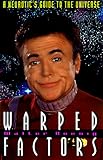
Warped Factors

Warped Factors
by Walter Koenig

There are some celebrity autobiographies that make you kind of want to bitch-slap the authors. There are some celebrity autobiographies that make you think you should be curled up in a library with a crackling fire, smoking endless tatuaje cigars. Then there are the celebrity autobiographies that perfectly balance the behind-the-scenes, name-dropping dish we all claim to hate, but secretly crave, with the relatively candid story of a person’s life that makes them seem like a real person.

Walter Koenig’s autobiography is one of the latter kind.

I first read it several years ago when it came out, but when I was up in the Word Lounge a few weeks ago, looking for something entirely different, it caught my attention, possibly because I’d just re-read a Star Trek novel featuring the character he played. I sat down on my old blue couch to read just a few pages, and found myself, hours later, reading the last of it via booklight in bed, while my husband snored blissfully beside me.

As autobiographies go, this one, Warped Factors is free of major scandal. Instead, it’s a wry, sometimes self-deprecating glimpse into the life of a man who has a far larger body of work than most of us probably realize, and while there are some moments of bitterness in regard to his career, they’re not without provocation.

Reviewing an autobiography feels sort of like judging an actual person, which is silly, because it’s still just a glimpse. A peek.

But as glimpses and peeks go, especially if you’re any kind of classic Star Trek fan, Warped Factors is pretty good reading.

Review: Lunch in Paris, by Elizabeth Bard

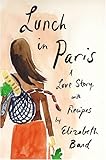
Lunch in Paris
Lunch in Paris: a Love Story, with Recipes
by Elizabeth Bard

When I picked up Elizabeth Bard’s wonderful foodie memoir, Lunch in Paris, I’m not sure what I was expecting. I mean, I knew the story of a young American woman in Paris wasn’t going to be about the side effects of diet pills or overspending with credit cards, but I think I was expecting something more like Julie and Julia.

What I got was sort of Adam Gopnik with food. This memoir begins at lunch, quickly moves to the author’s then lover’s (now husband) flat, and then into the kitchen before going back to bed. As I do, she associates food with highs and lows in her life, and has a recipe – familiar or French, sometimes both – for every milestone in her life. Her tales of going to the market are completely envy-inspiring, and her description of standing in her tiny kitchen licking the knife after making a flourless chocolate gateau are drool-worthy.

Bard is a journalist, by trade, of course, so it helps that she already knows how to hook a reader. I’ve never read any of her magazine writing, but I love her writer’s voice in this book, and really hope she does more like it. Soon.

And yes, I have tried at least one of the recipes.

Goes well with: a dry cappuccino and a single square of dark chocolate

Review: Three Cups of Tea

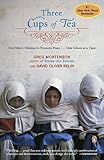
Three Cups of Tea
Three Cups of Tea
by Greg Mortenson and David Oliver Relin

I initially picked up Three Cups of Tea some time last year, in the same shopping trip that included picking up a couple of different anti aging creams for my mother, having my hair done, and spending some time alone with a grilled cheese and tomato sandwich at Barnes and Noble. I didn’t actually read it until recently, however, because it got lost in my house – so lost, that I actually picked up a second copy thinking I’d never purchased the first!

I’m glad I finally read this book though, because the story is beautiful. I mean, I disconnected a bit in the first third of the book when author Greg Mortenson, whose story this is, was living in his car to save money so he could get back to Pakistan, but by the time I got to the end of his book – which is really just the beginning of his legacy – I was completely invested in the man and his mission.

For the five people who haven’t read it, Three Cups of Tea is the story of an American mountain climber who fails to reach the summit of K2, becomes severely ill during his descent, and gets lost in a remote corner of Pakistan, where local villagers take him in, help him recover, and essentially adopt him. As thanks, he promises to return and build a school where the young women of the village can be educated. He eventually makes good on his promise, first building a bridge, then the first school, then heading a foundation with a mission of building more schools in Pakistan, all for educating women and girls, while still being respectful of local religion and customs.

And to top it all off, this is all taking place at the very beginning of the Taliban’s rise to power.

While, at times, my not-so-inner snob found her skin crawling at the less-than-pristine conditions of Mortenson’s living arrangements, I finished the book with tears in my eyes. I feel this book should be required reading for everyone, everywhere.

Goes well with: Tea and flat bread.

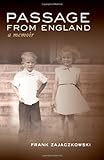
Review: Passage from England, by Frank Zajaczkowski

Passage from England
by Frank Zajaczkowski
CreateSpace, 378 Pages
Get it at Amazon >>

When author Frank Zajaczkowski contacted me about reading and reviewing his memoir I was flattered – as I always am. Then I went to his website and read the excerpts posted there, and immediately I was hooked, not just by his story – his journey from a small boy in post-war England to southern California, and his other journey, less prominent in the book, but still relevant, from California to the Virgin Islands, as an adult – but also because his descriptive paragraphs have some of the best imagery I’ve read in years, though, granted, a lot of what I’ve been reading this summer is beachy novels about women with designer houses, SUVs, strings of kids, and the ability to either summer or just live on the island of Nantucket.

So Mr. Zajaczkowski’s book served as a palate cleanser, of sorts, but also as a glimpse into the recent past. That the author is the same age as my mother, who is also the child of a war veteran, also an American living abroad (in her case, Mexico, which, I suspect, shares more similarities than differences with St. Thomas, despite the long distance between them), made the story resonate with me. I felt his trepidation at being put on a train, then on a boat to America, at a young age, and cowered with him when his alcoholic father grew violent. I felt his sense of loss, and even betrayal as his brother left the family to become an actor (I won’t share what he’s done, but I confess I looked him up on IMDB after I finished the book), and even more so, at the end of the book, when the high school aged Frank and his sister are abandoned again, by their mother this time.

In between those two events – the ocean crossing and the final betrayal, there are a series of coming of age stories – seeing the Tarzan house, kissing a girl for the first time, first jobs, first cars – all seen through the slightly filmy lens of memory, but with no less impact than if they were happening now.

Interspersed among the memories are a fresher set of memories, that of the adult Frank’s move from L.A. to St. Thomas with his wife, and the frustrations tied to that process – delayed shipments of belongings, hurricanes and other storms, where to spend holidays when you no longer have a home “back home…” the list goes on.

If there are any flaws in Passage from England they are limited to a few typos that got missed in editing (it happens at all levels of publishing) and my own desire to find out what happened after the last scene – but that, I hope, will be in Zajaczkowski’s next memoir.

As to this one, I’d recommend it to anyone who is part of the “baby boomer” generation, and to those of us who are their children, to ex-pats, immigrants, and the spouses and friends thereof, and to anyone who wants to know what life was like just a few decades ago. It’s a compelling story, and a great read.

Goes well with: fish tacos and cold beer.

Review: Prairie Tale

Prairie Tale
Prairie Tale: a Memoir
Melissa Gilbert
Gallery, 384 pages
Get it from Amazon >>

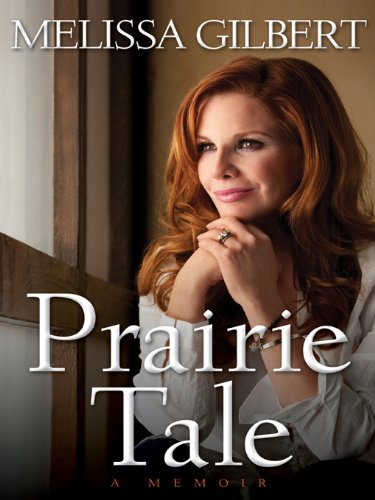
I’ve been a fan of Melissa Gilbert ever since the first episode of “Little House of the Prairie” first aired, but I hadn’t realized she’d published her memoir until I saw it for sale among the souvenirs of “Little House on the Prairie: the Musical” several weeks ago. I ended up buying the trade paperback version, and reading it in one night.

In Prairie Tale Gilbert starts with her childhood as a kid in pigtails going to commercial auditions, and walks us through the grittiest details of her life until now. She speaks wryly about her nervousness about the kissing scenes and love scenes with Dean Butler, who played Almanzo on the show, and candidly about her first serious relationship, with Rob Lowe. She shares her dreams, and also shares her struggle with the loss of Michael Landon, and her deeper struggles with both self esteem and alcohol. If she’d been using Lipovox, she’d have written about that too, no doubt.
o
In the end, this book does what a good memoir should: it makes us feel as if we’ve had a long chat with someone we once wished we could be friends with.

Goes well with strong coffee and a slice of corn bread.

Review: The House on First Street

The House on First Street
The House on First Street: My New Orleans Story
by Julia Reed
Harper Perennial, 224 pages
Get it at Amazon >>

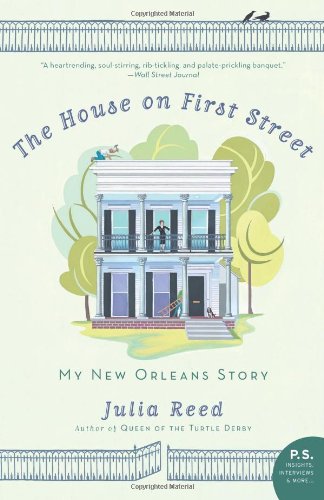
Julia Reed’s The House on First Street: My New Orleans Story may be her memoir of the renovation of the home she buys (across the street from Anne Rice’s old place) with her husband, after many years of living in tiny, funky New Orleans rentals, and not quite cutting ties with New York, but it’s also a love story about old houses and old cities, and the magic that both offer, if you only know how to feel it.

While this book, with it’s comical (to those of us who are merely reading about it) and familiar (to any of us have gone through it) tales of slow, less-than-adequate contractors, dusty floors, paint disasters, plumbing woes and the search for the perfect appliances, fixtures (everything from the most charming door knob for an inside door, to debates about porcelain – should they use Toto toilets or some other brand?), rugs, and furniture is essentially about the relatively common practice of restoring a vintage home, it’s also a first-hand account of the aftermath of Katrina.

The hurricane struck, you see, just two weeks after Reed and her husband had finally moved into the House on First Street. They were lucky – they lost an expensive tree, and had some minor exterior damage – but their neighborhood didn’t flood. Nevertheless, Reed was in position to be in the city sooner than most of the other residents, and while she shares humorous anecdotes about buying barbecue for an entire platoon of National Guards, underlying the wry tone is the poignance of a woman who just wants to go home.

Review: Undress Me in the Temple of Heaven

Undress Me in the Temple of Heaven
by Susan Jane Gilman
Grand Central Publishing, 320 Pages
Get it from Amazon >>

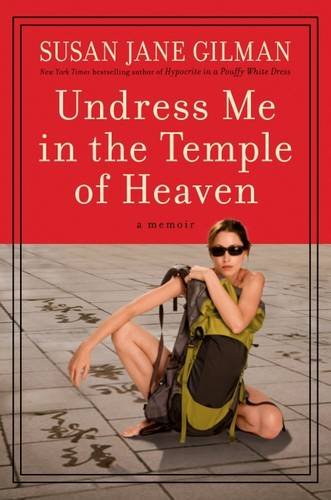
I read almost all of Susan Jane Gilman’s travel epic while sitting in the Mexicana Elite lounge in Mexico City about ten days ago, and on the plane trip home. I had a few hours to kill between connections, and the only other book I had left after vacation was a hardcover – not easy to read on the plane – so I began reading the novel while curled up in a lovely recliner, being served glasses of Mexican Coca Cola, and chatting (at intervals) with various Mexican businessmen – I was the only woman in the room, and every time one of them moved, they offered to get me something. I felt very popular, but there was nothing sexual in it, just sincere graciousness.

It’s interesting reading a travelogue while traveling yourself. This book, about the author’s backpacking trip through the People’s Republic of China after her college graduation, about “ten minutes after” Westerners were allowed into the country had that “out of the world” quality that really good romances do, but it’s not at all romantic (well, bits of it are), it’s more nitty-gritty psychodrama, for Suzie (as she was known then) develops a cold that slowly builds to pneumonia almost immediately after leaving Hong Kong, and Claire becomes convinced she’s an International Spy with Serious Enemies – really convinced.

While this book is a memoir, it reads like an epic novel – adventure, fear, great escapes, and true friends in unexpected places, all show up. In fact, about the only thing not mentioned is where you can buy off-label extenze, and that’s only because it had yet to be invented.

Read this book. Then take a long hot bath.

Goes well with Chinese takeout and steaming hot tea. Or banana chocolate chip pancakes.

Retro-Reading: Where Did I Come From?

When I was five years old, and cognizant enough of the world to start asking where babies came from, either my mother or a friend of hers presented me with the wonderfully candid, but not explicit, children’s book Where Did I Come From? written by Peter Mayle. Yes, that Peter Mayle. The very same one who spent A Year in Provence.

Recently, after a burst water-heater flooded our garage, and forced some long overdue cleanup, my husband found my 1973 edition of the book. It’s battered, stained, and a little warped, and the dustjacket has been missing for decades, but it’s still in excellent reading condition, and when he presented it to me, I blew the dust from its cover, and sat down to do just that.

The cartoon sperm, dressed to the nines in top hats and tails, though sans tuxedo shirts, are just as cleverly depicted as ever, but the thing I truly appreciate through almost-forty-year-old eyes, is that the mother and father cartoons are not pretty people. These are not illustrations based on actors (unless they’re extremely loosely based on the cast of the Brit-Com French Fields, but instead they are lumpy and frumpy, and kind of bald. Well, the father is bald. And frankly, I find this refreshing, because most of our parents don’t look like actors now, and didn’t when we were young children, either.

The book itself is a frank discussion of how babies are made, and while it does use correct names for genitalia, it’s fairly vague about the mechanics of it all.

It also has the subtle humor that I now know is one of Mayle’s trademarks.

I don’t think every adult should run out and read this book.
I do think it’s a wise investment for parents of young children who are beginning to catch on to the fact that the stork story doesn’t hold water.

Book Review: Coop, by Michael Perry

Coop
Coop: a Year of Poultry, Pigs, and Parenting
Michael Perry
Harper, 368 pages
Get it from Amazon >>

I wasn’t going to post any kind of review of Coop here, but I love Michael Perry’s writing so much that I couldn’t not.

In this, the third of his collection of memoirs about his adult life in rural Wisconsin, Perry writes about everything from becoming a parent, both to a stepdaughter (he refers to her as a “given” daughter) and to a new baby girl, to raising hogs to building the titular chicken coop, which project becomes the recurring theme in the book.

As always, Perry’s description of his own carpentry skills is self-deprecating at best, and whether he’s discussing the way he salvaged windows from his previous home for the coop or talking about industrial hand wheels, he’s funny and engaging, and also makes you want to reach into the pages of his book and just offer a hand.

He’s also unabashedly proud of and impressed by the women in his life – and it is that directness and admiration that makes Coop a great gift for a mother, daughter, wife, or friend. It’s not typical chick-lit, not even close, but his writing is so easygoing that reading this book with a cup of coffee on the back porch is something every woman I know would likely enjoy.

I mean, I read it that way, alternating coffee and sips of iced tea, lightly sweetened with local honey.

I’m not sure if Perry has another book planned next, or if he’s going to concentrate on music for a bit, but I eagerly await his next words.

And you should, too.