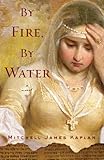
Review: By Fire, By Water, by Mitchell James Kaplan

By Fire, By Water

By Fire, By Water
Mitchell James Kaplan

Description (from Publishers Weekly, via Amazon.com):
Kaplan, a screenwriter, sets his debut novel in 15-century Spain, amid the Inquisition, the attempt to unify the kingdoms of Spain under Christian rule, and the voyage of Christopher Columbus to what the seaman expects will be the Indies. The action centers on the historical figure of Luis de Santángel, chancellor to the king of Aragon and a converso, a Jewish convert to Christianity at a time when the Inquisition sought to repress judaizing. Santángel is friend and financier of Columbus, surviving parent of young Gabriel, and more curious than is prudent about his Jewish heritage. While he learns about Judaism in clandestine meetings, a parallel story unfolds, centering on Judith Migdal, a beautiful Jewish woman who learns to become a silversmith in Granada, located in the last part of Spain under Muslim rule. Santángel’s attraction to Judith grows, even as the Inquisition closes in and the prospect of another world to the West tantalizes. Kaplan has done remarkable homework on the period and crafted a convincing and complex figure in Santángel in what is a naturally cinematic narrative and a fine debut.

Review:
When the author of By Fire, By Water, Mitchell James Kaplan, contacted me about reviewing his amazing novel set at the dawn of the Spanish Inquisition, I said yes, even though period novels really aren’t my thing, because the story intrigued me. I started reading it immediately, and loved it. I hadn’t planned for my life to go into a tailspin before I could write the review.

Still, this story, which is part history, part social commentary, and part romance, has stuck with me. It’s about religion and faith, and how they differ, and how they’re similar, but it’s also about wealth and politics and passion. The love story between Judith and Luis is poignant, but written with a lot of truth.

Maybe it’s Kaplan’s background as a screenwriter, but this book sings it’s vividness to the world. Reading it, I had such strong senses of place and time – I could see it as a movie in my head. (I could totally see this film as a Merchant Ivory production.)

This review is vague and disjointed not because I didn’t love the story – because I did. If all historical novels were this interesting and well crafted, and relevant to modern times, I’d read more of them. It’s just that I read it very quickly several months ago, and the details have blurred.

I do remember thinking, however, that if this book were a movie, the after-the-credits cookie would be a time jump to modern times and a connection to the Hidden Jews of New Mexico, or some such.

Anyway, buy this book. It’s brilliant. Epic, even.

By Fire, By Water
Mitchell James Kaplan
320 pages, Other Press, May 2010
Buy this book from Amazon.com >>
Review: A Widow’s Awakening, by Maryanne Pope

A Widow's Awakening

A Widow’s Awakening
Maryanne Pope

Description (via Amazon.com)
A Widow’s Awakening draws you in from the first page as you listen in on a conversation one month before the death of Sam, a police officer. Readers are given a glimpse into an everyday marriage on the brink of a tragic event. Written as creative non-fiction, the story follows the character of Adri, Sam’s wife, as she learns to come to terms with the death of her husband. The story opens with what will be Adri s last vacation with her soul mate and grips the reader s interest until the end. A Widow’s Awakening is a page-turner full of conversational dialogue that reflects the feelings and thoughts of Adri, who is gripped with guilt over her last conversations with her husband, stunned by his sudden and needless death, and the path she is forced to follow that was not of her own choosing. A Widow’s Awakening is a tragic, heart wrenching, but humourous look at grief while giving the reader hope that life can go on after loss and it s what you do with it that counts. This book has something for everyone. It’s not a depressing book; it s an engaging, inspiring and powerful read. The book fits in several categories: self-help, biography, current events, politics, health, spirituality, psychology, death and dying, and grief. In addition, 20% of the proceeds of the sale of this book are going to the John Petropoulos Memorial Fund, a non- profit organization set up in memory of the author s husband. The Fund’s safety initiatives educate the public that workplace safety for emergency services personnel is a shared responsibility.

Review
This review is months overdue. I read the book early this year, after having a publicist pitch it to me via email. I loved every word, and despite the seemingly dark subject matter, found it to be uplifting and beautifully written. It’s a love-song to the author’s dead husband as well as a song of hope and new life.

Originally, reading this helped me accept the death of my brother-in-law, and I thought about sending it to my sister-in-law, because I thought she might appreciate the notion of having her husband’s presence as a sort of silent guardian, much as Adri did in this book, but ultimately, I decided not to.

So, if I loved this book so much, why am only posting the review five months later? Because just as I’d finished it, my nephew’s cancer was officially terminal. He would die about a month later, in mid-April, and during that time, instead of blogging, I was doing the bare minimum I could for work, and reading a whole bunch of escapist literature because I couldn’t cope with anything else.

My apologies, then, to Ms. Pope, because her book is wonderful, and I would recommend it to anyone who is dealing with grief, or who just wants a really candid look at a woman and her grief.

If you’re a writer, perhaps you’ll even take this book as a warning to find the time to really write while you still can.

A Widow’s Awakening
Maryanne Pope
312 pages, Self-published in September, 2008
Buy this book from Amazon.com >>

30-Day Book Meme #2: Certain Women

Certain Women

I’ve been a fan of Madeleine L’Engle since a friend of my mother’s gave me A Wrinkle in Time to read while I was at her house. It was, quite literally, a dark and stormy night, and I was sprawled on a guest-room bed covered in a patchwork quilt, immersed in a story and unafraid of the storm.

I’ve probably read A Wrinkle in Time at least a dozen times, but the novel I’m actually using for this prompt – a book I’ve read at least three times – is one of L’Engle’s adult novels, Certain Women. I like it because it’s a story within a story – on one level, it’s about an adult daughter spending time with her dying father, but on another level it’s the story of the play that her ex-husband created for father and daughter to perform, about King David and all his wives.

As someone whose religious education has been rather eclectic, I read it, the first time, with very little frame of reference, save for the fact that I read the Catholic version of the Bible cover-to-cover when I was seven. In the years since my first reading, however, my knowledge has expanded, and I’ve gotten more from the book.

I think I got even more from it as I’ve aged, as well…you can read the same book at forty that you did at twenty-five and even fifteen, and always enjoy it, but experience it three different ways, and with this novel, I’ve done that.

30-Day Book Meme #1: The Wave

The Wave

The 30-day book meme asked me to talk about the best book I read last year. I don’t really rank my books in “best ever/worst ever” categories. I either didn’t like something, liked it, or loved it enough to read again. One of the books that fit the latter category, was The Wave: In Pursuit of the Rogues, Freaks and Giants of the Ocean, by Susan Casey (review here).

This book alternates chapters, speaking with scientists and then surfers about finding the world’s biggest waves, predicting ocean waves and currents, surviving rogue waves, and even seeing waves from space – no really.

It’s a great book to go back to in weeks like this one, when it’s predicted to reach 109 today, and I’m really missing the ocean, but I’d recommend it to anyone who likes the science behind sailing and surfing, and why waves may be getting bigger and more dangerous.

Was it really the best book I read in 2010? Maybe, maybe not. It did, however, inspire me to download a surf report app for my iPhone.

Review: ‘Deed So, by Katherine Russell

Deed So
Deed So
Katherine Russell
CreateSpace, 438 pages
November 2010
Buy this book from Amazon or Read the first chapter for free

Product Description (from Amazon.com):
It is 1962, and Agnes Hayden Bashford, Haddie, a brainy Southern teen from a tradition-bound family, dreams of breaking free from suffocating expectations placed on girls and from Wicomico Corners. She vows to escape to the exhilarating world beyond its narrow borders, like her handsome, older friend Gideon Albright who is going to Vietnam. A series of shocking incidents brings the outside world crashing down on her peaceful village, exposing long-buried family secrets and setting Haddie on a collision course with an unstable firebrand who will have to silence her to protect his identity. Haddie witnesses the fatal shooting of a black teen by a white down-on-his-luck farmer trying to protect his retarded son. The resulting murder trial attracts outside agitators and political aspirants, and pits townspeople against each other. Excited about being a witness in the trial, Haddie sees her moment of notoriety dissolve into frustration and discomfort and tragedy claim the people around her. The racially-charged case exposes civic fault lines and secrets within Haddie’s own family, shattering her comfortable home life, and unleashes an arsonist who terrorizes the community by night. In Deed So, a young girl and an entire town lose their innocence in the last year of innocence, the year before the Kennedy assassination, the civil rights struggle, feminist activism and the Vietnam War changed America forever.

Haddie, the main character in Katherine Russell’s novel Deed So is the same age as my mother. That thought kept running through my head as I was reading her story, and mentally juxtaposing it with the stories my mother had told me about growing up in New Jersey in the same year. Haddie had a friend who was a soldier in Viet Nam – my mother’s only brother chose to go to Canada instead… Haddie was a witness to ethnic persecution – my mother, on a field trip to Washington D.C., saw Dr. King holding one of his first vigils, sitting alone and silently at the Lincoln Memorial. Separating my mother’s real story from Haddie’s fictional one proved difficult for me as I was reading this book.

And it’s a wonderful book, albeit one about some very un-wonderful events. Russell’s characters are vivid and completely three-dimensional, and the opening, in a Southern church supper makes you almost smell the ham, and hear the clinking of silverware against china. Her parents are portrayed not as Evil Adults, but as very human people who love their daughter and try to ride the line between encouraging her precocious intelligence and protecting her relative innocence.

I also enjoyed reading about Haddie’s friendships with the other girls her age – the sneaking of cigarettes and looking at the pictures in Grey’s Anatomy made me laugh – it’s such a universal experience for young girls in the pre-Internet age.

When the book turns darker, first because of a fight that Haddie witnesses, and which results in a court case, and later because of a series of fires that may or may not be related to the trial (I’m not telling!), Russell doesn’t flinch. Her characters represent the broad spectrum of public opinion about the rights and roles of African Americans during the civil rights movement, and while many of those opinions are decidedly unPC by modern standards, they are true to the period, and to the region.

The mark of a good writer, a good storyteller, is to take a difficult subject and present it in a fashion that is both interesting and compelling. In Deed So Russell has done exactly that.

This Isn’t Treasure Island

A Child's Garden of Verses

Robert Louis Stevenson’s poems were constant friends in childhood, poems my grandmother and I would memorize and recite. I knew all about having a little shadow, and going up in a swing.

One poem that I never appreciated until this weekend, which has been spent largely in bed, was “The Land of Counterpane,” in which a sick child turned the hills and valleys of his comfortable bed into all manner of landscapes for his imagination.

I don’t imagine my quilt squares as separate countries, but I do still let imagination run wild.

Even days spent propped on pillows have magic.

Originally written 30 August 2009 in another blog.

Review: Semper Cool: One Marine’s Fond Memories of Viet Nam by Barry Fixler

Semper Cool
Semper Cool
Barry Fixler
Exalt Press, 320 Pages
December, 2010
Buy from Amazon >> or Read the first chapter for free

Description (from Publishers Weekly):
From Publishers Weekly
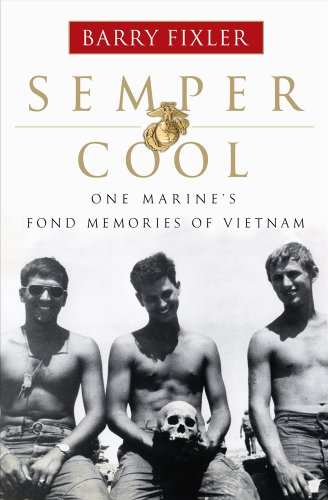
Many Vietnam veterans look back in anger on their wartime experiences, but Fixler, who endured one of the bloodiest battles of the war, isn’t one of them. The gruesome 77 days he spent defending an isolated hilltop near the border with North Vietnam forms the core of this nostalgic memoir. Growing up in a predominately middle-class Jewish neighborhood, Fixler was dazzled by his father’s stories of WWII and volunteered for Vietnam to earn his respect. As a teen, Fixler got into his fair share of trouble and that cockiness seeps into these pages. Arrival at the Marine Corps’ Parris Island boot camp is compared to “being thrown into a Nazi concentration camp.” He celebrates his sexual escapades and never sugarcoats the nasty business of war; he’d do “everything again in heartbeat.” Yet as wistful as he is about the “discipline” and “camaraderie” of the Corps, he’s unrelenting in his scorn for the soldiers who return in psychological pieces, suggesting that soldiers should just get used to killing. Nowhere near the league of We Were Soldiers Once…and Young, Fixler is nonetheless an intriguing, rare bird: a man who survived “hell in the raw” without a trace of trauma-or remorse.

Semper Cool is an interesting book. You don’t expect to find veterans talking about Viet Nam as if it was a long, black comedy bit, and yet at times Fixler seems to do just that.

Don’t get me wrong – this book is eminently readable. Fixler’s voice is alternately self-deprecating and wise-cracking. He doesn’t shy away from visceral description, and his scene-painting is very vivid. It’s just jarring to read something where someone comes home from a tour of Viet Nam seemingly unaffected.

And maybe the fault lies with me – maybe I have come to expect jarring horror stories about this period so much that when I read a story that doesn’t dwell on the horror my brain can’t accept it.

Bottom line: If you’re reading this for an unbiased look at Viet Nam, don’t. If you’re reading it for an entertaining look at one man’s experience, and how he personally grew after an experience that broke others, you’ll be satisfied, as I was, once I stepped away from the book, and stepped back with a fresh perspective.