Apartment Hunting

There’s a line that I remember reading in one of the Anita Blake books, “Friends help you move. Real friends help you move bodies.” I’ve been moved via self and via mover, but the line keeps running through my head in search of a connection, and today that connection is fictional dwellings.

Five of my favorites?

  1. Nero Wolfe’s brownstone: I could live without the orchid room, I guess, but I like brownstones, and always dreamed of living in one.
  2. V.I. Warshawki’s apartment: It’s not the largest on earth, of course, but there’s room for a piano AND she has a real tub. As in cast-iron and claw feet.
  3. Plumfield. We’re first introduced to it as the stately home of crabby old Aunt March in Little Women, but we get a better tour during it’s second incarnation, as a home and school for stray boys in Little Men. It always seemed like a place I’d love to visit.
  4. The Harper Hall from Anne McCaffrey’s Pern books. I’m not so fond of her work now as I was when I was thirteen and fourteen years old, and unaware of some of her social attitudes, but I’d have loved to study music at Harper Hall. In retrospect, the trilogy set at the Hall was very much a Pern-ish version of a classic boarding school story.
  5. The Murray House. I love the image of an old farmhouse where Mom is admonished for boiling stew in one beaker and conducting an experiment in another. Madeline L’Engle’s own home, Crosswicks, is very much in evidence in the Murray manse. I’d love to stay in either.

So, what are your favorite literary residences, from childhood, or from more recent reading?

Schuyler’s Monster by Robert Rummel-Hudson

Schuyler's Monster Schuyler’s Monster
by Robert Rummel-Hudson
Get it at Amazon.

Sometime in late 2006 or early 2007, I stumbled across the blog of one Robert Rummel-Hudson, and quickly became engaged. His writing style is upbeat and candid. He’s funny, but isn’t shy about using the word “fuck” when it’s appropriate, and he’s clearly completely devoted to his young daughter, Schuyler. At the time I first “met” his words, he’d just sold his book, and was beginning the long path to publication. When I re-encountered his work about a week ago, sparked by watching Autism: the Musical on HBO, I found that not only had the book been released, but I’d missed the signing in my local bookstore. (We both live in the same metro area, but my end of it is a good hour or so from his end.)

I was disappointed, but vowed to buy the book anyway. That weekend at Borders, among all the new non-fiction about romance, modern philosophy, and diet pills, I saw the book, Schuyler’s Monster, and it was even an autographed copy. I grabbed it, stopped at Jamba Juice, and headed home to read the entire book in one sitting.

I’m not a parent, nor am I particularly interested in children, and I’m generally one to avoid disabled-kid stories like the plague because they tend to be over emotional and / or horribly fluffy. Schuyler’s Monster is neither. Rather, it’s a love story from a less-than-perfect (and therfore more than perfect) father to his (in his word) “broken” daughter.

Why broken? Because Schuyler, for all she’s a bright and mischievous child, has a neurological disorder that not only compromises her fine motor skills, but also makes her unable to form intelligible speech.

The book is as much about Rob’s reaction to his daughter’s disability, and their journey toward helping her work around it as it is an ode to playful and loving father-daughter relationships. Who wouldn’t want a dad who let you watch monster movies, even if you were really too young? I know I would.

This book was moving, yes, but it’s also funny, sweet, nostalgic, and triumphant. Like Rob’s blog, it’s upbeat and blunt. Unlike Rob’s blog, the word “fuck” isn’t used terribly often, if at all. (I should note, I don’t judge blogs by whether or not people curse. I just believe that if “fuck” is the most appropriate expression of frustration, joy, whatever, cheating on it’s use is, well, cheating. I don’t believe people should ever be afraid of language.)

(And actually he doesn’t use it that often in his blog, either).

Seriously, though, it’s a great book. You should read it for the writing alone, even if you don’t like disbled-kid stories, either.

Vocabulary from Booking through Thursday

I’ve always wondered what other people do when they come across a word/phrase that they’ve never heard before. I mean, do they jot it down on paper so they can look it up later, or do they stop reading to look it up on the dictionary/google it or do they just continue reading and forget about the word?

Maybe it’s just because I’ve racked up a lot of reading miles on the treadmills of reading and writing – I mean, I wrote a poem stating that I wanted to be an author when I was about seven – but it’s been a long time since I’ve come across a phrase that wasn’t fairly obvious just from context.

In fact, one thing that drives me crazy is when I see other adults who don’t know how to infer meaning, don’t understand how helpful context is. Did they have bad teachers? Are their brains just not wired the same way mine is? Who can say?

On the rare occasion that I do have a word or phrase that remains a mystery, my choice of reference depends on where I am. If I’m comfortably settled in the bath, I’m not going to race to my laptop and hit Dictionary.com or the Urban Dictionary, or use Google, but I’ll let the phrase sit in the back of my head until I have time for such a thing.

If I’m reading online – as I do a lot – then yes, I will fire up another tab in FireFox and see where it leads me. Doing so can often lead to wonderful adventures, and new turns of phrase.

Prompt provided by Booking Through Thursday.

Red Chairs and Work Shoes

We caught the end of Ever After on television tonight, while eating dinner. Or drinking dinner, really, since my dinner was a smoothie from Jamba Juice. I always enjoy that movie, and not just because Dougray Scott looks great in tight pants (though that’s definitely a plus).

Tonight however, while watching the last snippet of this re-telling of “Cinderella,” I found myself drawn to a childhood memory, of sitting on my grandfather’s lap, my bare feet resting on top of his sturdy leather work shoes, his back resting against the back of the red leather wing chair that currently occupies a corner of my writing studio.

Together, we would read from one of the big red collections of fairy tales. I suspect they were Reader’s Digest offerings, but it doesn’t really matter. Those books were magic and I wish I’d stolen them away before he died and they disappeared.

In any case, I’d read a page, and then hold the magnifier so he could see better. Those page-sized magnifiers were used once in a while, but often a more traditional glass was the lens of choice.

I wish I still had one of those, too.

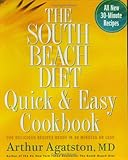
The South Beach Diet Quick & Easy Cookbook, by Arthur Agatston, MD

South Beach Quick & Easy The South Beach Diet Quick & Easy Cookbook
by Arthur Agatston, M.D.
Get it from Amazon.

Both of my kitchen sinks are full tonight, because while I was willing to cook, and I emptied the dishwasher I wasn’t in the mood to reload it, but that’s okay, because the one article that’s due tomorrow has been written.

Meanwhile, I can wax rhapsodic about this cookbook. I was looking for quick-meal cookbooks that were also healthy, and found this one at Half Price Books. So far, I’ve made about ten things from it – tonight we had roasted asparagus, and chicken breasts stuffed with spinach and chevre – and I’ve liked everything I’ve made.

More importantly, Fuzzy’s eating what I make, without complaining, even when it isn’t orange.

So, it’s a situation made of win.

When you’re trying to eat healthier, having a cookbook that is simple and doesn’t require hours of prep is essential. I’m all for elaborate meals, but I have a life, you know? If you’re a health conscious person with a busy schedule, I’d recommend this book.

Goes well with a shrinking waistline.

Feisty Old Ladies

Unexpected Mrs. Pollifax

The other day when I was at Borders, ostensibly shopping for the books I need for my Algonkian homework, but coming home $149 less solvent, the various Mother’s Day displays reminded me of Mrs. Pollifax.

If you don’t know who Mrs. P. is, she’s the fictional creation of Dorothy Gilman, and America’s version of Miss Marple, only with much more modern sensibilities. She wasn’t so fussy that she had to have the latest top wrinkle cream, but she did like hats and scarves, and while she preferred a notepad, she grew to understand computers.

I haven’t visited with Mrs. P since I was 18 or 19 years old and my mother and I spend a summer passing her novels back and forth, but I confess there’s a bit of guilt in my nostalgia, because while the books are lovely cozy mysteries, I always wished my own grandmother, who was feisty in her own way, was as fiercely independent as Mrs. P.

I’m going to have to revisit the series soon. Perhaps later this summer.

A Question: Can’t You See I’m Reading

To those with spouses, partners and roommates who read:

Fuzzy is a generally sweet guy, but when he’s reading and I need to talk to him about something, he gets all glarey and grumbly and says, “Can’t you see I’m reading?”

Yet if I’m reading, and clearly absorbed in my book, magazine, or website, and he needs to discuss some burning issue like adding more laptop memory to his brand new computer, it is somehow okay for him to interrupt me, and not okay for me to shoot back his favorite response, “Can’t you see I’m reading?”

Does this imbalance exist in your relationship, as well?
If so, what do you do about it?

Star Trek: Exodus by Josepha Sherman & Susan Schwartz

Star Trek Exodus
Star Trek: Exodus Book One of the Vulcan’s Soul trilogy
by Josepha Sherman & Susan Schwartz
Get it from Amazon.

Fans of Star Trek have always wondered exactly what it was like when a significant number of Vulcans packed up their belongings like so much Delsey luggage, and moved away to eventually become Romulans. In this trilogy, we find out.

It’s a story that runs in two timelines at once. The first takes place in the days of Surak, and shows us the acts that led up to and caused the Sundering, and the second shows us Spock, Saavik, Uhura, and Chekov rushing off with cooperation from modern Romulans to face down a little known enemy called the Watraii, who are as obscure as they are dangerous.

Both story lines have a mix of action sequences and character sections, which allow us not only to catch up the the characters we know, but also grow to like the original characters we meet.

A further review will be posted when I finish reading the trilogy.

Goes well with peanut butter and jelly sandwiches, and ice cold milk.

Kushiel’s Scion by Jacqueline Carey

Kushiel's Scion
Kushiel’s Scion, by Jacqueline Carey
Get it at Amazon.

Re-visiting the world of Terre d’Ange after more than a year since I last read about Phedre’ and Joscelin, and their adopted son Prince Imriel could have been a jarring experience – after all, Imri in this novel is no longer a child, afraid of monsters lurking beneath the bedroom furniture, but a young man about to attain true adulthood.

Jacqueline Carey’s world building is so detailed, however, that stepping back into Montreve, and the various other locations, was just like stepping into the kitchen of an old friend. Well, if that kitchen was in a time hundreds of years before now, and part of a society built on the concept of Love as thou wilt.

In this, the fourth novel of the Kushiel’s Legacy series, young Imriel is caught between being “good” and being true to himself, as a member of Kushiel’s line, and coming to grips with a childhood of abuse, and the darker desires he was born with. Amidst all this teen angst, there is a quest to find the source of a specific school of knowledge, and much ado with the ladies of the Court.

All in all, it’s a rollicking adventure that acts as the lead-in to the next two books in the series.

Goes well with a tankard of ale, hearty fresh-baked bread, and a good sharp cheddar.